• Skip to primary navigation
  • Skip to main content
  • Skip to footer
Benedictine Sisters of FL

Holy Name Monastery
Founded 1889

Donate Now
  • Home
  • About Us
    • History
    • Being Benedictine
    • Benedictine Monasticism
    • Meet Our Community
    • Holy Name Academy-Alumnae
  • What We Do
    • Mission, Vision and Our Partners
    • Invitation to Retreat
    • Accommodations
    • Volunteer Programs
    • Oblate Program
    • Spiritual Direction
    • Aqua/Hydroponics
    • More of Our Ministries
  • What’s Happening
    • Articles of Interest
    • Events
    • Newsletters
    • Brochures
    • Links
  • Support Us
    • Gifts of Support
    • Wish List
  • Stories Shared
  • Galleries
    • Photos
    • Videos
      • Benedictine Sisters of FL Videos
      • Other Videos
  • Contact Us

Holy Name Monastery

“Pursue What We Judge is Better for the Other Rather than Self”

June 27, 2016 by Holy Name Monastery 1 Comment

who-do-you-say-i-amWhile there are a number of crucial spiritual questions, none is more important than this question asked:  “But you, who do you say that I am?  Peter might have answered “Son of Mary and Joseph” or “Son of the carpenter” or “A great teacher.”  Or he might have uttered one of descriptions he’d learned since childhood from the Torah – titles we heard in last night’s reading from Judith: “Creator of the rivers, king of all creation, protector of the people.”  But, in a graced moment Peter cut to the heart of Jesus’ identity:  “You are Messiah, the Christ, son of the Living God.”

It’s crucial for each individual person to answer correctly.   Peter got it right but he did not realize the full impact of his answer.   It is the first time a disciple refers to Jesus as Messiah.  But, he and the other disciples had the wrong notion of Messiah.  To them it connoted a reigning King. They did not understand it involves suffering and death.   Their idea of a Messiah was all glory; no guts.

Only one answer is objectively correct to Jesus query:  “Who do you say I am?”  Jesus didn’t say, “Great answer, Peter! Do any of the rest of you have anything to add?  You others, how do you feel?”  How you feel about Jesus doesn’t change who He is. There is a single correct answer to the question that is not based on feelings or personal opinions, but on objective revealed truth.

To stretch their understanding,  Jesus immediately mentions His impending death and resurrection and the cost of discipleship.  He’s hinted at it before but this is the first explicit mention of it. From here on, it will become a frequent theme as Jesus makes this intention known to go to Jerusalem.   The disciples still did not really comprehend this until after Jesus’ resurrection. Once they had a fuller understanding of what Jesus meant – they were enabled to go out as bold witnesses.

Think about how difficult it must have been for the disciples to commit themselves to Jesus as the Christ? For centuries, faithful Jews had been waiting and looking for the promised Messiah. Many lived and died without seeing that hope fulfilled. Sometimes prophets came on the scene, raising hopes that they might be the Messiah. But they died and the people kept waiting. Then, suddenly there came upon the scene this young upstart, a mere carpenter from Nazareth who began preaching and performing miracles. Could He be the one? He certainly didn’t fit popular image of what the Messiah would be like. But the disciples committed themselves to Jesus as that long-awaited Messiah.

Remember, they didn’t have the 2000 years of church history that we have to confirm their faith.   They were the first ones to say, “This is the One!” And they had to say it in the face of public opinion that didn’t agree with them. This fact is underscored by the contrast between Jesus’ first question, “Who do the multitudes say that I am?” and His second question, “But you, who do YOU say that I am?”

The disciples had to stand against strong currents to affirm their conviction that Jesus is the Christ. The Roman government didn’t care if Christians followed Jesus as long as they affirmed Caesar as Lord.

They also had to go against the opinions of the Jewish religious crowd, which had varying notions of who Jesus might be. The disciples had to stand apart from the Jewish religious crowd to affirm Jesus as Messiah.

Perhaps the most formidable ones that the disciples had to oppose were the Jewish religious leaders. The disciples were not formally educated as their leaders were in the Hebrew Scriptures.  They had no public influence; they were not the recognized interpreters of the Law of Moses nor were they guardians of the Jewish law. Who did this bunch of uneducated fishermen think they were to go against the opinion of that august body of scholars?

This question: “Who do you say I am?” still divides people. It takes a strong faith, firm conviction and undying loyalty to take your stand with Peter and the disciples.  And, it takes an unwavering friendship with Jesus to steadfastly affirm your conviction.

And, how do we do that AND follow Jesus directive: do not tell anyone?  He said the same thing on the mount of the Transfiguration: “Tell the vision to no one.”  I wonder, was it His way of saying: actions speak louder than words?

In the next few lines of the Gospel, Jesus cautions: If you are sincere in saying you want to follow Me, you must deny yourself to the point of losing your life.  That’s a tall order!  But, not much less that Benedict telling us to keep death daily before our eyes.  That doesn’t mean being preoccupied with death because Jesus adds “you will have life.” So, be preoccupied with life – the opportunities of the moment.

Think about all the little deaths Jesus endured along the way: spending hours with the crowds when he might have preferred a quiet get-away for prayer – taking time to feed the crowd when it might have been simpler to take the disciples to mom’s for a home cooked meal; taking the energy to clear the temple of the sellers of unnecessary and costly sacraficial offerings when He might have slipped in through the side door to avoid the commotion at the main entrance.

We have abundant, daily opportunities to “die” these kinds of deaths. All that is required according to Benedict (in RB 72) is that we “pursue what we judge is better for the other rather than self.”  Or as we challenge and promise each other (in one of our Benedictine Sisters’ Community statements):  “We seek to form bonds of mutual love and respect and to call forth the best in one another.”    When it is exhausting or especially trying, remember what Jesus promised: whoever takes up her daily crosses, gives up herself for my sake, will save herself – you will have life!

~ Reflection by Sister Roberta Bailey, OSB, Prioress


Continue Reading

Filed Under: Blog, Homily Tagged With: Benedict, Christ, Jesus, Messiah, Peter, Scripture

Availability

June 6, 2016 by Holy Name Monastery Leave a Comment

availabilityThroughout his Gospel, Luke demonstrates that God’s promises to Israel are fulfilled in the person of Jesus.  In this part of Luke’s story, Jesus and his disciples are approaching the city of Naim when they come upon a large funeral procession. Luke does not tell us how Jesus knows that the deceased is an only son of a widow.  Did He know the family or was the scene and the ritual all too familiar to him and his disciples?   Whatever the reason, had Jesus not been present to the moment and available to its significance it may have gone without noticed or ignored by the evangelist as well as the passersby.

Before I continue: a disclaimer is called for: Much of what follows is borrowed or adapted from Robert Wicks’ little volume entitled AVAILABLILTY.

The virtue, the gift of availability is indeed a simple but a great gift.  The freedom to be present when needed is something special.  It is an opportunity to be spiritual – to be open to relationship in the deepest, most elegant sense of the term.  However, this wonderful state of living often seems hidden or distorted.  Today, availability is a premium because it is not only a gift but also sometimes a great challenge for many of us – one that we need to more fully understand and address if we are to be able to continue to be present in the full sense of the word.  Availability is not only a gift; it is also a problem.

Some of us are “too available.”  Thus, true availability becomes watered down. We become too busy to pray, too tired to reflect, and, ironically, too stimulated interpersonally present to others.

Others among us pull back in anxiety.  Being available to God seems to raise too many questions or doubts.  Spending time alone is no longer relaxing; instead we feel lonely or preoccupied with our faults and failures.  And being with others doesn’t seem to help either; in some cases, we feel used, left out, or misunderstood.  The end result is that our expectations for intimacy are not realized and we feel the need to pull back more than ever.

The situation is not merely a sad one; it is a dangerous.  Without a sense of availability to self, others, and God, life loses it spirituality.  Relationships suffer, break down, and we are left with a void or sense of confusion.

We must address availability with the imperative that openness to the personal and interpersonal is essential if the Spirit is to be heard and felt. Any blocks to relationship must be removed if we are to prepare ourselves always for the continual coming of what is Good.  The very vitality of living out the Gospel depends on our being involved –  in an ongoing way – in the process.

When we spend time, especially unplanned time, with others it is not so much that we TAKE TIME OUT OUR DAY to be with them as that we had make the other part of our life.  For instance, today’s funeral for Kurt … because we generously welcomed them into our home God, through us, was enabled to share compassion, comfort and hospitality to a large group of mourners.

Jesus absorbed the widow’s sorry, made it his own and offered deep compassion and consolation to her even before he raised her boy from the funeral bier.  Did Mary witness this incident or did others relate to her?  Later when her son died do you think  she recalled he’d brought this Only son back, and Lazarus, too, back to life?  Did she live in hope that such a miracle would be granted her son?  Someday we may know.

Picking up cues, recognizing a silent need – reaching into self and out to others: this kind of attitude is at the heart of a life that reflects an appreciation of the gift of availability.  This attitude merits being kept in mind as we look at some of the basic problems we encounter in trying to be available to ourselves, others, and God.  Though the concept is simple, living a life of true availability isn’t easy for most of us.  It takes a conscious desire and effort to be present to all the nuances of the present moment.  Some people see only the dark clouds gathering; others see the rainbow emerging.  Let us be present to the moments when rainbows quietly and slowly are revealed in our lives.  Jesus would have missed the funeral scene if he had been too intent on getting to the farmer’s market in town.

~Reflection by Sister Roberta Bailey, OSB, Prioress


Continue Reading

Filed Under: Blog, Homily Tagged With: Availability, funeral, gift, God, Gospel, Jesus, Luke, Widow

Body of Christ; Blood of Christ

May 31, 2016 by Holy Name Monastery Leave a Comment

euch1With the singing of Vespers this evening we begin our celebration of the feast of the Body and Blood of Christ – once called Corpus Christi (but that only refers to the Body of Christ).

This one of my favorite feasts … it celebrates the ultimate in self-giving… not only to lay down one’s life for another but, further, to freely give its essence to another.

This particular version of the story of the feeding of the 5,000 is the only one of Jesus’ miracles to appear in all four Gospels. Luke places it between Herod’s question, “Who is this about whom I hear such things?” and Peter’s response to Jesus’ question about who he thought Jesus was.  In Luke’s version of the feeding of the crowd it is not the result of Jesus’ compassion for the crowd but is an incentive to the disciples to do something about the problem they perceive.  When they want Jesus to send the crowd away to so they (the crowd and themselves) can get something to eat, Jesus tells them to give the people some food on their own.

When we come to the Eucharistic table, hungry for the Word of God and the Body of Christ, what does the Jesus, in the person of the priest say?  “Take, you all, and eat of this.  Take, you all, and drink.”  How contradictory, then it is, a few minutes later to hear the same person say to the worshiping community:  “If you are not Catholic, fold your arms across your heart for a blessing.”

I recall in 1959-60 when our wood-frame convent was condemned by the fire department.  The local community responded with open hearts to us when they were asked: “May we live with you until we can build a new house?”  We certainly felt “welcomed as Christ” – the people viewed it a privilege to house the sisters and some of our boarding school students. They did not ask “are you Catholic” nor did we pick and choose a dwelling place based on a host’s church membership.

Today, everyday Jesus asks each of us … have you reserved a guest room in your heart for Me where I may rest, where I may eat a meal with you?   We think about Benedict’s words “guests are always present, wash their feet, acknowledge them with a greeting or a nod, set a special place at the table for them, reverence Christ in the person of the guest.  Our corporate commitment statement continues to challenge us to “respond with the compassion of Christ” to the variety of hungers of the human heart.

I agree with the author who says: “… Admittedly, hospitality won’t cure all of our ills.  It won’t erase underlying problems that promote a climate of division or create a magical panacea for human suffering.  But hospitality can help.  It can assist and guide us in the way we deal with, and the ultimately solve our problems.  It can allow us to function with grace and dignity.  Hospitality is a seed planted deep within us that awaits our attention and care.  Nurtured by willingness, watered by prayer, hospitality reflects the face of a loving, accepting, compassionate God.  Wherever we go, whatever we do, we can pray that a spirit of hospitality will permeate our thoughts and animate our actions.  (Everyday Hospitality by Thea Jarvis)

Pondering the significance of this feast, it strikes me that with Christmas we are touched with joy and awe at the birth of Christ.  At Easter we explode with ALLELUIA at the resurrection of our Savior.  The Ascension leaves us quietly looking upward, outward waiting in expectation for “what’s next?”  Then comes the Solemnity of the Trinity – the mystery that baffles us … that God is so great, so awesome that only in three persons can all the divine manifestations be expressed.  And, today; the solemnity of the Body and Blood of Christ – this touches, awakens in us feelings we can hardly express – that our God, our Jesus, our Savior would choose to gift us in such a personal, so intimate a way … the Creator chooses to be assimilated within the body of the creature.  His body and blood become, over and over, absorbed into my body – His blood courses in my veins.  Did you ever wonder how an aspirin knows where you ache is?  Or an antibiotic knows what to attack?  Is it heresy to say: Jesus attaches himself to every fiber of my being?  When the minister looks us in the eye and greets us: “Body of Christ; Blood of Christ”, we are stunned speechless except to respond as we’ve been taught: “AMEN!”

~Reflection by Sister Roberta Bailey, OSB, Prioress
Continue Reading
Filed Under: Blog, Homily Tagged With: Blood of Christ, Body of Christ, Corpus Christi, God, Jesus, Savior

What’s that you say?

May 26, 2016 by Holy Name Monastery Leave a Comment

Trinity SundayTrinity Sunday

The Gospel just proclaimed comes near the end of Jesus’ discourse at the Last Supper and is an example of the implicit teaching on the Trinity.   Jesus tells his disciples, and us, there is much more He could tell us, but we cannot bear it now.  When the Spirit comes we will be guided to all truth – for the Spirit will take what is Jesus’ and declare it to us.  Elsewhere Jesus has told us, “The Father and I are one.”  If Jesus and the Father are one and the Spirit speaks what Jesus says, it follows that the three must be one.

In first reading God is revealed as wisdom.  The words of the Responsorial Psalm remind us that human beings are the work of God’s fingers, little less than the angels and crowned with glory.   In the 2nd reading, from the letter to the Romans,  We are reminded that the love of God has been poured into our hearts.  And, as you just heard in the gospel, the Spirit will make the revelation.

But, if one expects today’s readings to give a clear presentation of the doctrine of the Trinity – they will be sorely disappointed. In fact the word “Trinity” is not found in the Scripture.  One writer has said if Jesus were to ask the question today, “Who do you say that I am?”  A modern theologian might answer: “Thou art the Logos, existing in the Father as His rationality and then, by an act of His will, being generated, in consideration of the various functions by which God is related to his creation, but only on the fact that Scripture speaks of a Father, and a Son, and a Holy Spirit, each member of the Trinity being coequal with every other member, and each acting inseparably with and interpenetrating every other member, with only an economic subordination within God, but causing no division which would make the substance no longer simple.”  Jesus might have replied: “What’s that you say?”

You have most likely heard this incident attributed to St Augustine of Hippo, who wanted so much to understand the doctrine of the Trinity and to be able to explain it logically. One day as he was walking along the sea shore and reflecting on this, he suddenly saw a little child all alone on the shore. The child made a hole in the sand, ran to the sea with a little cup, filled her cup, came and poured it into her hole in the sand.  Back and forth she went to the sea, filled her cup and came and poured it into the hole. Augustine asked her, “Child, what are doing?” and she replied, “I am trying to empty the sea into this hole.” “How do you think,” Augustine asked her, “that you can empty this immense sea into this tiny hole and with this tiny cup?” To which she replied, “And you, how do you suppose that your small head you can comprehend the immensity of God?”  With that the child disappeared.

Like Augustine we may not be able to understand the how of the Trinity but it seems very important to understand why God revealed this mystery to us.  An overriding reason, it seems to me, is because we are made in the image of God. Therefore, the more we understand God the more we can understand ourselves. An important question for us today is: What does this doctrine of the Trinity tell us about the kind of God we worship and what kind of people we should be?

Remember the old saying “Two is company, three’s a crowd?” The Trinity shows us that three is community, three is love at its best; three is not a crowd.  Love when it becomes complete is a trinity.  We become fully human only when we are in relationship with God and in relationship with each other.  When we receive forgiveness and a new determination to live a life more purposefully in the service of others, then we have an experience of God’s redemption.  We have a more personal, more dynamic, experience of God – we come to more fully know the inner relationship of the Father, Son and Holy Spirit.  Our understanding grows but it’s still a dynamic that is incomprehensible to the human mind. It is a mystery!

In days gone past, more so than today or so it seems to me, Trinitarian symbolism held a significant place in family life and here at the monastery.  For example: parents signed the cross on their spouse’s and children’s foreheads as part of a goodnight or leaving the house ritual; at mealtime people would break a slice of bread into 3 pieces in honor of the Father, Son and Holy Spirit.  A tiny piece was left on the plate in remembrance of the poor who had no bread to eat.  Even today, three candles, three flowers or a bunch of three colors of flowers remind us of the Trinity.  Of course, there is also the lesson of the Trinity seen in St. Patrick’s clover.  In some cultures when a person blesses herself the ritual includes three smaller crosses.  In preparation for the reading of the Gospel we sign ourselves on the forehead, lips and heart praying: “May the Word of God be in my mind, on my lips and in my heart.”  Here at home, I recall one feast day when, in perfect silence, a large box of chocolates was being passed along the dining room table for each one of us to make her choice.  Suddenly Mother de Chantal’s stern voice was heard: “Sisters, You don’t need to honor the 7 sorrows of Mary or Jesus’ last words on the Cross;  three in honor of the Trinity will do just fine.”

Continue Reading

Filed Under: Blog, Homily Tagged With: Father, God, Holy Spirit, Jesus, Trinity, Trinity Sunday

Fourth Sunday of Easter

April 19, 2016 by Holy Name Monastery Leave a Comment

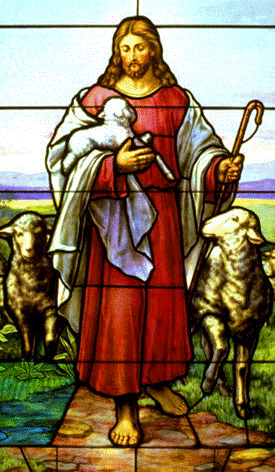
Have any of your ever raised sheep?  Or played with a lamb?  Maybe you’ve seen or touched a lamb at a demo farm for children?  Ok, so what we know about sheep we’ve learned from the media or in a science class.  I’ll take it for granted that you are a little familiar with the metaphors of sheep and shepherds but no so much as those who listened to Jesus talking about shepherds tending their sheep.   But, the image of Jesus as Good Shepherd has endured over the centuries as a primary image in our faith tradition.  One of the few Christian symbols dating from the first century is that of the Good Shepherd carrying on His shoulders a lamb or a sheep, with two other sheep at his side.

The power to describe the relationship between Jesus and his followers doesn’t necessarily require first-hand experience with raising or tending sheep.  In the earliest Christian art, the only depictions of Jesus are as the Good Shepherd.  And that image of Jesus persisted until about 500 AD.   By that time eighty-eight frescoes of the Good Shepherd depicted on the ceilings of the Roman catacombs because artists had run out of space of the walls of the churches of Rome.  The image speaks to us about the protection, intimacy, security, and care of shepherds for their sheep.

If we don’t know anything about the customs of shepherds and the unique relationship between the good shepherd and the sheep, then much of what the Psalms, namely Psalm 23, have to say will simply passes us by.

It’s an image of Jesus that’s popular with many people.  In some we see Jesus holding a lamb around his neck, over his shoulders, holding the two front legs of the sheep in one hand and the two rear legs in the other. These images appeal to us because of the tenderness of Jesus, his care and compassion for the lamb. Our minds naturally begin to wander and we realize it holds personal meaning for us. We are that lamb who is being carried by Jesus. It’s reassuring for us, in the dark days of our lives, that although we may feel empty and alone, we are never abandoned.  This is portrayed very beautifully in the poem Footprints which you may recall.

In each scene (of my life) I noticed footprints in the sand.

Sometimes there were two sets of footprints, others times there was one set of footprints.

This bothered me because I noticed that during the low periods of my life,

When I was suffering from anguish, sorrow or defeat, I could see only one set of footprints.

So I said to the Lord, “You promised me, Lord, that if I followed you, You would walk with me always.

But I Have noticed that during the most trying periods of my life

There has only been one set of footprints in the sand.

“Why, when I needed you most, have you not been there for me?”

The Lord replied, “The years when you have seen only one set of footprints,

My child, is when I carried you.”

The image of the Good Shepherd is symbolized in a beautiful way by the Pallium which the pope and archbishops wear over their shoulders while celebrating Mass. The Pallium is made from lamb’s wool from sheep raised by the Trappist monks on the outskirts of Rome.  When mature, the sheep are taken to the Pope for a blessing and then cared for by Benedictine Nuns at St. Cecelia’s (where Benedict lives while he was going to school in Rome) until they are sheared on Holy Thursday.   The lamb’s wool is meant to represent the lost, sick or weak sheep in the desert which the shepherd finds and places on his shoulders and carries to the waters of life.

One of the amazing things about shepherds and their sheep is how the shepherd moves them from place to place – and how the sheep know and trust the voice of their shepherd.  A similar phenomenon is observed when expectant parents speak to their babe in utero, reciting nursery rhymes, reading stories aloud – even adult literature or the newspaper – when after birth the infant perks up at the sound of that voice, the cadence of the words being read, indicating, “I heard that before.”

Some people think sheep are rather dumb – but really they are not.  Perhaps, it is cattle ranchers who are responsible for spreading that ugly rumor, because sheep do not behave like cows.   Cows are herded from the rear by hooting cowhands with cracking whips, but that will not work with sheep.  If you come up behind a flock of sheep making loud noises and all they will do is run around behind you, because they prefer to be led.  You push cows, but you lead sheep, and they will not go anywhere that someone else does not go first namely their shepherd who goes ahead of them to show them that everything is all right.

At night the shepherd can walk right through a sleeping flock without disturbing a single one of them, while a stranger cannot step foot in the fold without causing pandemonium.  And when several shepherds and their sheep are at a watering hole and it is time to leave all the shepherds have to do is call and their flock separate themselves out – and follow their shepherd away.

This is what we need to do when confronted with a cacophony chorus of conflicting opinions … but we can only do this if, as Pope Francis reminds us, “it is essential in order to cope with complexity and change, that we have developed the ability to withdraw for quiet reflection.  Only then will we truly know the voice of our shepherd, heed His voice and follow wherever God calls.

~ Reflection by Sister Roberta Bailey, OSB, Prioress
Continue Reading
Filed Under: Blog, Homily Tagged With: Christian symbol, footprints, God, Good Shepherd, Jesus, sheep

Third Sunday of Easter

April 11, 2016 by Holy Name Monastery Leave a Comment

FishingwithJesusAt the end of a long day, swapping stories about Jesus and his miracles, Peter’s friends may have asked him, “When do you think we will see Jesus again?”  Peter could have replied, “I have no idea.  In fact, I’m getting a bit frustrated with his absence.  It had been easy to follow Jesus around during his earthly ministry, but now they never know where he’s going to appear.”

Peter, the leader, decides to make a move. “I’m tired of sitting around waiting for him.  I’m out of here. I’m going fishing.” It is what he knows best. The others go along with him.   I think he’s simply saying: I gotta get out of here – I need some space to unwind – figure this out!  Like a lot of people, Peter is grateful that the others joined him.  It’s comforting to have friends who are on the same page. And, this is where Jesus finds them.  Strange isn’t it since Jesus had told them to go into Galilee and wait there for Him?

These disciples had been fishermen most of their lives before Jesus called them.  Some say they suffered a moment of doubt – a scary moment of spiritual darkness. I prefer to think of it merely as a night stress reliever, not unlike the desire that many people have to go fishing today.  Like us sometimes, they just wanted to get away for a while – an excuse to leave the stress of the everyday by returning to nature.

They know their trade well, they know these waters like the back of their hands – just where to get the best fish.  But this is a frustrating night – nothing, nil, zip, nada!  After each toss of the net, they come up empty.

Well, it’s dawn by now.  They were ready to draw up the nets and call it a night, when they spied someone at the shore line – there by a charcoal fire.  They don’t recognize the fellow.  This time, unlike the night of the storm on the lake, Jesus does not tell them “It is I.”  What he says is, “Try the other side – lower the nets on the other side of the boat.”   Baffled but trusting that the stranger might know what he’s talking about, or maybe just to humor him, they switch the nets.  And AMAZINGLY they pull in a huge haul!  If you know anyone who goes fishing, you know they have to tell you about their catch.  It appears it is such an ingrained trait even the evangelist reports it – 153 fish!  The number may be symbolic or it may just be to emphasize it was a BIG catch.

Suddenly the light bulb goes off: this is a familiar voice – John cries out, “It is the Lord!”  Always the impetuous one, Peter grabs his garments and drives in the swim to shore.  He throws clothes ON to jump in the water – isn’t that a bit backwards?  But Jews regarded a greeting as a religious act that could be done only when one was clothed.”

The disciples reach the shore; they find that Jesus had a fire prepared with fish already cooking.  Jesus had all the things they needed after being out all night on the water.  They found food, warmth and companionship.  They found a Savior who loved them and who had all the provisions in place that they needed.  Everything they lacked on that boat, they found when they came to Jesus!

The last thing we hear Jesus did is to give Peter this command, “Follow Me!”  It wasn’t the first time Peter’d heard this.  The last call is the same as the first.  It’s a re-commissioning.  We see that Jesus hasn’t changed His mind about Peter, even though Peter had denied him or any knowledge of him.  Peter’s call had not changed.

What can we learn from this folksy story which is found only in John’s Gospel?  What lesson is Jesus teaching us?

First, I believe we have to acknowledge that our first call is our forever all.  And, I don’t mean a vocational call.  Long before our call to a state in life or a ministry in the church or a career, God called to each of us: You are Mine!  We may back step, misstep, wander off the path. But God still calls Follow me.  Remember the hymn: What a Friend we have in Jesus. – He is our forever friend.

Another thing we see in this story … we have to be willing to wait through the dark night, the darkness, the emptiness in our boat when nothing seems to be happening.  When fishing and everything else seems in vain….  Seekers go elsewhere, we have poor attendance at programs, plans fizzle, volunteers don’t show up.  Be patient!  As it says in the Benedictus we pray each morning: “In your tender compassion, O God, the morning sun will rise, giving list to those who wait.”

This is when we have to flexible – cast the nets of the “other side of the boat.”  Look at the trends, where the fish are biting – listen to others’ suggestions and try new ideas – that’s where the 153 fish are ready to take a nibble.

Remember the part in the story about Peter being lightly clad.  (Some translations say “naked”.)  We have to be willing to be unclad before God – to stand naked before the Lord: put down our defenses, let up the shades and face the shadow-self so that when Jesus appears we can be clothed with the garments of innocence and integrity to greet the Lord.

When the night is over, and the dawn approaches, our ministries will be expanded, our nets will be ready and in good shape to catch the “fish” God sends to us for hospitality and membership.  We’ll bring our gifts of bread and wine, made from gifts that God gave first us: grain and grapes, the fruit of the earth. God has no need of anything further. Yet God accepts the offering we bring  – “the work of human hands”—and transforms them into the gift of his very presence.

As the dawn comes, Jesus meets us on the shore with everything we need.  And it’s customized, personalized just for me, just for our faith community.   Jesus is not only standing on the shore, he is waiting.  The question for us is: how long must he wait?

~Reflection by Prioress, S. Roberta Bailey, OSB


Continue Reading

Filed Under: Blog, Homily Tagged With: 153 fish, disciples, fishermen, Follow Me, God, Jesus, Peter

  • « Go to Previous Page
  • Page 1
  • Interim pages omitted …
  • Page 119
  • Page 120
  • Page 121
  • Page 122
  • Page 123
  • Interim pages omitted …
  • Page 127
  • Go to Next Page »

Footer

Prayer / Newsletter / Info

 Contact Info

Benedictine Sisters of Florida

PO Box 2450
12138 Wichers Road
St. Leo, FL 33574-2450
(352) 588-8320
(352) 588-8443

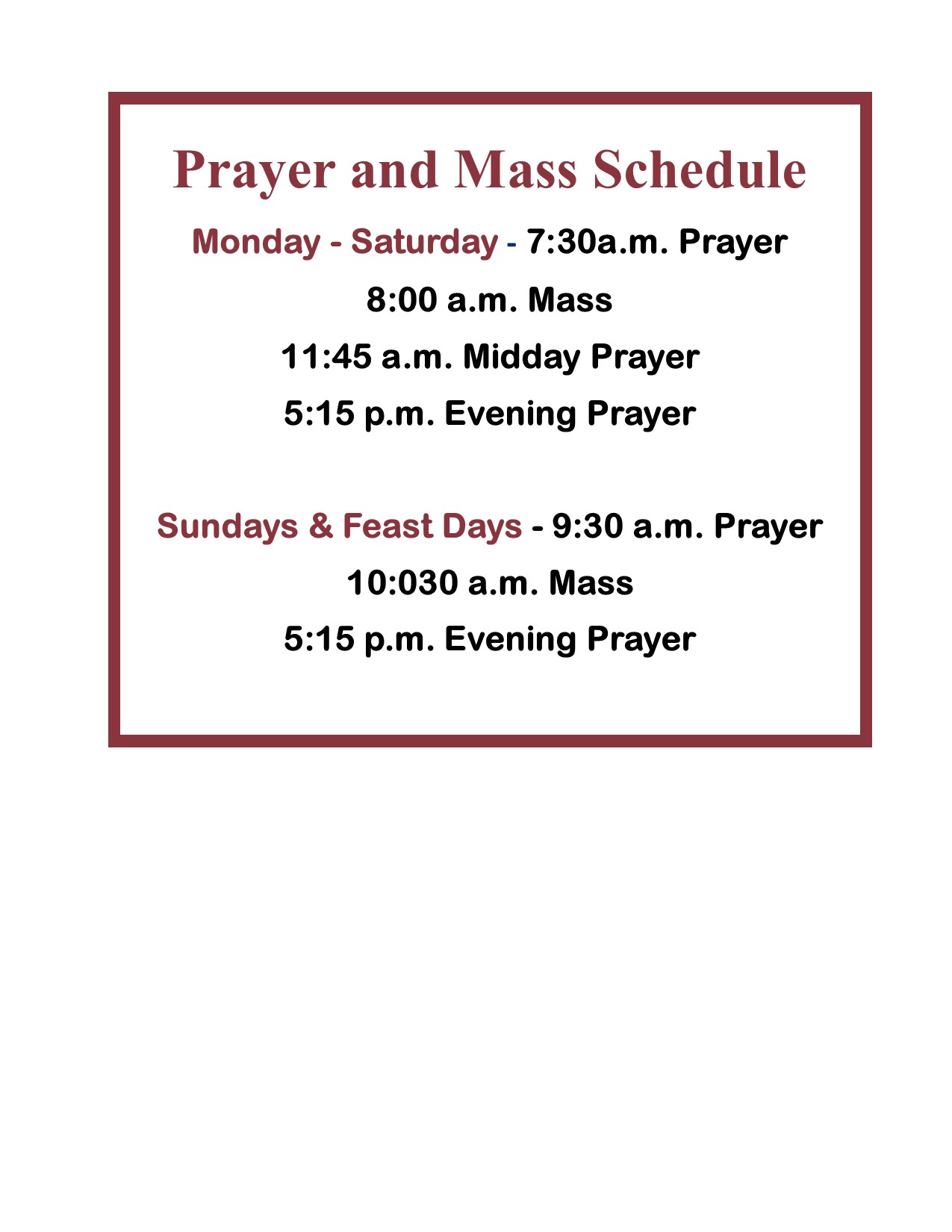
 Mass Schedule

Related Links

Copyright © 2026 · Benedictine Sisters of FL · Touching Lives Through Prayer and Service

Copyright © 2026 · Bendedictine Theme on Genesis Framework · WordPress · Log in