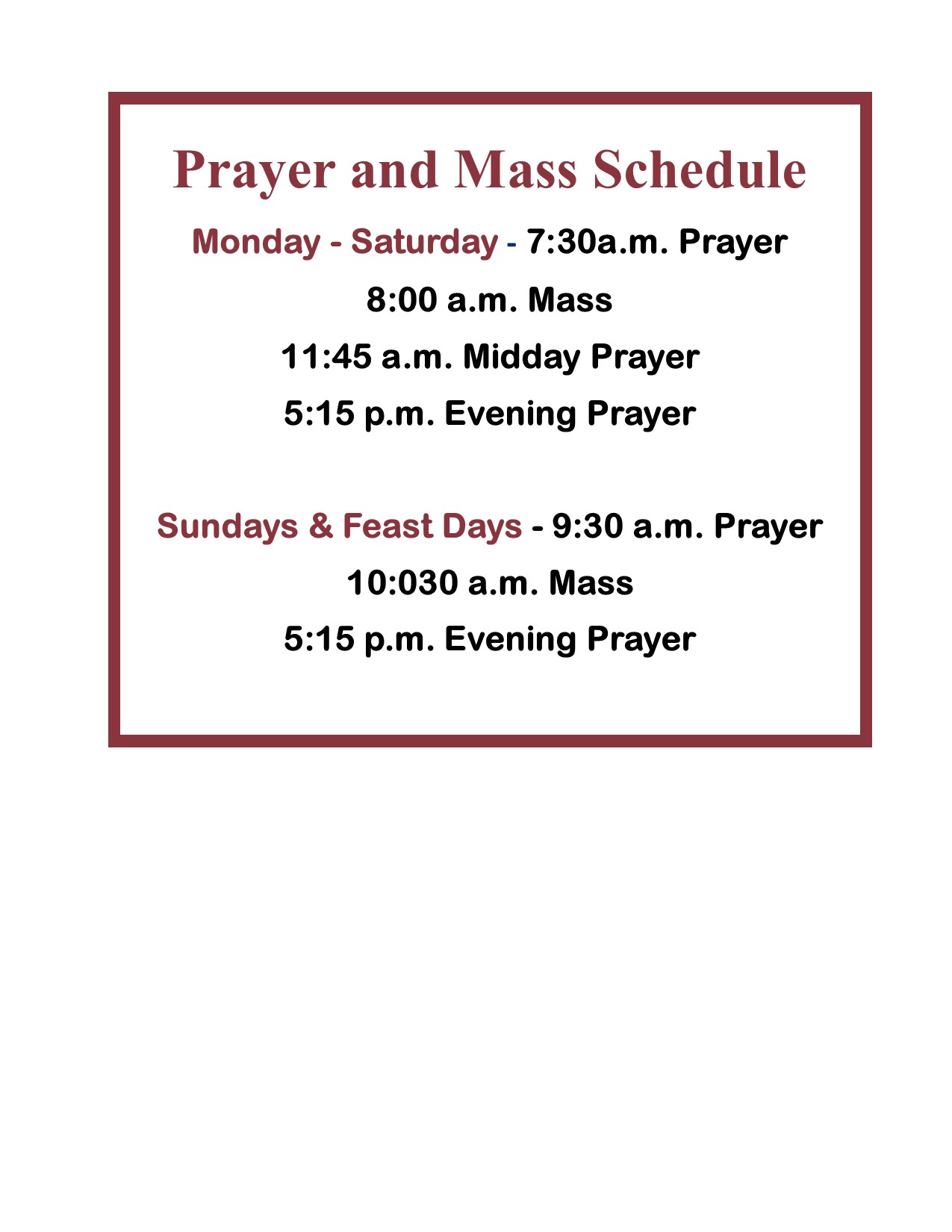
Interesting in growing your own food, check out the flyer below for our Aqua/Hydroponics Training.

Continue Reading

Holy Name Monastery
Founded 1889
Continue Reading
 It seems to me, that sadly, we live in a society that seems, in many ways, to have forgotten much of this Gospel message. Children participate in what is termed “competitive sports”, but they come to believe there is a trophy or a tiara for everyone for every event. They miss an opportunity to know the thrill of running for the sheer joy of feeling the wind on their faces, a hug from a parent – a loving squeeze without words that conveys, “I am so proud of you!” The pleasure St. Paul writes about to Timothy: “I have fought the good fight, I have finished the course, I have kept the faith.” I wonder, did he watch or participate in the competitive games in the coliseum he writes about to the Corinthians: “Do you not know that in a race all the runners run, but only one receives the prize?”
All-too-quickly today’s young people can lose (and sadly never rediscover) the warm, fuzzy feelings of self-satisfaction that was once a natural reaction to success. You know that gleeful, almost smug smile the first time they stood alone, took their first step… when, for the first time, to the consternation of the adults, they opened a child-proof container, hammered that first nail into mom’s precious table or exhibited their wonderful drawing with indelible pen on the living room wall and exclaimed: “Look what I did!” No one could be prouder of an achievement!
Jesus advises us: Give your cloak AND your tunic – not just your warm coat (that you haven’t worn in eons) but also the shirt off your back. Today Jesus might challenge us – Why is your closet stuffed with clothing you haven’t worn since your weight changed or we moved across the street? It is quite unlikely you’ll ever wear them again. But that Daystar customer, or that lady from the Sunrise shelter, or the Saint Leo University student who is looking for a business outfit for her first job interview? Your blouse would fit her perfectly and give her a boost of confidence.
Jesus reminds us, when we invite company for a meal not to wait for a return dinner date. Don’t ask: whose turn is it to pick up the tab this time? He says to lend freely without expectation of repayment. And when you respond generously to the impulse to do good – what caused that desire arise? Be slow to assume it is due to anything you have done. Remember Jesus says, “Even sinners lend to their own kind.” Give, and gifts will be given to you – in good measure, tamped down, packed tight, so your vessel can hold every tiny possible grain of blessing – full to overflowing – spilling over into your life and influencing those around you.
So how will you measure out your kindness – by the teaspoon, tablespoon or a cupful? By the minute, by the hour it might take you? We have 24 hours in a day; that’s 168 hours a week. It’s true they’re not all waking hours. All toll we have time in excess of 8000 hours a year! How flexible will you be with these God-given hours? Will you respond to an imposition on your time? Now? Tomorrow? Next week? Or with a prayer that the request will be forgotten or someone else will be enlisted to make a donation of her time? Or will you give with open hands and heart – freely, without measure?
Jesus promises us: “The measure with which you measure, it will in turn be measured out to you.” And, in turn we will reap the kind of joy recognized by the child who is quoted in the current issue of Reader’s Digest. She received birthday money from her grandmother to “buy something nice for yourself.” “I did,” she said when questioned about why she put her gift money in the church collection basket. “I did” she said, what Grandma said: “I brought happiness!”
~ Reflection by Sister Roberta Bailey, OSB, Prioress

The question is, then, what is the way to the beginning of peace?
The philosopher Blaise Pascal wrote: “The unhappiness of a person resides in one thing, to be unable to remain peacefully in a room.” It is silence and solitude that bring us face to face with ourselves and the inner wars we must win if we are ever to become truly whole, truly at peace. Silence gives us the opportunity we need to raise our hearts and minds to something above ourselves, to be aware of a spiritual life in us that is being starved out by pollution, to still the raging of our limitless desires. It is a call to the Cave of the Heart where the vision is clear and the heart is centered on something worthy of it.
There are some things in life that need to be nourished simply for their own sake. Art is one, music is another, good reading is a third, but the power of the contemplative vision is the greatest of them all. Only those who come to see the world as God sees the world, only those who see through the eyes of God, ever really see the glory of the world, ever really approach the peaceable kingdom, ever find peace in themselves.
Silence is the beginning of peace. It is in silence that we learn that there is more to life than life seems to offer. There is beauty and truth and vision wider than the present and deeper than the past that only silence can discover. Going into ourselves we see the whole world at war within us and begin to end the conflict. To understand ourselves, then, is to understand everyone else as well.
Because we have come to know ourselves better, we can only deal more gently with others. Knowing our own struggles, we reverence theirs. Knowing our own failures, we are in awe of their successes, less quick to condemn, less likely to boast, less intent on punishing, less certain of our certainties, less committed to our heady, vacuous, and untried convictions. Then silence becomes a social virtue.
Make no doubt about it, the ability to listen to another, to sit silently in the presence of God, to give sober heed and to ponder is the nucleus of the spirituality of peace.
—from For Everything a Season (Orbis) by Joan Chittister
Continue Reading
 For me this story in Luke is one of the most touching in recorded Scriptural history. A poignant portrait of a very human Jesus. The opening lines for me convey a wealth of meaning hard to capture in words. “Jesus came down and stood on level ground.” Humility personified!
And the next line speaks volumes, too. Jesus’ eyes roved over the crowd. Who is He looking for? Watch him. Like a loving parent, a faithful friend, he spies his disciples. And, begins to remind them: “Blessed are you!” He reminds me of an elder, saying to a grown child or a grandchild, “It’s going to be OK. Someday your luck will change. That boy will wake up and realize what a catch he’s let go. You’ll realize how lucky you are. You may hungry for a special relationship today. I can promise you, you will be satisfied.” The words of Psalm 30 console us: “Weeping may last for the night, but a shout of joy comes in the morning.”
Then, lest we become complacent, Jesus reminds us that this world is passing with all that is in it. You who are filled today, you who have a sufficiency today, will be hungry tomorrow. Those who pat you on the back today, may speak behind your back and denounce you tomorrow. They who laugh today will be among those who weep tomorrow.
Luke shares the lessons he’s learned from those who personally spent time in Jesus’ company. They’d learned from him the know-how of turning negativity to learning opportunities. Sounds like Jesus was a “when life gives you lemons make lemonade” kind of person. His close friends had witnessed Jesus special regard for people who suffer and feel out of the loop of belonging.
As Jesus spoke to the crowd that day each must have wondered: Is he talking about me? To me? Am I too settled in my comfortable niche? Why do I feel like squirming at this words? How differently He expresses His Father’s love for all people. Wealth isn’t really an overflowing abundance of money and things! Real wealth is believing that your reward will be found in delayed satisfaction. Today, Jesus says, Rejoice and leap for joy; your ancestors went through the same trials you experience. Different characters; same stories. Trust me: your reward will be great in Heaven.
The feast day of Saint Scholastica (480-543), twin sister of Saint Benedict, is today February 10th. Considered the patron saint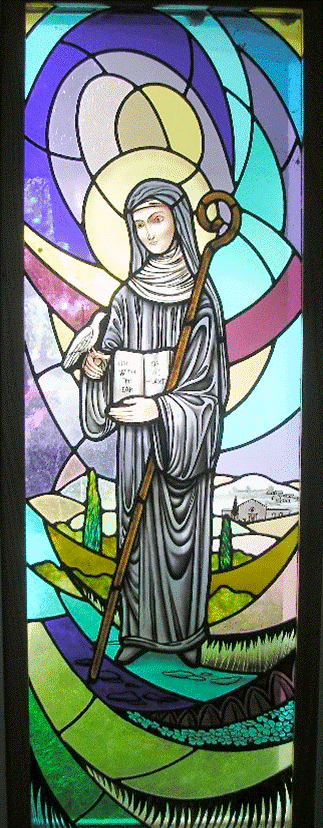 of Benedictine women and education, her life, like her brother’s, was centered on love and peace. At a very young age, she devoted herself to God and established a convent about five miles from Benedict’s monastery. They enjoyed a close relationship, meeting yearly to discuss spiritual matters.
As you may recall, the Benedictine Sisters of Florida refer often to Saint Benedict’s The Rule. His vision of how to live in community begins with the words “Listen with the ear of the heart.” The story of what would be Benedict’s last visit with his sister Scholastica illustrates how strong the communication link or dialogue can be between God and His people. Scholastica, feeling somewhat unsettled, wanted her dear brother to stay the night on this particular visit. Though she implored him, Benedict insisted on the necessity of returning to his monastery. Saint Scholastica prayed to God who listened and within minutes, a roar of thunder and heavy rain made it impossible for her brother to leave. It would be the last time the siblings would share precious time together. Saint Scholastica died three days later.
The Benedictine Sisters of Chicago remind us that January 24th is the memorial of Francis de Sales who is known as the great saintly communicator. In that vein, Pope Francis writes on the 56th Annual World Day of Communications about “Listening with the ear of the heart.” The Pope’s message reads “From the pages of Scripture we learn that listening means not only the perception of sound, but is essentially linked to the dialogical relationship between God and humanity.”
We pray fervently that our patron Saint Scholastica, cradles our hearts so that we truly listen with heartfelt compassion always.
Continue Reading