• Skip to primary navigation
  • Skip to main content
  • Skip to footer
Benedictine Sisters of FL

Holy Name Monastery
Founded 1889

Donate Now
  • Home
  • About Us
    • History
    • Being Benedictine
    • Benedictine Monasticism
    • Meet Our Community
    • Holy Name Academy-Alumnae
  • What We Do
    • Mission, Vision and Our Partners
    • Invitation to Retreat
    • Accommodations
    • Volunteer Programs
    • Oblate Program
    • Spiritual Direction
    • Aqua/Hydroponics
    • More of Our Ministries
  • What’s Happening
    • Articles of Interest
    • Events
    • Newsletters
    • Brochures
    • Links
  • Support Us
    • Gifts of Support
    • Wish List
  • Stories Shared
  • Galleries
    • Photos
    • Videos
      • Benedictine Sisters of FL Videos
      • Other Videos
  • Contact Us

Articles of Interest

2017 Fourth Sunday in Lent

March 27, 2017 by Holy Name Monastery Leave a Comment

First Reading   1 Samuel 16:1b,6-7,10-13a   Second Reading   Ephesians 5:8-14
Gospel John 9:1-41 (shorter form: John 9:1,6-9,13-17,34-38)


Today’s headline above the fold … and TV scrolling Breaking News:

It’s a Miracle! Man Born Blind Can Now See!

Earlier today a man, blind from birth, encountered the man they call Jesus of Nazareth and apparently now he can see! It was Jesus who stopped and spoke to the man, rubbed clay on his eyes, and then instructed him to go and wash in the pool of Siloam. Like magic, the blind man then could suddenly see! Of course, some of the authorities spoke out in dismay since this so-called healing took place on the Sabbath. Even his parents had very little to comment out of fear of repercussions. However, what’s the bottom line? Man born blind now can see!

Fake news for sure!  Like my mother always said, “If a story is too good to be true, it probably is.” There are just so many fake news stories nowadays it can be very difficult knowing truth from fiction. We need to be very careful.

I don’t blame those Pharisees for being overly cautious. Someone spreading such news could have really upset things to the point of creating chaos. But of course, everyone is drawn to sensationalism.

There is an overwhelming flood of news and information that can wash us away if we are not careful. Unfortunately, much of it is commentary disguised as factual news coverage. Then there is the phenomenon of fake news stories that so often mislead well-intentioned people. With all this inundating us, it is easy to become overly skeptical of anything we hear, or even simply deaf to all news, fake or real.

Of course, once you cut away all the junk you can find truth out there. In living out our faith, we are dependent on knowing truth. Yet too often we act like the facts of our faith story are up for debate. We begin to see the account of Jesus in the Gospels as just another series of tales like they were written for a grocery store aisle magazine.

The story of the healing of the blind man tells of an encounter with Jesus that leads to freedom and healing. Jesus was and is real and the fact that he can heal us should be undisputed. But too often we live our lives in desperation and despair, seemingly unaware that we can take our burdens to Jesus. We act like the Bible story is just a nice tale to be told at church and not one that exists to change our lives.

My fear is that too many Christians hear the stories of Jesus but they don’t listen to them. When we hear something we take in sound and physically react. When we really listen we internalize what we hear and then form a real opinion that can motivate us for a response. Indeed, in our world we are lacking a good bit of response to the Gospel.

These Gospel readings of the three weeks in which we find ourselves, from the Samaritan woman at the well to the raising of Lazarus, are proclaimed every year at the liturgies that feature Scrutinies for those in RCIA. They are meant to truly form and change the person who listens to them. They tell of a Jesus who offers us new life in him. Our Savior offers living water, dispels the darkness, and conquers the power of death. These are not simply the climaxes to good stories. This is real truth.

The Son of God is alive and well and we are all called to testify to that truth with our lives. We must step out of the shadows and be bold in our testimony. We must proclaim to a world in dire need that Jesus is Lord. We must take seriously the call to evangelize all who can hear and to spread the good news to the ends of the earth.

After all, it isn’t fake news. It isn’t alternate facts.   It isn’t even simply factual news. It is the GOOD news.

Borrowed mainly from LPI Reflection by Tracy Earl Welliver
Reflection by Sister Roberta Bailey, OSB, Prioress
Continue Reading

Filed Under: Blog, Homily Tagged With: 4th Sunday, blind man, Fake News, Jesus, Lent, Nazareth

Soul-shaking Change

March 20, 2017 by Holy Name Monastery Leave a Comment

2017 Third Sunday in Lent

First Reading  Exodus 17:3-7              Second Reading  Romans 5:1-2,5-8
Gospel  John 4:5-42

This unnamed but well-known woman experienced a major change in her life.  She was engaged in the longest recorded conversation with Jesus.  The most starting aspect of the conversation is that it happened at all.  Jesus, an observant Jew, was expected to avoid conversation with women in public.  Move than that, to begin with, the animosity between the Jews and the Samaritans would have prevented the conversation in the first place.  The woman herself mentions it, “How can you, a Jew, ask me, a Samaritan woman, for a drink?” Yet Jesus not only converses with her, he also asks her to share her drinking vessel, an action that, according Jewish law, makes him unclean.

The high point of the conversation is when Jesus reveals himself to her as the Messiah.  As this, the woman becomes a disciple.  She, an outcast and not a Jew, returns to her town to round up people to come meet Jesus for themselves.  This personal encounter has both a social and an educational dimension.  The woman became an evangelist to her own people and Jesus uses the incident to incident to teach the disciples a lesson in mercy.

Don’t you love how Jesus gently converses with this woman!  In the view of his disciples she was the wrong gender, from the wrong place, and lives a wrong life.  But, this day, Jesus is tired and thirsty.  Then, this lady (though her neighbors would never have called her a lady) approaches.  No one went to the well at high noon – it was just too hot.  She is skittish at the sight of a strange man.  She had to get her water when she thought no one else would be around.  She’s grown accustomed to suffering two extremes:  guys’ catcalls as she walked down the road or she’d been ignored.  Her defenses were up.  She wasn’t going to take any guff (she may have thought another word for it).  But, she wasn’t stupid; she was gutsy.  Despite the taboo of tradition, she talked back to Jesus.  And Jesus in the words of Psalm 34 “watched over the righteous and listened to her cry; He rescued her from her troubles and drew near to this one who was discouraged; He saved her who had lost hope.”  “Give me a drink.”

The exchange continued between the two of them.  He offered her living water.  This must have sounded GREAT!  She wouldn’t have to go to that well anymore!   She wouldn’t have to suffer the jeers, the whispers, the stares and finger-pointing.  She took in all Jesus said, pondered his words, digested it and then insisted the townspeople listen to her.  It was such an amazing, remarkable experience she couldn’t keep it to herself.  She ran shouting: “Come, see a man who told me everything that I did.  Can this be the Christ?!“    In the end, they answered for themselves, “This is indeed the Savior of the world.”

In Joan Chittister’s blog this week there is an excerpt from her book ILLUMINATED LIFE.  Joan reminds her readers that there is a lot more involved than may at first appear in making a soul-shaking change in our lives.  In Joan’s words:

Changing the way we go about life is not all that difficult. We all do it all the time. We change jobs, states, houses, relationships, lifestyles over and over again as the years go by. But those are, in the main, very superficial changes. Real change is far deeper than that. It is changing the way we look at life that is the stuff of conversion.

Metanoia, conversion, is an ancient concept that is deeply embedded in the monastic worldview. Early seekers went to the desert to escape the spiritual aridity of the cities, to concentrate on the things of God. “Flight from the world”—separation from the systems and vitiated values that drove the world around them—became the mark of the true contemplative. To be a contemplative in a world bent on materialism and suffocated with itself, conversion was fundamental. But conversion to what? To deserts? Hardly. The goal was purity of heart, single-mindedness of search, focus of life.

We do not need to leave where we are to become contemplative. “Flight from the world” is not about leaving any specific location. (Remember the Samaritan woman didn’t leave town – she ran back to the villagers. Joan continues:)  “Flight from the world” is about shedding one set of attitudes, one kind of consciousness for another. We simply have to be where we are with a different state of mind. We have to sit at home … with the good of the whole world in mind…

What needs to be changed in us? Anything that makes us the sole-center of ourselves. Anything that deludes us into thinking that we are not simply a work in progress… all of those professional degrees, status, achievements, and power are no substitute for the wisdom that a world full of God everywhere, in everyone, has to teach us.

To become a contemplative, a daily schedule of religious events and practices is not enough. We must begin to do life, to be with people, to accept circumstances, to bring good to evil in ways that speak of the presence of God in every moment.

[from Illuminated Life by Joan Chittister]

Continue Reading

Filed Under: Blog, Homily Tagged With: Flight from the world, Jesus, Joan Chittister, Lent, living water, Messiah, Soul searching, Woman

An Unspeakable Event

March 13, 2017 by Holy Name Monastery Leave a Comment

First Reading  Genesis 12:1-4a               Second Reading 2 Timothy 1:8b-10
Gospel   Matthew 17:1-9

Let’s set the scene: there is a mountain, there must have been clouds since we hear a voice come from out the clouds … then, there is Jesus. Three special friends, a face shining like the sun, clothes dazzling white, a voice from a cloud!   Something powerful is occurring here. And, it’s more than the disciples can comprehend.  They knew Jesus was someone special.  They’d known Him as a teacher, a healer, even a prophet… but that did not capture His full identity. Peter gets it “You are the Christ, the son of the living God!”    But his human understanding did not grasp the full meaning of what he said.

Peter recognizes that Jesus’ dazzling appearance in the presence of Moses and Elijah is significant–“Lord, it is good for us to be here!”   His suggestion to build three booths, or dwelling places sounds like an attempt to capture the moment, to preserve for safekeeping this frightening experience.   Imagine Peter (the extrovert par excellence) , jumping up and down with his hand in the air, like a child desperate to give the right answer, but who cannot quite get it right because he does not fully understand the question.

In his attempt to make sense of the magnificent transformation taking place before his eyes, Peter tries to talk it out, to speak words for the unspeakable event.  While he is still speaking, a bright cloud overshadows all of them and a voice interrupts: “This is my Son, my Beloved; in whom I am well pleased; listen to him.”

A stunned silence follows.  The four-some turns to go back down the mountain.  And Jesus asks them to tell no one what they experienced UNTIL He has been raised from the dead.

There are times when it is best to be quiet.  Times when we are a part of something much bigger than ourselves. There is more going on than what our physical eyes can see or understand. We have entered a mystery that can neither be defined nor discussed, only experienced.

There are moments like that in every life. Lovers gazing at each other see more than just another person. They have been brought face to face with the mystery of love. Parents and grandparents will recall when they beheld for the very first time the new baby in the family.  They see more than a baby. They are face to face with the mystery of life.  We’ve all seen a little child squealing with excitement. It is more than excitement. That child has come face to face with the mystery of deep joy. Recall a time you made a confession, formal or informal, and experienced the forgiveness of God or another person. It was about much more than words, past behavior, and the memory of estrangement. You came face to face with the mystery of grace.  And, many of us have been with a dying confrere, or parent, or friend.  We waited and watched for the person to be carried into new life. We came face to face with the mystery of death.

These are the moments of transfiguration. Each one of them is distinct, unique, and unrepeatable.  Yet they are somehow the same. Each one is so transparent, so real, they glow with the light of God’s presence. They are moments of pure grace. We cannot make them happen. We can only be there when it does happen. Thus, the importance of simply living in the present moment where everything around us seems to fall away.  It is a moment of pure, complete presence.

That is what happened to Peter, James, and John on the mountain.  They “looked up and saw only Jesus.”  This was as much their transfiguration as it was Jesus’. They didn’t just see the light they were absorbed into the light!

Jesus did not become something he was not before that night on the mountain. He was always filled with the glory of God. He didn’t become something new; but the disciples did.  In a flash of insight they saw the world with God’s eyes.  For, you see, transfiguration is not so much about what we see as it is about how we see. As long as we see only with our physical eyes, we will always be looking for something … looking over the fences of our own reality for that greener grass on the other side of the fence.

~ Reflection by Sister Roberta Bailey, OSB, Prioress
Continue Reading

Filed Under: Blog, Homily Tagged With: God, God's presence, Jesus, Mountain, Peter, Trasfiguration, unspeakable event

Does your “Yes” and/or your “No” have Strings Attached?

February 13, 2017 by Holy Name Monastery Leave a Comment

Sixth Sunday in Ordinary Time

First Reading  Sirach 15:15-20                Second Reading  1 Corinthians 2:6-10

Gospel  Matthew 5:17-37                           Intention  Engaged couples

Are you a person of integrity? Can people take you at your word? If You can answer, I am, then folks know that your ‘Yes’ means ‘Yes,’ and our ‘No,’ means ‘No.’   Or, as Pilate once said – or someone around here says – “What I have spoken, I have spoken.”

Every Jew in Jesus’ day knew these words: “…ye have heard that it has been said by them of old time, you shalt not forswear thyself…”   We call it perjury – a willful act of swearing a false oath or of falsifying the truth.

Last week was National Marriage Week during which the church prayed: “Let’s strengthen marriage.”  This week our community intention is for engaged couples.  How appropriate that Justin Barthle, John’s son, is getting married on Sunday.  May their commitment be without reservation: Let their YES be yes.

You see, a vow doesn’t need an oath. Jesus made it clear that our yes is enough to satisfy the binding requirement. With a vow what we say is what we mean.  If we do not mean it, if we, or a marrying couple, hold on to “except when” or “unless” or “until it’s not working or it doesn’t fulfill me – then I’m out of here’ – that’s perjury, a false oath.  We vow with “no strings attached.”

As vowed Benedictines what do we do to insure we are truly life-long learners – committed to a perpetual pursuit of growth in the monastic way of life?  What do we do to expand our knowledge of the writings of the fathers and mothers of the church?  Our familiarity with the Rule of Benedict?  In particular, how deeply do we delve into Scripture to realize new, fuller meaning of God’s Word?  What do I hear today that somehow I never heard before?

Do we strive to enlarge the understanding and application of our vow of obedience?  Has our observance of obedience matured beyond a childish fear of a parent finding out we took an extra cookie or a beginner’s strict adherence to every regulation to please her director or because she worries that the whole community is watching her day and night?  What does obedience mean to us?  What is legitimate authority?  In a spirit of mutual obedience do we conscientiously seek input from a superior and spiritual elder?  Suppose what is offered is not what I had in mind?  Do I give it serious consideration or was my asking simply pro forma?  Do I give a half-hearted acquiescence to a superior’s request as merely a suggestion or the call of the Spirit in my life to follow or not as I choose? How distressing it can be to have someone say “yes” – pretend she’s going to obey – but then never perform the deed or show by her every comment to others and her body language that she detests the command

What if the group makes a decision I don’t like – do I have any obligation to follow it if I voted against it?    What about annoying behaviors – not immoral actions, just a behavior that grates on another’s nerves?  Like, for instance, if you use earplugs to listen to music but hum along or keep time by drumming audibly on the desk – knowing all the time that it is driving the other up the walls.  It’s not bad to play an “air drum” is it?  And the other could leave the room if she doesn’t like it.  I am not playing the music out loud … do I stop the drumming or sit there justified that it is my right to give expression to the music.  It’s not a sin to hum or beat out the rhythm, is it?   Or is it?  Here’s the authentic test question: how closely does our behavior mirror Benedict’s “deference to one another?”

To keep our “yes” a “yes” takes much prayer, honest introspection, willingness to open our hearts to new meanings and a spirit of grounded integrity.  Otherwise, our vows, a couple’s marriage bonds, are not worth the piece of paper they are written on.

This is where our vow of stability comes into play.  With our vow we are publicly professing responsibility to work on fidelity to our covenant with God and our commitment to one another.  That takes an awareness of what is going on inside of ourselves, and a responsibility for how we might be contributing to the building up or destruction of a bond into which we’ve entered.  Remember: if you are not part of the solution, you are part of the problem.

In this Gospel reading Jesus is talking about a lifetime pursuit of a way of living, in which our integrity isn’t just a matter of external conformity, but an internal way of life.  There’s that sticky vow of conversion of life.  This calls for strength and integrity, an inner discipline, an awareness of and acknowledgement of what makes us tick.  Our words should simply be our bond, and mean what we say.

When we say yes, you should speak it with enough conviction that there’s no doubt. When you say no, mean it.  If you sometimes say yes with your lips when your heart is thinking NO WAY!  People will pick up on that.  When in my heart I say NO, but my lips say yes…that’s deceit, it’s a lie.   My tongue speaks what my heart isn’t feeling. I’m lying to myself and to another person.  If I solemnly say “I promise I’m telling you the truth,” does that mean that sometimes I’m not telling the truth?

One of the angels in the Book of Revelation tells us: I know what you have done; I know that you are neither cold nor hot.  I wish you were either one or the other!  But because you are neither, I am going to spit you out of my mouth! “

Ultimately our relationships with other people are inseparable from our relationship to God; and it is the love of God that binds all in all.  It is God’s love that teaches us about relatedness, about truth, about personal integrity.  Heed Jesus’ words: Let your YES be YES and your NO be NO!

~ Reflection by Sister Roberta Bailey, OSB, Prioress
Continue Reading

Filed Under: Blog, Homily Tagged With: commitment, integrity, Jeses, Let Yes be Yes and No be No, monastic way of life, no strings attached, oath, vows

The Beatitudes or Blessings

January 30, 2017 by holyname Leave a Comment

“Be perfect as your Heavenly Father is perfect.” Jesus challenges us with this task in every time and place.  How often people shy away and make the excuse: “I’m only human. I’m not perfect.” Jesus never requires anything of us without giving us the means to acquire it. He calls us to perfection and, in turn, gives us the Beatitudes as the road-map to the path of perfection.

The Beatitudes have been called the Magna Carta of the Christian life, and the Charter of the New Covenant.  By striving to live them, we will grow in holiness.  In today’s Gospel, Jesus takes a seat on the Mount which signifies the ancient gesture of a teach communicating important truths to his followers.  The Beatitudes challenge us to measure ourselves against them.”

The eight Beatitudes, St. John Paul II, said are the road signs that show the way. It is an uphill path, but He has walked it before us:  Blessed are the poor in spirit. Blessed are those who mourn. Blessed are the meek. Blessed are those who hunger and thirst for righteousness. Blessed are the merciful. Blessed are the clean of heart. Blessed are the peacemakers. Blessed are those who are persecuted for the sake of righteousness.

What better way could we examine our consciences than to prayerfully reflect on the Beatitudes, their meaning in one’s life, and most of all to ask the question: “Am I living them?”  Even if we have failed to measure up to them, we can begin anew through the grace of God’s mercy in the sacrament of penance.  Jesus has given us the roadmap to heaven; let us do all in our power, with His grace, to reach our destination safely.                                                                                                        Fr. Paul Burke, Holy Spirit College


Continue Reading

Filed Under: Homily

What is the Astuteness of the Christian?

January 24, 2017 by Holy Name Monastery Leave a Comment

3rd Sunday in Ordinary Time

 Right to Life (January 23)  St. Paul (January 25)

First Reading   Isaiah 8:23-9:3          Second Reading  1 Corinthians 1:10-13,17
Gospel Reading  Matthew 4:12-23

In this Gospel the power of Jesus’ call is immediately evident – Peter, Andrew, James and John dropped everything to follow Jesus immediately.  Jesus doesn’t have to pitch the idea to these individuals nor does he need to persuade them.  Each has little reason to leave their current way of life.    Each seemingly has a steady job.  Most importantly they have familial ties to their vocations as family men and fishermen.  Now, in the new lifestyle they were inaugurating, their security would come from life in a mutually supporting community, where the needs of each one were taken care of.

Having begun to assemble his company of companions, Jesus turns to his ministry, as the Gospel describes it: teaching in the synagogues, proclaiming the gospel of the kingdom, and curing every disease and illness among the people.   He moved quickly and determinedly from one place to another … planting dreams, raising expectations, and opens doors of possibility.  His followers witnessed a dramatic alternative to the emptiness and despair that filled the lives of the people immersed in an atmosphere devoid off their trust and hope.

Whether man or a woman, when one joyfully responded to Jesus’ call to follow, and entered Jesus enterprise, their lives were dramatically changed.  They became agents of new possibility for all who came into contact with them – beacons of encouragement for the discouraged – inviting the stranger to faith in God and purpose in life.

The late Speaker of the House “Tip” O’Neill loved to relate a valuable lesson he’d learned early in his career. During his first political campaign, one of O’Neill’s neighbors told him: I am going to vote for you tomorrow, even though you didn’t ask me to! O’Neill was surprised and said: Why, Mrs. O’Brien, I have lived across from you for eighteen years, I cut your grass in the summer, I shoveled your walk in the winter; I didn’t think I had to ask for your vote! Mrs. O’Brien replied: Oh, Tommy, let me tell you something … people like to be asked!

A vital faith community will always be asking … inviting followers just as Jesus did.
It is never enough to simply welcome people when they happen to visit, we must also invite them to join us in our worship and ministries.  Without a direct “ask” a vocation may be stifled or a prayer-partner lost.  My mother spoke with great admiration for the Benedictine Sisters who were her teachers in elementary school.  I asked her once when she didn’t become a Sister – she replied “None of them asked me – so I figured I was not worthy.”  Of course, I would not be here telling you this story if she’d been asked and said YES.

Tomorrow (Monday, January 23) the church leads us in prayer for the sanctity of all life: for an end to abortion, euthanasia and the death penalty.  And more than that: to honor, respect and love all God’s people without reservation.  I invite you to listen to these words of Pope Francis (adapted slightly to be gender inclusion):

The Christian cannot allow her/himself the luxury to be an idiot, that’s clear. We don’t have the luxury to be fools because we have a very beautiful message of life and we’re not permitted to be fools.  For that reason, Jesus says, “Be astute, be careful.”  What is the astuteness of the Christian?  In knowing how to discern who is a wolf and who is a sheep. 

And when … a wolf disguises itself as a sheep, (the Christian) knows how they smell. “Look, you have the skin of a sheep but the smell of a wolf.” And this, this mandate that Jesus gives us is very important. It’s for something very great.  Jesus tells us something that attracts our attention, when someone asks him: “Well, why did you come into the world?” “Look, I come to bring life and for that life to be in abundance, and I am sending you so that you can advance that life, and so that it will be abundant.”

Jesus didn’t come to bring death (of the body), but rather, the death of hatred, the death of fighting, the death of slander, that is, killing with the tongue.  Jesus came to bring life and to bring the abundant life, and he sends us out, carrying that life, but he tells us: “Care for it!” Because there are people bringing us today the culture of death.  That is, life interests them insofar as it is useful, insofar as it has some kind of utility and if not, it doesn’t interest them.  And throughout the world, this weed has been planted, of the culture of death.

How beautiful is caring for life, allowing life to grow, to give life like Jesus, and to give it abundantly, not to permit that even one of these smallest ones be lost.  That is what Jesus asked of the Father: “that none of those whom You have given me be lost, that all of the life that You gave me to care for, might be cared for, that it might not be lost.”  And we care for life, because He cares for our life from the womb.

Caring for life from the beginning to the end. What a simple thing, what a beautiful thing.  Father, is that why there are so many wolves who want to eat us?  Is that why, tell me?  Who did Jesus kill? No one.  He did good things. And how did he end up?  If we go down the road of life ugly things can happen to us, but it doesn’t matter. It’s worth it.  He first opened the way.

So, go forth and don’t be discouraged.  Don’t be fools, remember, a Christian doesn’t have the luxury of being foolish, I’m going to repeat this: an idiot, a fool – you can’t give yourself that luxury.  You have to be clever, be astute!     Care for life. It’s worth it! “

~ Reflection by Sister Roberta Bailey, OSB, Prioress
Continue Reading

Filed Under: Blog, Homily Tagged With: astute, Christians, Faith, God, Gospel, Jesus, Pope Francis, Prayer

  • « Go to Previous Page
  • Page 1
  • Interim pages omitted …
  • Page 118
  • Page 119
  • Page 120
  • Page 121
  • Page 122
  • Interim pages omitted …
  • Page 132
  • Go to Next Page »

Footer

Prayer / Newsletter / Info

 Contact Info

Benedictine Sisters of Florida

PO Box 2450
12138 Wichers Road
St. Leo, FL 33574-2450
(352) 588-8320
(352) 588-8443

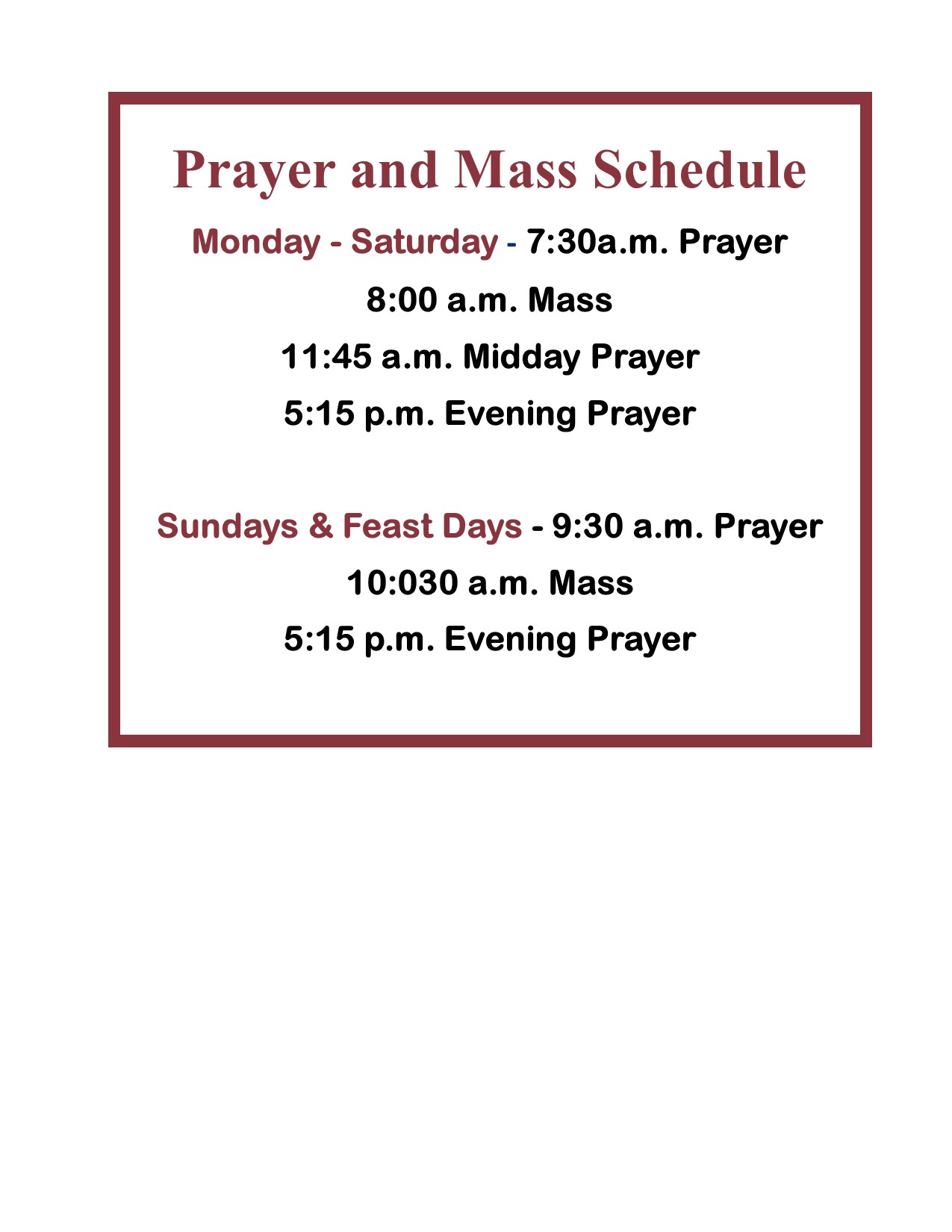
 Mass Schedule

Related Links

Copyright © 2026 · Benedictine Sisters of FL · Touching Lives Through Prayer and Service

Copyright © 2026 · Bendedictine Theme on Genesis Framework · WordPress · Log in