• Skip to primary navigation
  • Skip to main content
  • Skip to footer
Benedictine Sisters of FL

Holy Name Monastery
Founded 1889

Donate Now
  • Home
  • About Us
    • History
    • Being Benedictine
    • Benedictine Monasticism
    • Meet Our Community
    • Holy Name Academy-Alumnae
  • What We Do
    • Mission, Vision and Our Partners
    • Invitation to Retreat
    • Accommodations
    • Volunteer Programs
    • Oblate Program
    • Spiritual Direction
    • Aqua/Hydroponics
    • More of Our Ministries
  • What’s Happening
    • Articles of Interest
    • Events
    • Newsletters
    • Brochures
    • Links
  • Support Us
    • Gifts of Support
    • Wish List
  • Stories Shared
  • Galleries
    • Photos
    • Videos
      • Benedictine Sisters of FL Videos
      • Other Videos
  • Contact Us

Articles of Interest

Advent – The Season of Hope

November 29, 2016 by holyname Leave a Comment

adventcandlesWe started our service this evening (Nov. 27, 2016) with a short procession – barely six yards and a few steps from the doorway to the Advent candle — but it is long enough to set the tenor for this holy season. In a world where it would be easy to seclude ourselves and disengage from others, we walk… together… in silence.
Not more than a few steps were had before the silence occasionally is broken naturally enough. A cough, a sneeze; the perpetual sound of footfalls against the tile floor. Our voices start out quiet but our bodies aren’t. Indeed, it seems as if our very bodies sing out as we enter the chapel, calling out to the whole Body of Christ to march together in quiet contemplation as we chant an ancient Advent hymn – the verses change from week to week telling the story of salvation history.
As we walk, and as we pray, we all share one thing: a strained hope for a world of mercy, of justice, of peace. This season we’re not going “up to Jerusalem” but quietly moving together to “Bethlehem town” – to the cave of our own hearts and the cradle of God’s love incarnate.
And this is how we come to God: quietly shuffling along, coughing, maybe a whisper to point out the place in the hymn book, and bumping into one another. And, bowing to one another as we reverence the Christ within personified in our partners. We walk together toward the rebirth of our own spirits.
You see, this is not the glorious, boisterous, triumphant atmosphere of a Palm Sunday. Advent is a season for the broken, for those hurting in body or mind or spirit. It is a season for people who have struggled, who can do nothing else but wait. It is a season for a people whose exhausted, desperate cry is only, “Come!”
The four weeks of waiting, preparation, and anticipation is marked by the lighting of the candles on the Advent wreath. As we listen to the strike of a match (or these days to the click, click of a lighter) and watch the flame on the candle leap to life, something happens in us. Gazing on the lighted candles inspires reflection and the recall of memories – not whole stories but snippets of Advent and Christmas past: the gifts we received and the ones we gave – our presence at a special Christmas Mass or program. On and on goes the string of moments and episodes that people offer up when given an opportunity to share.

One such story is told by a woman who recalled the Christmas she experienced when she was a young child eager for a particular doll for her Christmas gift. She’d searched without luck every hiding place she knew her parents used. Now it was Christmas eve. Her parents had a rule that the children couldn’t get out of bed until 5 a.m. to wake them up and open their gifts. But the young girl couldn’t stand it, so at 4 a.m. she sneaked down to the tree to have a look. She recalled the tree was beautiful, all lit up and surrounded by presents. Some were obviously socks, and sweaters and PJs but one looked promising and was marked with her name. Against her better judgment, she peeled back a little bit of the wrapping paper – on the underside where she thought no one would notice. Lo and behold it was just the gift she had hoped for! She danced a silent, exhilarated gig in glee!
Hardly able to contain her joy, she put the wrapping paper back together as best she could and crept back upstairs and went back to sleep with visions of her doll dancing in her dreams. Then, about an hour later, she woke up her parents and the family trooped downstairs – the kids taking two stairs at time, the parents looking almost awake. Much to everyone’s surprise (well, almost everyone) they found a note from Santa that explained that, because Susie had peeked at her gift, Santa had taken back all her presents. She recalled she had never cried so hard in her life. It turned out it was all a prank by her older brother, who had witnessed the peeking. The story has a happy ending though: Susie’s presents reappeared.
Like an eager child, during Advent, Christians wait in anticipation for the gift of Christmas: the coming of Jesus. But unlike curiosity about toys, it’s OK to take a sneak peek. That’s because God wants us to anticipate. And, God will never ever take away our Christmas present from us.
It is the beautiful task of Advent to awaken in all of us memories of goodness and thus to open doors of hope. God only asks that we take time to be aware that in the very midst of our busy preparations for the celebration of Christ’s birth in ancient Bethlehem, Christ is reborn in the Bethlehem of our community, in our homes and daily lives. Take time, slow down, be still, be awake to the Divine Mystery that looks so common and so ordinary yet is wondrously present.
An Ancient Ones was fond of saying, ‘The devil is always the most active on the highest feast days.’ The supreme trick of the devil is to have us so busy decorating, preparing food, practicing music and cleaning in preparation for the feast of Christmas that we actually miss the coming of Christ. Hurt feelings, anger, impatience, injured egos—the list of clouds that busyness creates to blind us to the birth can be long, but it is familiar to us all. The coming of Christ and his presence among us—as one of us—gives us reason to live in hope: that light will shatter the darkness, that we can be liberated from our fears and prejudices, that we are never alone or abandoned.
May this season of Advent be a time for bringing into our hearts, and homes, a spirit of hope and transformation that flowers at Christmas.                                                                                                                        S. Roberta Bailey, Prioress


Continue Reading

Filed Under: Homily

All Saint’s Day – November 1st

November 1, 2016 by Holy Name Monastery Leave a Comment

all-saints-day-9-450x318While historians do not have a definitive date for the Christian beginnings of All Saints’ Day, it is believed by many, to have been initiated by the Greeks.  In the fourth century, they chose the first Sunday after Pentecost to honor all saints and martyrs.

In 837 CE, All Saints’ Day was authorized a holiday by Pope Gregory IV.

Continue Reading

Filed Under: Homily Tagged With: All Sain't Day, Jesus, November 1

The True Host

October 31, 2016 by Holy Name Monastery Leave a Comment

First Reading  Wisdom zacchaeus11:22—12:2       Second Reading 2 Thessalonians 1:11—2:2
Gospel Luke 19:1-10

Have you ever been to a parade, or a concert or a sports event where you couldn’t see much more that a sea of hats or heads?  When that happens, a periscope may be just what you need – you know, one of those things they use in submarines to see above the surface of the water … you can see over tall objects, even around corners.

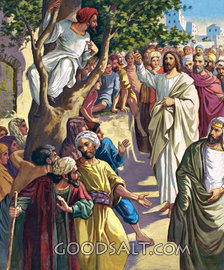
Well, today’s story is about such a situation.  A man went to a parade, but couldn’t see above the crowd.  The main attraction in this parade was man who had become quite famous because he had performed many miracles.  He had raised people from the dead and restored sight to the blind; he cured people of leprosy and drove out demons.  This man Jesus, Luke tells us, was passing through Jericho.  Notice He wasn’t intending to stay overnight.  The atmosphere was like a circus parade. People lined the streets hoping to get a glimpse of Jesus.  Zacchaeus REALLY wanted to see Jesus!  But he was small of stature and he didn’t have a periscope

Remember the song ….  Zacchaeus Was a Wee Little Man ….

So what’s a short guy to do? He runs on ahead of Jesus and climbs a sycamore tree.  Now, I’ve read that people in the Middle East do not generally run and they wouldn’t be caught climbing a tree.  Zacchaeus would have had to run a long way ahead of the crowd to have time to climb up this tree and get a view of Jesus.  The law – the city codes – did not allow the planting of sycamore trees within the city limits.  They had to be planted at least 75 feet outside the city walls. So, Zacchaeus had to run past everyone in town to climb up that tree.  Now, just imagine that parade of people surrounding Jesus.  Most had their attention focused on Jesus but surely some would have spotted the little thieving rich guy climbing up in the sycamore tree.

Jesus arrives under the tree and looks up to Zacchaeus.  Their eyes meet.  Jesus called Zacchaeus by name. He made eye contact, and spoke to him face to face.  Jesus communicated to Zacchaeus that he was glad to see him.  How embarrassing for Zacchaeus.  You can just hear the people taunting him, shouting insults, and calling him names.  Jesus knew everything there was to know about Zacchaeus, yet He still loved him and still had compassion on him.  What a picture of grace!  That’s how it is for us, too.  Jesus knows everything there is to know about us, but He still loves each of us.

Jesus silences the crowd and His voice rises above the din of their taunts and shouts.  He absorbs the ridicule and shame of Zacchaeus upon Himself and invites Himself over for supper.  The people in the crowd were shocked!  Zacchaeus was one of the most hated men in all of Jericho.  They considered him a thief and a cheat!  No observant Jew would dine with this sinner.  Yet, Jesus chooses to honor the tax collector by staying at his house.  The crowd couldn’t believe it!  Of course they grumble. Jesus, on the eve of the Passover, hadn’t planned to stay in town.  And now he’s going to stay and eat in an unclean house?  Jesus is defiling Himself.  Zacchaeus gets down from the tree and gives his famous speech.  He promises, if he has ever cheated anyone, to give half of his goods to the poor and restore four times the amount he has ever stolen.

That’s when Jesus makes the bold declaration, “Salvation has come to your house!” Zacchaeus got saved! He was born again!   Experiencing the love of Christ, he became more concerned about others.

Jesus doesn’t say that Zacchaeus is saved because he plans on repaying everyone. Salvation has come to Zacchaeus’ house because He is simply lost.  In his search for salvation, he humbled himself by making a spectacle of himself climbing up a tree.  Perhaps you have heard the saying, “To reach the fruit of a tree, you must go out on a limb.”  That’s exactly what Zacchaeus did.

One Biblical scholar has described the paradox in this story.  “Zacchaeus is spectacular because he is not like other characters who encountered Christ.  He was not called as the disciples were, nor was Zacchaeus suffering from some kind of affliction.  What makes Zacchaeus so special is that he was an average man.”  Most of the characters in the Bible experience a call from Christ either as a personal invitation or through the public preaching of Jesus.  Others sought Jesus because of some affliction.  Zacchaeus was different.  He was a successful business man – and a wealthy one!  An interesting part of this story is that, as far as we know, Zacchaeus did not change jobs after his encounter with Jesus.  He did not join the entourage that traveled with Jesus.  He was a tax collector before he met Jesus, and it seems he continued collecting taxes after he met Christ.  His job was the same, but his destiny was different.

The text says Zacchaeus was “seeking” Jesus.  But if I read the story right, Jesus really was seeking Zacchaeus.  He came to seek and save all the lost.  Zacchaeus tried to climb up to God, but he didn’t get past the lowest branches.  Zacchaeus gets to host Jesus that evening because Jesus invited Himself to celebrate the Passover meal. Jesus always ends up being the true host.  Jesus invites Himself here today. If you’ve come to seek good news, it’s the same the message Jesus spoke to Zacchaeus: “Come down; salvation has come to your house.  I want to dine with you this night.”

~Reflection by Sister Roberta Bailey, OSB, Prioress


Continue Reading

Filed Under: Blog, Homily Tagged With: God, Jericho, Jesus, salvation, sycamore tree, tax collector, Zacchaeus

A Study of Contrasts

October 24, 2016 by Holy Name Monastery Leave a Comment

righteousnessFirst Reading  Sirach 35:12-14,16-      Second Reading  2 Timothy 4:6-8,16-18
Gospel  Luke 18:9-14

It is important to note at the outset of this particular reading to whom Jesus is speaking in this parable.  Luke says:  “Jesus also told this parable to some who trusted in themselves that they were righteous, and treated others with contempt.”

The whole parable is a study in contrasts between the prayer of the Pharisee and the prayer of the tax collector.  Jesus teaches us, his listeners, to pray in humility before God. He surprises his listeners, including us, by highlighting the tax collector as the example of faith – a model for prayer. He reminds us if we are too full of ourselves, there is too little room for God’s grace to work in us.

It’s interesting to notice that everything the Pharisee says is true. He has set himself apart from others by his faithful adherence to the law. He is, by the standards of his day what Luke and Jesus seem to term, righteous. So before we judge him too quickly, we might reframe his prayer slightly and wonder if we have uttered it ourselves. Maybe we haven’t said, “Lord, I thank you that I am not like other people…”, but what about, on seeing someone down on her luck, “There but for the grace of God go I”? It isn’t that the Pharisee is speaking falsely, but rather that the Pharisee misses the true nature of his blessing. As Luke says early on in this reading, he has trust in himself. His prayer of gratitude may be addressed to the God, but it is really about himself. He credits his righteousness entirely in his own actions.

The tax collector, on the other hand, does not even raise his eyes to heaven.  He knows that he possesses no means by which to claim righteousness. He declares he has done nothing of merit. So, he stands back, hardly daring to approach the Temple, and throws himself on the mercy of the Lord.  He seems not so much humble as desperate.  He is too overwhelmed by his plight to take time to divide people into categories.  He stakes is hope entirely on the mercy of God.

At the end of the day, the Pharisee will leave the Temple and return to his home righteous. This hasn’t changed; he was virtuous, honorable, and righteous when he came to the temple.  That hasn’t changed … he’s still righteous when he leaves the temple. His mistake, as Scott Peck says, is that he thinks that whenever he wants to he can pull “God out of his back pocket.”   On the other hand, the tax collector will leave the Temple and go back down to his home justified, that is, accounted righteous.  As Luke expresses it: he is exalted in God’s eyes because he humbled himself.

If you’re spiritually alive, and give credit where credit is due, you’re going to love this take on the parable.  If you’re spiritually dead, you won’t even want to hear / read it.
If you’re spiritually curious, there is still hope!

A Church goer wrote a letter to the editor of his hometown newspaper and
complained that it made no sense to him at all to go to church every Sunday………

He wrote: “I’ve gone for 30 years now, and in that time I have heard something like 3,000 sermons, but for the life of me, I can’t remember a single one of them.  So, I think I’m wasting my time, the preachers and priests are wasting their time by giving sermons at all”.

This started a real controversy in the “Letters to the Editor” column.  Much to the delight of the editor, it went on for weeks until someone wrote this clincher:

“I’ve been married for 30 years now….. In that time my wife has cooked some 32,000 meals…… But, for the life of me—- I cannot recall the entire menu for a single one of those meals.

[Or we might say: I’ve been in community x number of years… in that time I’ve been  nourished and supported by my Sisters thousands of times in hundreds of different ways …But, I can only recall a few instances in detail ….]

But I do know this: They all nourished me and gave me the strength I needed to do my work.   If my wife (my community) had not given me those meals, I would be physically dead today.

Likewise, if I had not gone to church – been faithful to my time of private and communal prayer – for nourishment, I would be spiritually dead today!”  AMEN!

~Reflection by Sister Roberta Bailey, OSB, Prioress
Continue Reading

Filed Under: Blog, Homily Tagged With: contrasts, God, Jesus, parable, Pharisee, Pharisees, righteous

Perseverance of Prayer

October 17, 2016 by Holy Name Monastery 1 Comment

luke-18-1-8-2First Reading    Exodus 17:8-13.                  Second Reading    2 Timothy 3:14—4:2
Gospel           Luke 18:1-8

Here we have a lesson about perseverance in prayer.  The point of the story is not that prayer is nagging God for what we want.  Nor is it meant to teach us that God is like the judge in the parable – worn down by requests and coerced to respond.

The key to understanding the meaning is found in the description of the judge as corrupt and unjust.  Since God can be neither, we must understand Jesus to be saying that if even an unjust judge responds to the persistence of the widow, how much more will God listen to our prayers.  God truly wants to hear our needs and respond generously.  Didn’t Jesus say: “Ask and you shall receive?”   Jesus is telling us that God wants us to be like the persistent widow, staying in relationship with God, confident that God hears and answers prayers.   And He understands how easy it is to lose heart.  He asks: “Will such faith, the faith of the widow, be found when the Son of Man returns?”

A beginning of the answer to the question appears to be that the Son of Man will find faith, but it may be in unexpected places, as it has been in the Gospel — not among the religious professionals or the ones certain of their own righteousness, but among the outsiders, the unlovely, the unclean, the ones certain of their sinfulness.

The parable suggests that a sign of faith will be a willingness to persist in prayer, as we see in this widow who persists against all odds in her fight for justice against the powerful judge.  Another sign may be in what we pray for: daily bread, the Holy Spirit, the coming of the kingdom, justice.

In his gospel, the evangelist Luke portrays widows as vulnerable but at the same time prophetic, active, and faithful.  The widow of this parable is forceful enough to get the justice she demands even from an utterly unjust judge.

If we could read the Greek version of this parable, we’d get a glimpse of Jesus sense of humor.  Now by “Greek” I don’t mean the language we refer to when we say “It’s all Greek to me.”  In the Greek Scriptures the judge gives in to the widow because if he doesn’t he fears she may give him a black eye.  Jesus uses a metaphor from boxing to make his point about the need to continue in prayer.  Be as persistent as a boxer in the ring when it comes to prayer.  Jesus gives a second teaching in the parable. If an unjust judge answers the pleas of a widow how much more will God answer our prayers.  We just don’t know WHEN.  Remember the words of the prophet Habakkuk?  “The vision still has its time and will not disappoint.”  God takes the long view … knows what is best and we may sometimes have to wait until we’re, as they say: “on the other side of the grass,” where we’ll understand that all along God knew best.

Luke seems to be very much aware of the real danger of giving up, of losing heart when we suffer injustice.  Luke is saying that if we pray hard enough and if we don’t lose heart, God will give us justice, right?  Well, does God?  Is there justice in the world?  In our country?  In our local communities, and (sadly) in our churches?  We have only to watch the evening news or read the day’s headlines to learn of multiple cases of brutality and injustice.

Could it be possible that God’s justice looks different than our justice?  Good question. Yet, somehow I trust that God gives us a righteous sense of justice–especially if it is a selfless sense of justice–one that is concerned with others.  Look at our widow. What does she do to obtain justice? She is persistent.  She is stubborn.  Perhaps we should call her attitude a kind of “holy stubbornness.”  She doesn’t give up – she doesn’t lose heart.  She keeps knocking at the judge’s door.

Now, I believe I don’t have to explain “stubbornness.”  Some of us had it sprinkled on us in our cradles!  We can prettify it, call it by another name, whatever we want: high principles, perseverance, tenacity, determination or just plain pigheadedness.  Yes, we seem to be naturally endowed with the “great gift of stubbornness” and the only thing God has to help us with is to learn how to be stubborn for the right causes — God’s justice.  In that case we may talk about a “holy stubbornness.”  That happens when we start not only to pray our prayers, but when we start to live our prayers.  In other words, we put our actions where our words are.  Victims of poverty, injustice or violence don’t want to hear about God’s commandments, about moral values, about self-denial, or even about justice.

Luke is right: it is easy to lose heart and go with the flow rather than go against the current.  It takes more than a petition at Mass to make our prayers effective. Think of all the corporate commitment action opportunities we are offered.  When we support our petitions with a donation to Christmas for the residents at Heritage, attend the Sunrise Prayer Vigil, write letters asking for legislative action on behalf of the poor, make a donation to the Soup Supper or volunteer at Daystar.

You may ask, or be asked: “can prayer move God’s arm?” Jesus turns this question back on us today and concludes his parable with the question: “Will the Son of man find faith when he returns?”  In other words he is asking: “Can prayer move your own arm?  Are you willing to put your actions where your words are?”  God always has relied on his children–people like you and me–to usher in His Kingdom.  God will give us strength, God will empower us, but we still need to stubbornly live out our prayers for justice.  The first reading reminds us we don’t have to be alone in our entreaties.  One of the beauties of living in community or being part of a faith community is that, like Moses’ (in tomorrow’s first reading) – we have friends who “hold our hands until sunset” – we have the prayer support of many others.  Are our prayers effective?  The answer lies squarely with us: “it depends on how effective we help make them.”


~Reflection by Sister Roberta Bailey, OSB, Prioress
Continue Reading

Filed Under: Blog, Homily Tagged With: Faith, God, Jesus, parable, perserverance, Prayer

Are You the One of Ten Who Found Salvation?

October 10, 2016 by Holy Name Monastery Leave a Comment

luke-17-11_19First Reading   2 Kings 5:14-17              Second Reading    2 Timothy 2:8-13
Gospel    Luke 17:11-19

This Gospel has much to say about gratitude and salvation.  All 10 of the lepers were given the gift of healing, but only one found salvation because he recognized the gifts he had been given and knew to whom he owed thanks.

At the outset of this story we know that these ten men are stuck – Stuck in a “no-man’s” land of being socially, religiously, and physically unclean having to distance themselves from but all other lepers.  By the end of the story, all ten were made well.  But one has something more. He has seen Jesus, recognized his blessing and rejoiced.  Because he saw what had happened, this man is not just healed, but is made whole, restored, drawn back into relationship with God, and his family, friends and neighbors. In all these ways he has won salvation.

Recently I heard a true story of gratitude that wrought salvation.  The lady who told the story works downtown in a large city.  Every morning, she encountered a middle‑aged woman in a shabby coat soliciting spare change from passers-by.  She greeted everyone with a smile and a pleasant “Good morning.”  The lady who told the story almost always gave her something.  After almost a year of this routine, however, the woman in the shabby coat disappeared.  My friend wondered what had happened to her.  .

Then, one beautiful morning, she was in her place in front of the church, still wearing the same, shabby coat. As folks reached into their purses or pockets for their usual donation, the woman stopped each of them. “Thank you for helping me all those days,” she said. “You won’t see me again because I’ve found a job.” With that, she reached into a bag and handed each one a wrapped package. She had been standing at her old spot waiting, not for a handout, but for the people she recognized so that she could give each of them a doughnut.  She recognized those who had given to her in her time of need. This is gratitude!

In our account today ten men encounter Jesus and called out (the scripture say “loudly” or yelled) “We want to be well!”  You may know that leprosy also attacks the vocal chords so that these men probably could only make a raspy sound. But that didn’t stop them from raising their voices and crying, “Jesus, Master, have mercy on us!” The gracious Lord Jesus will never turn a deaf ear to a cry like that!

Jesus appears to do nothing, but quietly directs the men:  “Go, show yourselves to the priests.”  Now, you have to understand that the local priest, besides leading worship services was also something of a health official – to test and certify a complete removal of the dread disease and then to announce that the person was healed.

As these men took heed of Jesus’ words and set out in search of the priest, one may have noticed his hand, once eaten away by the disease now tingled with life.  Or maybe he dropped his crutch when we saw his leg was back, healthy, whole and complete.  Their skin was beginning to clear and regain natural color.  One looked at the other, another looked at the rest, and the screaming started. The smiles broke into cheering, and a sweet madness. They raced off in the distance, hardly believing that the nightmare was finally over.

But in order for the miracle to happen, the men had to start a journey in faith before their circumstances had begun to change even one tiny bit. We are not told whether the ten lepers had a debate about whether or not to go. I can well imagine one of them arguing, “We’ll look like fools if we show up before the priest in our present condition!” Another countered, “Yes, but we’ve got nothing to lose; this is our only hope.” “But it hurts to walk on these leprous feet!” “I know, but if we do what He says, maybe we’ll be healed.” “But this isn’t the way He healed the other lepers. Why doesn’t He heal us in the same way?” “I don’t know, but we must obey.”

Maybe they didn’t have any such debate, since the text doesn’t record any, but at any rate, it says, “as they were going, they were cleansed.” It must have been a marvelous experience!

One of the men came back to Jesus.  The gospel does not make it clear whether he had seen the priest and been declared clean.  The evangelist tells us he praised God. He was thankful. He was public about it. He was loud – he wasn’t shy at all.

Why was he so loud? This guy had been forced to yell for as long as he’d had leprosy. Might have been years? He’d probably yelled so long, he didn’t know how to come to the Lord quietly, or even in a normal voice. When he came back and fell at the feet of Jesus, he was just louder than the normal person, and he was praising God.

He had reversed his steps, put his family on hold, put the priest on hold, and came back to the one who was the Cause of his celebration. His response, his thankfulness led to action.

Jesus asked: “Where are the other nine?”  They had got what they wanted from God in terms of healed bodies.  But, according to the story, they never returned to Jesus to receive salvation. They received the temporal benefit of healed bodies, but it is only to the one thankful leper who returned that Jesus proclaimed, “Your faith has saved you.” In the same way, it is possible to receive special blessings from God in answer to prayer, and yet to fall short of the best blessing of all. Thus when we realize that God has blessed us with some temporal blessing, we must not become satisfied with that and stop before we’ve thanked the Source of all blessings.

A story is told of a man who was lost in the woods. Later, he told how frightened he was and how he had even finally knelt and prayed. Someone said, “Well, obviously God answered your prayer?” “Oh, no,” the man replied. “Before God had a chance, a guide came along and showed me the way.”

~Reflection by Sister Roberta Bailey, OSB, Prioress
Continue Reading

Filed Under: Blog, Homily Tagged With: Faith, gift, God, gratitude, Healing, Jesus, lepers, priests, salvation

  • « Go to Previous Page
  • Page 1
  • Interim pages omitted …
  • Page 120
  • Page 121
  • Page 122
  • Page 123
  • Page 124
  • Interim pages omitted …
  • Page 132
  • Go to Next Page »

Footer

Prayer / Newsletter / Info

 Contact Info

Benedictine Sisters of Florida

PO Box 2450
12138 Wichers Road
St. Leo, FL 33574-2450
(352) 588-8320
(352) 588-8443

 Mass Schedule

Related Links

Copyright © 2026 · Benedictine Sisters of FL · Touching Lives Through Prayer and Service

Copyright © 2026 · Bendedictine Theme on Genesis Framework · WordPress · Log in