• Skip to primary navigation
  • Skip to main content
  • Skip to footer
Benedictine Sisters of FL

Holy Name Monastery
Founded 1889

Donate Now
  • Home
  • About Us
    • History
    • Being Benedictine
    • Benedictine Monasticism
    • Meet Our Community
    • Holy Name Academy-Alumnae
  • What We Do
    • Mission, Vision and Our Partners
    • Invitation to Retreat
    • Accommodations
    • Volunteer Programs
    • Oblate Program
    • Spiritual Direction
    • Aqua/Hydroponics
    • More of Our Ministries
  • What’s Happening
    • Articles of Interest
    • Events
    • Newsletters
    • Brochures
    • Links
  • Support Us
    • Gifts of Support
    • Wish List
  • Stories Shared
  • Galleries
    • Photos
    • Videos
      • Benedictine Sisters of FL Videos
      • Other Videos
  • Contact Us

Articles of Interest

We are Commissioned…

May 31, 2017 by Holy Name Monastery Leave a Comment

First Reading  Acts of the Apostles 1:1-11  Second Reading  Ephesians 1:17-23
Gospel Matthew 28:16-20

When someone commands you to do something, it is all on you.  You will either succeed or fail, but no matter how it turns out, it’s on you.  Even the consideration of whether you have the capacity to do it doesn’t necessarily factor into the equation.  You have been commanded, and now you must obey, sink or swim.

But being commissioned to do something, that’s different.  When you are commissioned you are not merely commanded but also equipped, empowered, and given the necessary authority to accomplish your duty.  Police officers and leaders in the military, for instance, are given many commands over the course of their careers, but before those commands come, they are commissioned into their offices – that is, invested with the necessary authority and support to accomplish their mission.

In life, maybe we’re most aware of this happening in religious life in community – we are often asked to do something that seems impossible.  It may be presented as if it is intended to be a request but it comes across as a command, certainly not a commission since it does not include a package of skills to complete the task.   Benedict in his Rule describes how the monk should respond when asked to perform what for them may seem an impossible task.  He apparently decided to include these directives after some time of living with the various characters who joined the ranks of community.  Chapter 68 is in the portion of the Rule thought to be a collection of after-thoughts.   It’s like “oh, and by the way, after what I said about obedience in Chapter 5, it could happen that: “A Sister may be assigned a burdensome task or something she cannot do. If so, she should, with complete gentleness and obedience, accept the order given her.   Should she see, however, that the weight of the burden is altogether too much for her strength, then she should choose the appropriate moment and explain patiently to the superior the reasons why she cannot perform the task.  This she ought to do without pride, obstinacy or refusal.  If after the explanation the superior is still determined to hold to her original order, then the junior must recognize that this is best for her. Trusting in God’s help, she must in love obey.”

We sing about the scene in today’s Gospel in the one of our hymns: “Lord, you gave the great commission … with the spirit’s gifts empowering us, for the work of ministry.”  The disciples, and we, are being entrusted and enabled to continue Jesus’ own work – to share the news of God’s love in word and deed.  And, not only that, but to invite those who receive it to be co-workers in bringing the kingdom to fruition. .

To be effective it takes willing teachers as well as willing pupils.  More than that, it takes disciples as well as students – pupils may be just there, students are open to learning – absorbing and putting into practice.  Everything we do in life initially begins with being directly or indirectly taught.  Children raised in environments where there is inadequate attention, care and interaction, suffer failure to thrive and many die at a young age.  We come into this world ready and willing to learn.  God gave us the power of reasoning that we might learn.  God sent us into this world to learn his will for our lives so that we might influence others to recognize God’s glory.  Remember the 2nd question in the Baltimore catechism?  “Why did God make you?  God made me to know, love and serve Him in this world and to be happy with him forever in the next.”

We are commissioned both as individuals and as a community.  Thus, we are accountable as individuals and as community.  Benedict places much of the burden of responsibility on the prioress.  However notice the role of mutual obedience in our lives … each one to each other.

If we are com-missioned then we have a mission.  But, it’s easy to lose sight of our mission.  We can get excited about proposed projects, ministerial opportunities, and personal pursuits.   New projects may have appeal but if they do not reflect our mission as Benedictine Sisters of FL, they are not for us.  Or, we need to discern and then endorse a new statement of mission.

This little story – maybe true – illustrates the principle of accountability – “inspect what you expect.”

The story goes: a young soldier was deployed for a minimum of a year.  When he left, his fiancé gave him a harmonica. Strange gift – but she said, “I want you to learn to play this: it will help to keep your mind off the war and the girls.”

He wrote to her often and told her that he was faithfully practicing his harmonica every evening.

After a year she met him at the airport, he grabbed her to kiss her and she pushed back and said, “Wait before you kiss me, I want to hear you play the harmonica.”

She was no fool.  She knew that the man’s love would be reflected in what he did. If he’d done what he’d promised – she’d know it by his actions.

So, too, does God know by our actions how sincere, how faithful we are to our God-given personal mission, and our community commitments.

~Reflection by Sister Roberta Bailey, OSB, Prioress


Continue Reading

Filed Under: Blog, Homily Tagged With: Benedict, commissioned, Community, God, Jesus, Rule, sisters, solemnity of the ascension

“I am in my Father and you are in me and I in you”

May 22, 2017 by Holy Name Monastery Leave a Comment

First Reading  Acts of the Apostles 8:5-8,14-17    Second Reading  1 Peter 3:15-18
Gospel John 14:15-21

Today’s Gospel is a continuation of the selection read last weekend.  The Gospel selections all this week have built on the same theme: faith in Jesus’ word, impending separation with a promise of an abiding presence.  You’ll recall that Jesus is speaking to his disciples at their last supper together … and given the length of his discourse, it must have been a LONG, many-course supper. He reassures them that even though he will leave them, he will not abandon them. He contrasts his impending departure with the permanence of the gift of the Holy Spirit:  “On that day you will realize that I am in my Father and you are in me and I in you.”

When a lifetime friend moves far away we can reassure one another that we’ll stay in touch but we also probably agree: “It’s just not going to be the same.” This may have been the feeling of the disciples.  Jesus is saying his goodbye. He is preparing those closest to him, whom he loves and who love him, for his departure. Not just a farewell before going on a short trip, when they will see one another again in a few weeks or months, but a more permanent farewell. He is preparing them for the shock of his violent death and the collapse of their plans for the future. Everything is about to change for them. “It’s just not going to be the same.”

Unbeknown to them at the supper where Jesus is speaking, a few days after his crucifixion Jesus would rise from the dead and they would see him again, at least for a short time. Then, after that, it will be all different: they would see him no longer. They wouldn’t have him physically there with them when they needed to ask for advice as problems arose; or feel his comforting and healing touch when they hurt, or when someone they loved was sick; or hear his voice, speaking words of forgiveness when they needed to be freed from guilt.

Jesus was sensitive to the sense of loss they were about to endure. He was telling them quite clearly, “It’s just not going to be the same.”  He knew they couldn’t make it on their own.   Their human courage, like ours, just wouldn’t be enough – they’d need continued support to spread Jesus’ message after he was gone.

So, Jesus makes a FANTASTIC, and unbelievable promise:  He is going to the Father and he will send the Holy Spirit to guide them as they face new challenges.  There’ll be new issues and suffering for what they believe but they will become aware of Jesus’ abiding presence even though they cannot physically see, hear, or touch him.

We may be 2000 years away from those disciples around the table with Jesus that night; but we too have experienced loss and need. We have said many goodbyes to family and community members.  We’ve experienced big changes in our lives (even if we did not know life before Vatican II)   There have been times when we’ve needed to be strong ourselves and for others: times of grave illness, worry over a troubled or addicted loved one, sorrow over a broken relationship or an uncertain future..

Those are the times when we’ve known:  “It’s just not going to be the same.” And it wasn’t.  God sends us curved balls when we least expect it.  But, like a skilled ball player we can still hit a home run.  God gives us the strength to stay faithful; the wisdom to maneuver life’s many twists and turns.

Our duty, our challenge, then, is to believe, to trust that we have the Spirit with us – in Word, the Eucharist, in each other – to believe Jesus has kept his promise to give us the gift of the Spirit – an abiding, permanent dwelling with each of us – Or, as Jesus said, the “Advocate” – a word that means counselor, consoler and mediator – the divine energy that binds us together with one another, and all to God.

A wise person shared this truism: in life we’re either entering difficulty, going through it, or coming out of it.   There are points along the journey when the way forward is unclear – when all we know for certain is: “it’s not going to be the same.”

This prayer written by Thomas Merton, speaks to me when all I do know is: “it’s not going to be the same.”

“My Lord God, I have no idea where I am going. I do not see the road ahead of me. I cannot know for certain where it will end. Nor do I really know myself, and the fact that I think that I am following your will does not mean that I am actually doing so. But I believe that the desire to please you does in fact please you. And I hope I have that desire in all that I am doing. I hope that I will never do anything apart from that desire. And I know that if I do this you will lead me by the right road though I may know nothing about it. Therefore will I trust you always though I may seem to be lost and in the shadow of death. I will not fear, for you are ever with me, and you will never leave me to face my perils alone.”

(Thomas Merton, Thoughts on Solitude, 1956)

~Reflection by Sister Roberta Bailey, OSB, Prioress


Continue Reading

Filed Under: Blog, Homily Tagged With: change, friend, God, Holy Spirit, Jesus, Last Supper, Thomas Merton

Message of His Holiness Pope Francis

May 8, 2017 by Holy Name Monastery Leave a Comment

[An adaptation of excerpts from] Pope Francis’

MESSAGE FOR THE 54th WORLD DAY OF PRAYER FOR VOCATIONS

Sunday, May 7, 2017


In the last few years, we have considered two aspects of the Christian vocation: the summons to “go out from ourselves” to hear the Lord’s voice, and the importance of the ecclesial community as the privileged place where God’s call is born, nourished and expressed.

Now, on this 54th World Day of Prayer for Vocations, I would like to reflect on the missionary dimension of our Christian calling. Those drawn by God’s voice and determined to follow Jesus soon discover within themselves an irrepressible desire to bring the Good News to their brothers and sisters through proclamation and the service of charity.

Commitment to mission is not something added on to the Christian life as a kind of decoration, but is instead an essential element of faith itself. A relationship with the Lord entails being sent out into the world as prophets of his word and witnesses of his love.

In the depths of their hearts, all disciples hear this divine voice bidding them to “go about,” as Jesus did, “doing good and healing all.”

To be a missionary disciple means to share actively in the mission of Christ. Jesus himself described that mission in the synagogue of Nazareth in these words: “The Spirit of the Lord is upon me, because he has anointed to bring good news to the poor. He has sent me to proclaim release to the captives and recovery of sight to the blind, to let the oppressed go free, and to proclaim the year of the Lord’s favor.” This is also our mission: to be anointed by the Spirit, and to go out to our brothers and sisters in order to proclaim the word and to be for them a means of salvation.

Our mission might appear to be mere utopian illusion or at least something beyond our reach. Yet if we contemplate the risen Jesus walking alongside the disciples of Emmaus, we can be filled with new confidence. Jesus transformed the disciples’ discouragement. He made their hearts burn within them, and he opened their eyes by proclaiming the word and breaking the bread. In the same way, we do not bear the burden of mission alone.  We come to realize, even amid weariness and misunderstanding, that “Jesus walks with us, speaks to us, breathes with us, works with us”.

The seed of the Kingdom, however tiny, unseen and at times insignificant, silently continues to grow, thanks to God’s tireless activity.  God surpasses all our expectations and constantly surprises us by his generosity. He makes our efforts bear fruit beyond all human calculation.

With this confidence born of the Gospel, we become open to the silent working of the Spirit. There can be no promotion of vocations apart from constant contemplative prayer.  Our life needs to be nourished by attentive listening to God’s word and, above all, by the cultivation of a personal relationship with the Lord in the Eucharist, our privileged encounter with God.

I wish heartily to encourage this kind of profound friendship with the Lord, above all for the sake of imploring from on high new vocations to the priesthood and the consecrated life. I ask parish communities, associations and the many prayer groups present in the Church, not to yield to discouragement but to continue praying that the Lord will send workers to his harvest.

Dear brothers and sisters, today too, we can regain fervor in preaching the Gospel and we can encourage young people in particular to take up the path of Christian discipleship. Despite a widespread sense that the faith is listless or reduced to mere “duties to discharge,” our young people desire to discover the perennial attraction of Jesus, to be challenged by his words and actions, and to cherish the ideal that he holds out: a life that is fully human, happy to spend itself in love.

Mary Most Holy, the Mother of our Savior, had the courage to embrace this ideal, placing her youth and her enthusiasm in God’s hands. Through her intercession, may we be granted that same openness of heart, that same readiness to respond, “Here I am,” to the Lord’s call, and that same joy in setting out, like her, to proclaim him to the whole world.

~Reflection by Sister Roberta Bailey, OSB, Prioress
Continue Reading

Filed Under: Homily Tagged With: Christ, Christian, God, Jesus, Pope Francis, Prayer, World Day of Prayer for Vocations

“Not the Kind of Perfect the Ninjas or Superman Display”

April 24, 2017 by Holy Name Monastery 1 Comment

First Reading  Acts of the Apostles 2:42-47   Second Reading   1 Peter 1:3-9
Gospel  John 20:19-31     Weekly Intention

The Frailty of Easter  Based in part on a reflection by John Slattery  (adapted)

We humans are a comparatively slow maturing and short-lived species. The average life-span in the United States hovers between 75 and 80.  The age of the earth, on the other hand, is around 4,500,000,000 years.  The age of the universe is around 13,800,000,000 years.  You and I inhabit just a small bit of that time, the tiniest morsel of space time lived out on a relatively small planet that orbits an average size star.  Our star, the Sun, is one of trillions upon trillions of stars, and our planet is one of trillions in the known universe.  But it’s ok.

Easter is all about smallness.   That’s why we are drawn to reading and re-reading the Easter accounts in the Gospels each year.  Despite the ocean of books, songs, sermons, and lectures written about Easter or on Easter-themes, our Scripture includes just four small stories about this Jesus who rose from the dead.  The combined resurrection stories encompass about 3500 words–the equivalent of about 15 pages, the length of an average term paper.

Jesus’ resurrection was such a humble thing.  There were no angel trumpeters or singers in the skies. It was more like the story in Psalm 119 that we prayed yesterday morning: “Without a word, without a sound, without a voice being heard, the message fills all the earth, resounding to the ends of the universe.”    First, Jesus surprised Mary in the garden.  She told a few other women,  then they told a few men and soon Jesus appeared to them.  He spoke about peace, about the Spirit of God, about hope.  He showed his wounds.  He ate some food and then he drifted up into the clouds.  He didn’t march on Rome or lead a rebellion against the priests who brought him to Pilate.  After his resurrection He didn’t heal anyone else or preach to vast crowds as He had done previously.  He didn’t cast out any more demons, trade barbs with rabbis, or visit the Temple.  The resurrection, in many ways, was quiet.

It challenges us to read that Jesus showed his followers his wounds.  “See,” he seems to say, “a broken body is not made whole by erasing the imperfections.  Feel this hole in my side,” he says to Thomas and to each of us.   “See, I have sanctified what the world calls spoiled.  A broken body is made whole not by removing the scars but by embracing the permanence of the wounds.”

We like this small and quiet resurrection where Jesus is not the definition of a contemporary superhero.  He doesn’t return triumphant and knock Pilate off his throne, bringing God’s wrath on the vicious Roman Empire.  He appears to his friends, simply showing his wounds and talking about love and peace.

This story today of Thomas illustrates our Christian experience. We are called to believe without seeing.    In fact, all Christians after the first witnesses have been called to believe without seeing. Thus, we sing “without seeing you, we love you; without seeing you, we believe.”  Thomas’ doubt is hardly surprising; the news of Jesus’ appearance was incredible to the disciples who had seen him crucified and buried. Thomas’ human nature compelled him to want hard evidence that the Jesus, who appeared to the disciples after his death, was indeed the same Jesus who had been crucified. Thomas is given the opportunity to act on that desire. He is our witness that Jesus is truly raised from the dead.  With him we proclaim: “We’ve been told, we’ve seen his face, and heard his voice alive in our hearts.”

Jesus wants us to be perfect, but not the kind of perfect that Ninjas or Superman display.  Jesus wants us to be perfect “as our heavenly Father is perfect.”  God’s perfection and the message of Jesus’ Resurrection calls us an unconditional embrace of frailty, pain, and brokenness.

It is an embrace that calls us to resist all forms of violence, power, and hatred.  There is growing acknowledgement of that fact that TV and video game violence, like second-hand smoke affects one’s lungs, permanently affects our brains.  Many families refuse to allow TV violence, fictionalized or news reports, to invade their living spaces.  Jesus did not arm his apostles with weapons for revenge — he armed them with prayer and baptized them in a spirit of hope and forgiveness.

We are surrounded today with so much sadness and fear and anger.  We who live in a peaceful community rejoice in the security and sanctity that empowers us to extend open arms in hospitality to those in the world who yearn for that same privilege.

At the end of our Gospel selection we read, “Jesus did many other signs that are not written in this book.  But these ARE written that you may come to believe …and through this belief you may have life in Jesus’ name.

We join the psalmist in singing: By the Lord has this been done; it is wonderful in our eyes.  This is the day the Lord has made; let us be glad and rejoice in it.”

~Reflection by Sister Roberta Bailey, OSB, Prioress
Continue Reading

Filed Under: Blog, Homily Tagged With: Easter, God, Jesus, Jesus' resurrection, John Slattery, unconditional embrace

From Holy Week into the Rest of our Lives

April 10, 2017 by Holy Name Monastery Leave a Comment

Excerpts from “Opening Doors to Jesus & with Jesus”

A reflection inspired by a homily by St. Pope John Paul II

The liturgy of Palm Sunday is a kind of solemn entrance into Holy Week. Yet Holy Week itself is an entry into something greater. Palm Sunday combines a welcoming of Jesus and a welcoming of Jesus into our most sacred place. This is a place more our own than Jerusalem.   Jesus came to the so-called “city of peace” and was welcomed by a great crowd. In a certain way this city can symbolize the human race and its ambivalent reaction to the coming of Christ.

Today we want to belong to the crowd of welcomers. But if we welcome Jesus as our Lord then we must remember that he is Lord of truth, freedom, justice and love. We welcome him precisely as Lord insofar as we also welcome these realities with faith and joy, not just outside but inside ourselves. If we know what we are doing, we realize we are being called to work with Jesus, and one another, to build peace and justice and truth and love. That begins with our opening of ourselves to Jesus’ coming, and involves committing ourselves to work with him to build these realities within ourselves. This, at least, is the first step. But all are not ready to do this. So we have to be ready also to accompany Jesus to the cross. Who can guide us as we too climb the hill of Calvary with our Divine and Human Teacher? There is no better guide than Mary. What she teaches is part of the gift we receive when in accepting her as our spiritual Mother.

St. John has to open his home; we have to open ourselves, our most sacred inner place. We start by welcoming her but that will lead us to welcome others. Will we respond as generously as Mary to the Lord’s call? Will we persevere with joy and fidelity in the mission to others that this implies? Will we let Mary teach us this? O Mary, give us your eyes so that on the face of the crucified Jesus we may recognize that of the Risen One, the one who fears nothing when doing what the Heavenly Father has called him to be and do.

The first lesson is that of standing at the cross and joining Jesus’ love and forgiveness. The second lesson is that of opening our heart to all those who need love and forgiveness. This is our path into Holy Week and it is the path of our entire life as we come from Holy Week into the rest of our lives.

~ by Sister Roberta Bailey, OSB, Prioress
Continue Reading

Filed Under: Blog, Homily Tagged With: Christ, Holy Week, Jerusalem, Jesus, Mary, Palm Sunday

Fifth Sunday of Lent

April 3, 2017 by Holy Name Monastery Leave a Comment

First Reading  Ezekiel 37:12-14           Second Reading  Romans 8:8-11
Gospel  John 11:1-45 (shorter version John 11:3-7,17,20-27,33b-45)

This story of Jesus raising Lazarus from the dead is so familiar I’m curious what I need to hear this Lenten season.  I feel the anguish of the sisters and friends of the deceased as they watched their loved one struggle with a terminal illness, and then watch the life drain from him.  I can feel their frustration when Jesus did not come at their call… hoping against all hope that he would get there in time to keep Lazarus from dying.

We’ve wandered into a scene of much confusion.  Two sisters of a dead man had sent word to Jesus that his friend, their brother, was ill. Jesus is said to love the three siblings:  Mary, Martha, and Lazarus, but he delays responding with the haste we and they might have expected.  To the puzzlement of his disciples it is two days later that Jesus finally declares that he will make the journey to Bethany.  His disciples fear for his life. Thomas even declares that he and the other disciples should be prepared to die with Jesus.

Jesus’ delay heightens the drama today.  Because we know the end of the story, we can recognize that the delay was deliberate.  Jesus had to wait until Lazarus had succumbed to his illness in order for Jesus to glorify His father through Lazarus’ resurrection.

Many elements of the story of raising of Lazarus foreshadow the good news of Jesus’ own Resurrection.  In raising Lazarus, Jesus shows his power over death so that when He dies, those who believe in him might remember that and take heart. Just as Jesus calls for the stone to be rolled away from Lazarus’ tomb, so too will the disciples find the stone rolled away from Jesus’ tomb.

Today, we see Jesus being fully human in relation to his friends.  This relationship was vividly portrayed In the Stations of the Cross we prayed last evening.   He was able to love these people and be loved by them. They were very special to him and his relationship to them made him a more fully human being.


Maybe what is even more important for us though, as we think about this humanness of Jesus, is how he had such deep compassion. When He stood there at the tomb, He was fully aware, as we become aware when we are burying someone close to us, that they’re gone, they’re dead, Jesus wept. He sobbed because he had such intimate love with Lazarus and Martha and Mary.  He shared in their suffering.

That’s important to know about Jesus, because there are those times where we have had to face the loss of someone very close to us.  For some, it’s in cruel and unexpected ways.  Or when someone dies after a long, slow illness, we think we are prepared but it’s still hard to accept.  In all these times, we can always know that Jesus shares our suffering and our sorrow and he weeps with us.

The other sign in today’s reading that is important is what Martha says about Jesus, “Yes, I know you are the Christ, the son of the living God. You’re the messiah, the anointed one, the one who is filled with the divinity of God.“

So we have the mystery of Jesus, fully human, one like us in every way except sin and yet also fully God.  He tells Martha, “Lazarus will rise again.” And Martha says, “Well, I know that!’  But she misunderstands Jesus. She thinks He’s talking a time in the far distant future, at the end of time, that Lazarus will rise. That’s when Jesus says to us the most important thing for us to hear today:  “I am the resurrection and the life, not just at the end of time but right now. Anyone who believes in me will live. If you believe in me now, you will never die. You have the life of God in you. The spirit of Jesus lives within you now.”

And, notice the sequence of events: Jesus has conversation with the two sisters, elicits a state of belief,  asks the guys standing around to roll away the stone … but Lazarus does not magically appear – his friends don’t enter the tomb to walk him out – Jesus, cries out in a loud voice  “Lazarus, come out!”  When we’ve buried ourselves beneath our doubts, our short-comings, our shame or guilt, from our family, our friends, our community – they can try all sorts of interventions including prayer … dispatch Benedict’s Senpectae, a member of mature years and wisdom to secretly console and counsel the distressed or disturbed member – but until we hear, recognize and respond to the voice of Jesus calling: “Come out!” what binds us can’t be untied.  We can’t “go free at another’s bidding alone.”  We have to close the gap to the hand reaching out to us.

We are wise to make a special effort to be in touch with that spirit of Jesus who assures us:  “I am the resurrection and the life. Anyone who believes in me will never die. And if you live and believe in me, you will have life forever” Jesus assures us.  What grave have I dug for myself?  Who will roll the stone for me?  In the recently released remake of the movie “Beauty and the Beast,” one of characters asks (actually sings):[ “How does a moment last a lifetime?” ??]  This is what happens when we dare to reach out to close the abyss we’ve created to be in touch with that spirit of Jesus who is within.

Like Thomas said to his companions: “Let us go with him.” Let’s go with Jesus and follow his way, the way of forgiveness, the way of love, the way of compassion, the way of goodness.  Don’t we promise that with our corporate commitment?  Let us then go with Jesus these last two weeks of Lent to discover the real love and life that can come to us through being joined to him by following his way – the way of nonviolence, peace, compassion and love.  We question ourselves: how can I live my life as a trusting witness to my faith and the embodiment of the sentiments expressed in our mission and corporate commitment?

Continue Reading

Filed Under: Blog, Homily Tagged With: compassion, human relation, Jesus, Lazarus, Mary and Martha, raining from the dead, resurrection, spirit of Jesus

  • « Go to Previous Page
  • Page 1
  • Interim pages omitted …
  • Page 117
  • Page 118
  • Page 119
  • Page 120
  • Page 121
  • Interim pages omitted …
  • Page 132
  • Go to Next Page »

Footer

Prayer / Newsletter / Info

 Contact Info

Benedictine Sisters of Florida

PO Box 2450
12138 Wichers Road
St. Leo, FL 33574-2450
(352) 588-8320
(352) 588-8443

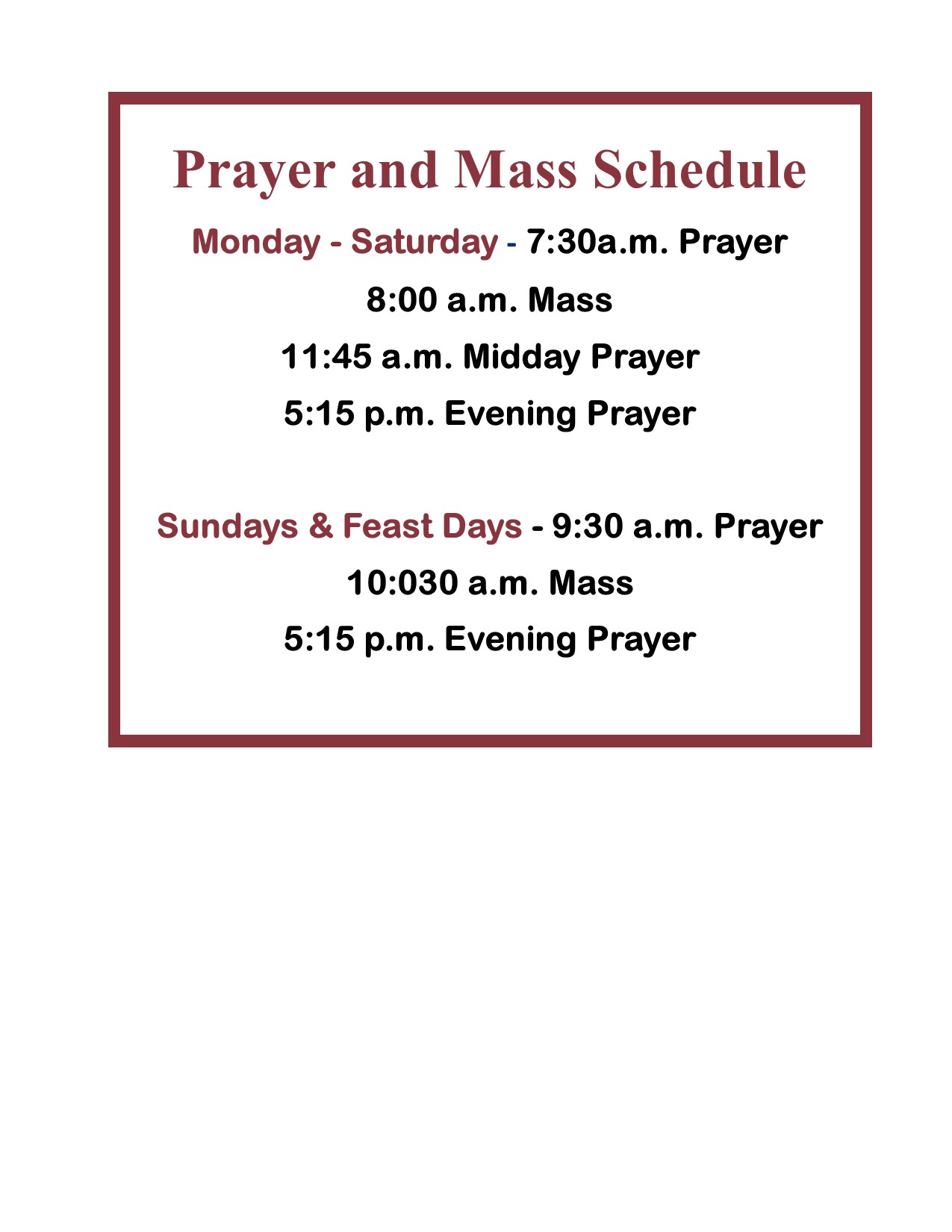
 Mass Schedule

Related Links

Copyright © 2026 · Benedictine Sisters of FL · Touching Lives Through Prayer and Service

Copyright © 2026 · Bendedictine Theme on Genesis Framework · WordPress · Log in