• Skip to primary navigation
  • Skip to main content
  • Skip to footer
Benedictine Sisters of FL

Holy Name Monastery
Founded 1889

Donate Now
  • Home
  • About Us
    • History
    • Being Benedictine
    • Benedictine Monasticism
    • Meet Our Community
    • Holy Name Academy-Alumnae
  • What We Do
    • Mission, Vision and Our Partners
    • Invitation to Retreat
    • Accommodations
    • Volunteer Programs
    • Oblate Program
    • Spiritual Direction
    • Aqua/Hydroponics
    • More of Our Ministries
  • What’s Happening
    • Articles of Interest
    • Events
    • Newsletters
    • Brochures
    • Links
  • Support Us
    • Gifts of Support
    • Wish List
  • Stories Shared
  • Galleries
    • Photos
    • Videos
      • Benedictine Sisters of FL Videos
      • Other Videos
  • Contact Us

Articles of Interest

Do You Recognize the Shepherd’s Voice?

May 14, 2019 by Holy Name Monastery Leave a Comment

Sunday, May 12th is designated Good Shepherd Sunday, a day of prayer for vocations.  We will certainly continue to pray for vocations to church ministries and for an increase in membership in religious communities.  In addition to that prayer, our community weekly intention is an intercessory prayer for MOTHERS – including all who mother others…  which in today’s society of broken families many daddies, too, serve in the role of both “mother” and “father” to their children.

The brief Gospel (just read) reveals Jesus as our unique “parent” – mother and father – our good shepherd.  Jesus is our means to salvation – the “sheep gate,” the gateway, the threshold to eternal life.  Jesus is the selfless, caring “shepherd” who provides protection and life itself.  How consoling and reassuring his words: “No one can take you out of my hand.  My Father, who has given you to me, is greater than all, and no one can take you out of my Father’s hand.”

A good shepherd’s life is not an easy one – the shepherd must be vigilant at all times, willing to keep the sheep close together (in community), lead them to green pastures and set a good pace sensitive to their endurance.  Jesus explains the difference between the concerned shepherd and the hireling.  The hireling is there only for the paycheck.  When trouble comes, he runs away and leaves the sheep to be devoured by the wolves.  The good shepherd, on the other hand, the shepherd who owns the sheep, has a vested interested in their welfare.  Therefore, the good shepherd is willing to pay any price to protect the sheep, even if it means that he has to give His very life for them.  Christ, the Chief Shepherd, knows our individual weaknesses and failings and watches over us with discerning love and sympathetic understanding.  With infinite concern He notes the doubts, fears, trials, conflicts, and defeats that disturb our peace, and He swiftly comes to our aid.

You’ve probably seen the painting titled “His Master’s Voice.”  It depicts a dog, looking with a cocked head, into an old gramophone.  It’s an apt symbol of what Jesus is saying to us or Benedict’s call to heed the voice of the Master.  Hear what Jesus says: “The sheep listen to his voice.  He calls his own sheep by name and leads them out.”

The spiritual writer, Tony Campolo tells the story of a census taker who went to the home of a rather poor family in the mountains of West Virginia to gather information.  He asked the mother how many dependents she had.  She began, “Well, there is Rosie, and Billy, and Lewella, Susie, Harry, and Jeffrey.  There’s Johnny, and Harvey, and our dog, Willie.”  The census taker interrupted her: “No, ma’am, that’s not necessary.  I only need the humans.” “Ah,” she said.  “Well, there is Rosie, and Billy, and Lewella, Susie, Harry, and Jeffrey, Johnny, and Harvey, and….”  At this the exasperated man interrupted, “No, ma’am, you don’t seem to understand.  I don’t need their names I just need the numbers.”  To which the old woman replied, “But I don’t know their numbers.  I only know them by name.”

Sounds like Jesus in today’s Gospel – Jesus says the good shepherd knows his sheep by name.  Although there may be several flocks sharing the same sheepfold, when the shepherds walk up to the gate and call their sheep, each one instantly recognizes the voice of its own shepherd or shepherdess.  When they hear the familiar voice, they instinctively follow (they are led and they follow, they are not driven, that’s for goats).  They will ignore the voice of a shepherd other than their own.  We will hear many voices competing for our attention, but there is a special note to the voice of Jesus that demands our immediate and full attention.

To the untrained eye, the individual sheep in a flock may all look alike.  A good shepherd, however, can tell them apart — often because of their defects and peculiar traits.  A man who was tending a large flock explained it this way: “See that sheep over there? Notice how it toes in a little.  The one behind it has a squint; the next one has a patch of wool off its back; ahead is one with a distinguishing black mark, while the one closest to us has a small piece torn out of its ear.”  Jesus says: “I know my sheep and they know me.”  (Reminds me of how we can detect who is coming down the hall by the sound of her footsteps.)

A man in Australia was arrested and charged with stealing a sheep.  But he claimed emphatically that it was one of his own that had been missing for many days.  When the case went to court, the judge was puzzled, not knowing how to decide the matter.  At last, he asked that the sheep be brought into the courtroom.  Then he ordered the plaintiff to step outside and call the animal.  The sheep made no response except to raise its head and look frightened.  The judge then instructed the defendant to go to the courtyard and call the sheep.  When the accused man began to make his distinctive call, the sheep bounded toward the door.  It was obvious that he recognized the familiar voice of his master.  “His sheep knows him,” said the judge. “Case dismissed!”

There is no question that Jesus is our Good Shepherd.  The only question that remains at this point is this: Do you know the Shepherd? Do you recognize His voice?


~Reflection by Sister Roberta Bailey, OSB, Prioress
First Reading:           Acts 13: 14, 43-52                      Second Reading: Revelation 7:9, 14b-17
Gospel: John1o: 27-30
Continue Reading

Filed Under: Blog, Front Page, Homily Tagged With: Chief Shepard, Father, good shepard, Gospel, Jesus, Mothers, sheep, Shepard

Foregiveness

May 7, 2019 by Holy Name Monastery Leave a Comment

PRAYER: “I know that God won’t give me anything I can’t handle.  I just wish He didn’t trust me so much.”  (Saint Teresa of Calcutta)


This past Thursday our nation celebrated the National Day of Prayer.  The Bill for the observance was initiated by Conrad Hilton, (founder of Hilton hotels) and was signed into law in April 1952 by President Truman.  Here’s an interest note: the president of the U.S. is required by law to sign a proclamation each year, encouraging all Americans to pray on the first Thursday in May.

Thinking about “prayer” – (but not directly connecting it to the Gospel just read) I find it curious that the disciples ask Jesus to teach them to pray “just as John taught his disciples.”  They wanted the words, didn’t they, for certainly Jesus had given them an example of prayer.  He had modeled time alone, told them to “go to your room and pray,” raised his eyes, hands and voice in intercessory prayer before miraculous healings.  But they, like we, wanted “the words to say.”  We forget sometimes that when we descend into our hearts in silent waiting that it is there we meet the Spirit who is already praying within us.

We look for “words,” don’t we … in a prayer book, on a holy card, in the life of a saint ….  We look for a guide, a director, a mentor.  I don’t mean to belittle the worthwhile role these companions play in our lives which is often critical to our spiritual growth and our salvation.  We just need to keep in mind, and really believe, the tremendous role that Scripture plays in our lives.  Jesus promised: “The Spirit of Truth will show you all things.”  St. Paul reminds us: “If you do these things you can be saved: be joyful at all times, pray without ceasing and give thanks for all things.”

Let’s look for a few minutes at the shortened version of what we call the “Lord’s Prayer.”  In it we pray “give us each day” EACH DAY – not a train load of blessings to last us all year – just today’s help, Lord, that’s all I am asking … not even tomorrow’s help … just get me through today – I trust you will be there tomorrow – even when I feel like Mother Teresa once prayed: “I KNOW GOD WON’T GIVE ME ANYTHING I CAN’T HANDLE …  I JUST WISH HE DIDN’T TRUST ME SO MUCH.”

In Luke’s version of the Lord’s Prayer, have you noticed the difference in the phrase regarding forgiveness?  We pray, “forgive us our sins for we ourselves forgive everyone in debt to us.”  A strong, firm statement of my willingness to forgive everyone.  In the traditional version we pray: forgive us our debts, or trespasses, as we forgive our debtors…”  It sounds as if God’s forgiveness to me is measured by my willingness to forgive others.

I like Luke’s version even while I feel it is a greater challenge.  I commit, I promise: I will forgive EVERYONE who is in debt to me.  No willy-nilly “this one I forgive but not that one, at least not today.”  When we pray Luke’s words we vow “I forgive EVERYONE.”  Think of that the next time you pray the Our Father … at Mass or in private prayer, you are agreeing to forgive EVERYONE.  What a huge and freeing commitment.

And we promise to do it day after day after day.  Repetitious practice isn’t just what we may have told our mothers seemed “stupid” and useless. Things like making the bed that we are only going to rumple up in a few hours or doing the dishes after every meal instead of collecting them until the cupboard is bare or cleaning the toilet that someone is going to mess up the minute I leave the bathroom.  Repetition perfects, and makes permanent skill in music, in handwriting, in the acquisition of good, or bad habits.  And, in the repetition of daily chores (even the tasks only God sees) there is a meaningful expression of hospitality to myself and my companions.  In the repetition of the Psalms, of favorite prayers, and liturgical actions there is a meaningful acknowledgment of our creaturely participation in God’s creative act, day after day, after day.

So, we pray day after day for vocations, for peace, for relief from suffering and war and for a forgiving heart.  Through our community and personal prayer we feed not only our own spirits, but we are, so to speak, attached by a spiritual cord to everyone we have ever come into contact with. We feed ourselves spiritually, and we also nourish all those contacts through our prayers.  Our prayer is universal.  We forgive everyone who is in debt to us.   Note, in Luke’s memory Jesus did not say “everyone to whom we owe a debt” … rather those who are in debt to us.  Who would that be?  And, why would someone be in debt to me?

~Reflection by Sister Roberta Bailey, OSB, Prioress


First reading Acts 5:27-32, 40b-41 Second Reading Revelation 5:11-14
Gospel John 21:1-14
Continue Reading

Filed Under: Blog, Front Page, Homily Tagged With: forgiveness, God, Gospel, Jesus, Lord's prayer, Mother Teresa, Prayer

Divine Mercy

April 30, 2019 by Holy Name Monastery Leave a Comment

Divine Mercy Sunday (April 28, 2019)

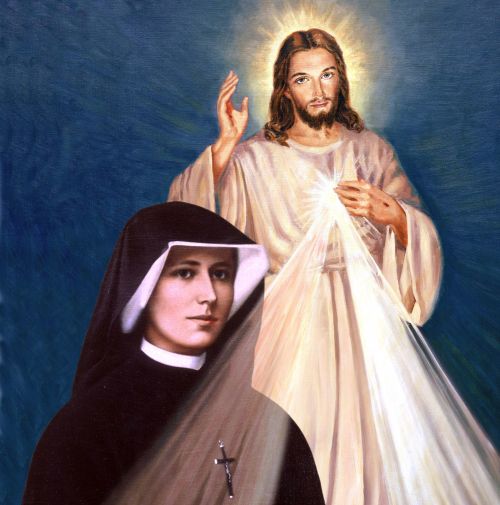
This past weekend we celebrated Divine Mercy Sunday. That raises a question: How can we learn mercy if we never see mercy in action?  That thought alone should be an impetus to model a spirit of mercy in all our interactions.  Mercy isn’t weakness – it takes patience, insight, control of your tongue, a peaceful spirit to be merciful.

The celebration of Divine Mercy Sunday is a relatively new addition to our church calendar.  It was first promulgated by Pope John Paul II in 2000, the day that he canonized Saint Faustina.  Christ appeared to a Polish nun, Sister Maria Faustina Kowalska, in a series of visions that took place over almost eight years.  In one of the visions, Christ asked Sister Faustina to pray for nine days, beginning on Good Friday and ending on the Saturday after Easter—the eve of the Octave of Easter.  Thus, since the 9 days of a novena are commonly prayed in advance of a feast, the Feast of Divine Mercy—Divine Mercy Sunday—was born to be celebrated at the close of Easter Week.

Sister Faustina is quoted from her diary: “Oh, if only all souls knew who is living in our churches?”  This belief is a taste of what Thomas experienced when, in his presence, Jesus appeared the second time to his disciples.  Thomas was invited to “touch and believe.”  He recognized Jesus, his doubt was vanquished, and he professed his belief in Christ. “My Lord and my God.”

Do we recognize the Christ among us?  When the Eucharistic minister looks you in the eye and greets you: “Body of Christ.  Blood of Christ” is our AMEN simply a rote, expected response?  What about when you are the Eucharistic minister?  Does your greeting to the communicant, “Body of Christ” convey your belief that, “Yes, THIS is the Body of Christ.”  But more than that, YOU are the Body of Christ; I am the Body of Christ?  Does our AMEN to the greeting signify a true conviction that “yes, you and I are Christ for each other?”  If we cannot greet Christ in each other, how will we recognize Jesus at the pearly gates?

Thankfully, there is a trend today among media services to make an effort to balance stories of horror and tragedy with illustrations of mercy.  For many people there are two stories that continue to stand out – the story of the Amish community that walked to the home of the man who had killed 5 (five) of their children to tell his widow they forgave her husband for what he had done, and they consoled her for the loss of her spouse.  They buried their anger before they buried their children.  Today on the wall of the community firehouse is a watercolor of the schoolyard painted by a local artist.  Its title is “Happier Days,” and it depicts the Amish children playing without a care before the shooting.  Five birds, which some say represent the dead girls, circle the blue sky above.

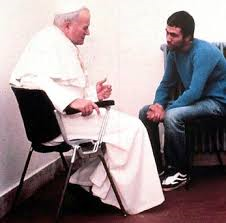
The other well-known story of forgiveness, you may recall, was depicted on the cover of TIME magazine 1984.  It pictured a prison cell where two men sat on metal folding chairs.  The young man wore a black turtleneck sweater, blue jeans and white running shoes.  The older man was dressed in a white robe and had a white skullcap on his head.  They sat facing one another, up close and personal. They spoke quietly to keep others from hearing the conversation.  The young man was Ali, an attempted assassin; the older man was Pope John Paul II, his intended victim.  The pope held the hand that had held the gun whose bullet had torn into his body.  At the end of their 20-minute meeting, Ali raised the pope’s hand to his forehead as a sign of respect.  John Paul shook Ali’s hand tenderly.

In the cell, unseen in the picture, were the pope’s secretary and two security agents, along with a still photographer and video camera man.  John Paul wanted this scene to be shown around a world filled with nuclear arsenals and unforgiving hatreds.  When the pope left the cell he said, “What we talked about must remain a secret between us.  I spoke to him as a brother whom I have pardoned and who has my complete trust.”  John Paul’s deed with Ali spoke a thousand words.  The scene of John Paul and Ali has become an icon of living mercy.

John Paul II and the Amish Christians teach us that forgiveness is central and that God depends on us to extend forgiveness to other people.  That’s what the mercy of God is all about.  Take some time this week to recall when God’s mercy has come to you through the graciousness of another.  How are you being called to share God’s mercy?

~Reflection by Sister Roberta Bailey, OSB, Prioress

Have a good week!

May 3 we, the Benedictine Sisters of Florida, mark Employee Appreciation Day, employees are invited to a luncheon in their honor and then have the rest of the day (paid) off… that means the cooks goes home too… But we also have a tradition now for about 7 years… a handful of volunteers take over the kitchen and provide an evening meal of a fish dinner with all the trimmings… always a good time.

And this year we have a newly screened-in porch off the dining room to “spill out” into… mosquito-free… The screen project was funded through an inheritance we received from a lady who had included us in her estate planning … God bless her and may she rest in peace…  imagining her looking down I can hear her saying: “it’s about time!”                                                                                                                                          Sister Roberta

Continue Reading

Filed Under: Blog, Front Page, Homily

Ask Yourself: Am I a mirror or a window?

April 16, 2019 by Holy Name Monastery Leave a Comment

I like this Gospel story from Luke – used on Palm Sunday for the Blessing of the Palms.  I find Jesus’ directive intriguing – has an ESP flavor.  The first reading in the Mass for tomorrow, from Isaiah tells me: “Morning after morning God opens my ear that I may hear.”  We know Luke wasn’t there on the first Palm Sunday or at the last supper.  So, this is an incident that he recalled his friends telling him.  His ear was open to hear their story and recognize its significance.

And, it’s a challenging one …  “Go into the village and immediately you will find an ass tethered, and a colt with her.  …  Untie the animals and bring them here to me.”  What a story of trust: Jesus trusts that the disciples will do exactly what he tells

them.  The disciples trust that what Jesus asks them can be done … for He never asks of us something that can’t be done.  The owners of the donkey and the supper room trust the disciples’ honesty in their request.  What implicit trust these men had in Jesus: you’ll see an ass, a donkey – take it.

In another gospel the story continues: Follow the man with the water jar – most likely a servant – to the house he enters – and ask the owner where the feast is being held or where we can prepare it.  The title “The Teacher” conveyed all the man needed to hear.  When Jesus comes to St. Leo looking for a place to eat a Passover meal with friends, do I open my door to say, “Come In – the place is yours – stay as long as you like?”

It reminds me of an old fable about the colt that carried Jesus on Palm Sunday.  It seems the colt thought that the reception was organized to honor him.  “I am a unique colt,” the excited animal thought.  When he asked his mother the next day if he could walk down the same street alone and be honored again, his mother said, “No, you are nothing without Him who was riding you.”  Five days later, the colt saw a huge crowd of people in the street.  It was Friday, and the soldiers were taking Jesus to Calvary.  The colt could not resist the temptation of another royal reception.  Ignoring the warning of his mother, he ran to the street, but he had to flee for his life as soldiers chased him and people stoned him.  Thus, the colt finally learned the lesson that he was only a poor donkey without Jesus to ride on him.

In the Gospel story, at least this time around, it appears what Jesus wants – Jesus gets!  At least today …  this time – but not for long.  Or, do I have that wrong?  Jesus may not have wanted the suffering (afterall he was human and could experience all our feelings of dread) but he does want what His Father wants – a procession with pomp and circumstance through the city streets, an event that shook the whole city.  The actual “quake” came later.  This is a foreshadowing of the quake that will shake the whole world 5 days later – at Jesus’ crucifixion.  Today, a procession with all the hoopla that surrounds a parade; five days later we witness a procession of ignominy with Jesus dragging a heavy cross.

I am reminded of another Palm Sunday story.  A little boy was sick and wasn’t able to go to church on Palm Sunday.  When his dad came home with a palm branch, the boy asked about it.  “Well, you see,” said his dad, “when Jesus came into town, everyone waved palm branches to honor him; so we got palm branches today at church.”  The child grimaced and responded “Wouldn’t you know it!  The one Sunday I can’t go to church, and Jesus shows up!”

Everyday concerns and obligations may fill the first few days of the coming week, but when the sacred Triduum opens on Thursday evening, let’s endeavor to personally and communally contribute to an atmosphere of quiet, solemn reflection …  to set a tone that says something of great religious significance is underway.  Let us be contemplative windows into the story we commemorate – an expression of gratitude, a repayment – or a paying forward, for Jesus’ expression of GREAT love for us!   Recall the story of the donkey.  As we enter Holy Week, let us examine our lives to see whether we carry Jesus and bear witness to him through our living or are we Christian in name only.

Tomorrow when we follow the palm-decorated cross in procession into the chapel…  or maybe later in the day when you weave a cross with your palm branch, ask yourself: “Am I a mirror or a window?  Do I reflect values or reveal them?  Am I opaque or translucent glass?  Is my life stained with the magnificent colors of God’s touches or filled in with more and more chunks of dulled or muted, blackened or smudged – ill-shaped light-resistant challenges to God’s voice?”

~Reflection by Sister Roberta Bailey, OSB, Prioress


First Reading:  Isaiah 50: 4-7  Second Reading: Philippians 2: 6-11
Gospel: The Passion According Luke 22:14—23:56
Gospel for Blessing of Palms Luke 19:28-40
Continue Reading

Filed Under: Blog, Front Page, Homily Tagged With: ass, donkey, Gospel, Jesus, Luke, mirror, Palm Sunday, quake, supper, window

Judgement vs Judgmental

April 10, 2019 by holyname Leave a Comment

During World War II, from 1941 – 1944 Oxford University theology professor C.S. Lewis published a series of three pamphlets: “The Case of Christianity,” “Christian Behavior,” and “Beyond Behavior.”  A BBC radio producer had read an earlier book that impressed him by the same C.S. Lewis and invited Lewis to give a series of talks based on the material in the pamphlets. In 1952, the talks were compiled and adapted for publication in the book we know as Mere Christianity. Herein is the quote that (I believe) relates to today’s Gospel story of the meeting between Jesus and a woman accused of adultery. In Lewis’ words:

     “If anyone thinks that Christians regard unchastity (sexual sin) as the supreme vice, he is   quite wrong. The sins of the flesh are bad, but they are the least bad of all sins. All the worst pleasures are purely spiritual: the pleasure of putting other people in the wrong, of bossing and patronizing and spoiling sport, and backbiting; the pleasures of power; of hatred. That is why a cold self-righteous prig who goes regularly to church may be far nearer to hell than a prostitute. But, of course it is better to be neither!”

Jesus never says: Don’t judge. That would be a denial of our human nature and a gift from God – and what God makes is all good. What Jesus warns us against is jumping to conclusions and judging others’ motives – being judgmental. (“I know why she/he did that!”) There is a significant difference between making a judgement and being judgmental. People make judgements all the time; it’s part of a balanced personality. It’s how we decide what constitutes a good or inappropriate choice. It’s how we are able to make clear decisions and avoid potentially dangerous ones. It helps us help others who come to us with a problem or a dilemma.

On the other hand, judgmentalism is a defensive stance. It makes us feel superior and protected, safe from being hurt by the other by pointing out his/her faults.

You’ll know you are slipping into judgmental mode if:

  • You assign motives and skip right to conclusions.
  • You struggle to tolerate ambiguity and uncertainty.
  • You’re generally pessimistic about life and you believe people are with ‘good’ or ‘bad’.
  • You struggle to see the beauty in others.
  • You are anxious and intolerant when you’re around people who are different from you.
  • You’re suspicious and untrusting; have a strong inner critic who judges you.

Did any of that list make you cringe? Be honest: did you get any uncomfortable feelings … did any symptoms raise your hackles? When you are tired, feeling overworked or overly busy, the tendencies will be worse. We seek to protect ourselves, inflate our ego with false self-worth and disown our own faults. This points back to our own feelings of low self-worth. The more you are rejecting of yourself – the real you – the more you will tend to reject others.

So, what to do? Self-talk can work wonders. When you are feeling upset, depressed, insecure or anxious, pause and focus on your inner talk. Accept the messy parts of yourself – be realistic – accept that you are human. But be wary of thinking: That’s just the way I am – they’ll just have to accept that!  Take care of your health, remove toxic people and situations from your life, do one self-loving thing each day: sit in the sun, read a book, seek out conversation with a friend, shampoo your hair, absorb the sunset … do something that makes you happy. Work on showing compassion rather than judging – look beneath the other’s behavior … where is the inner pain? Is there, perhaps, fear or sadness?

It is a curious twist in the Gospel story that Jesus is the only one who is qualified to stone the woman (He is the one without sin). And, he didn’t do it. According to the law, two witnesses were required for a death sentence. And, all the so-called witnesses had disappeared. Jesus wasn’t the one who had brought the charge against the woman. You’ve read that saying – “Every saint has a past; every sinner has a future?”  So, “case dismissed” – the woman is free to go.

Fifth Sunday in Lent – April 7, 2019

Ezekiel 37:114               Romans 8:8-11               John 8:1-11

Reflection by Sister Roberta Bailey, OSB


Continue Reading

Filed Under: Blog, Front Page, Homily

The Prodigal Son

April 2, 2019 by Holy Name Monastery Leave a Comment

This Gospel says that while away the prodigal “came to himself.”   Developmental psychologists say that some young people need to reject their conventional faith (e.g. of their family) in order to come to their own faith.

Put another way, at least some may need to go to “a distant land” in order to “come to themselves.”  Note that the second son who stayed home also had his rebellion from conventional faith as he talks back to his Father, refusing to go to the feast.

Rather than having failed, parents of prodigals or rebels may have succeeded – in giving their young person the confidence to leave home to spread their wings and find their own faith.  You’ve probably heard the saying: “If you love something set it free, if it returns it was meant to be, if it continues to fly let it soar, and have faith that God has something better in store.”  And another one: “Sometimes, you just have to take the leap, and build your wings on the way down.”

The gospel suggests that the Prodigal Parent is on the look-out for their wandering child, scanning the horizon, hoping against hope for their return.   Upon sighting their child, the parent’s heart is “filled with compassion” and rushes out to welcome the one for whom they have yearned and prayed.   “Prodigals” of all ages need to know that we are hoping for their return and that they will always be welcome home – with open arms.

Our Gospel shows us the difference between “coming home” and a “home-coming.”  The son approached in fear and trepidation; the parent flung aside any resentment and ill-will.  The child was coming home to he knew-not-what kind of a reception.  The parent threw a spontaneous homecoming party.

The Parent welcomed and embraced the Prodigal before an apology crossed his lips.  What a picture of unconditional love!  Our diocesan motto “Live the Gospel Courageously” includes the theme of welcome to all, Saints and Sinner alike.

It doesn’t matter if prodigals don’t return to our particular expression of faith within God’s family.  We hear the expressions “fallen away Catholic” or “lapsed Catholic.”  We remain hopeful that they will make their way home to God.  The path may not be ours.  We pray that the good values that were instilled and modeled for them over the years – will sustain their journey, whatever road they take.  And, we pray that we remember: true “forgiveness” is present long before the embrace of a homecoming.

The waiting father, the renegade son and the “look at how good I have been” son … all knew peace at the end of the day.  The father seems to have completely forgotten his agitation, worry and concern as peace overwhelms him at the return of his younger son.  That wayward son must have been so very relieved at the response of his father that peaceful gratitude must have washed over him.  I suspect that the older brother forgot to sweep at his own front door – yes?   What peace must have invaded his attitude as his father – and younger brother – assured this embarrassed, humbled fellow of their never-ending love.

We believe Benedict when he says that seeking peace is the way to heaven – heaven in the after-life and a little bit of heaven here on earth.  In the Prologue to Benedict’s Rule we find the admonition: “If you wish to have true and eternal life, keep your tongue from evil and your lips from speaking deceit; turn from evil and do good; seek PEACE and pursue it.”  Another translation says, “seek peace and go after it.”  That conjures up quite an image…  dashing out of the chapel, into the dining room, down the halls, out the door, into the neighborhoods, climbing God’s holy mountain pursuing PEACE – never abandoning charity nor giving a false peace, peacefully performing whatever duties are entrusted to us, ensuring we have made peace before sundown.

Let us renew our commitment to make PEACE more than a concept that we talk about … let us make a daily pledge to be people of peace, to be a peaceful people.   Make each day an echo of what Paul tells us in the second reading: “the old things have passed away; behold new things have come….  We have been reconciled through Christ and (this is the punch line) WE HAVE BEEN GIVEN A MINISTRY OF RECONCILATION.”

~Reflection by Sister Roberta Bailey, OSB, Prioress


4th Sunday in Lent (March 31, 2019)
Joshua 5:9a; 10-12      2 Corinthians 5:17-21     Luke 15:1-3; 11-32


Continue Reading

Filed Under: Blog, Front Page, Homily Tagged With: Benedict, catholic, God, Gospel, Prodigal, Prodigal child

  • « Go to Previous Page
  • Page 1
  • Interim pages omitted …
  • Page 105
  • Page 106
  • Page 107
  • Page 108
  • Page 109
  • Interim pages omitted …
  • Page 132
  • Go to Next Page »

Footer

Prayer / Newsletter / Info

 Contact Info

Benedictine Sisters of Florida

PO Box 2450
12138 Wichers Road
St. Leo, FL 33574-2450
(352) 588-8320
(352) 588-8443

 Mass Schedule

Related Links

Copyright © 2026 · Benedictine Sisters of FL · Touching Lives Through Prayer and Service

Copyright © 2026 · Bendedictine Theme on Genesis Framework · WordPress · Log in