• Skip to primary navigation
  • Skip to main content
  • Skip to footer
Benedictine Sisters of FL

Holy Name Monastery
Founded 1889

Donate Now
  • Home
  • About Us
    • History
    • Being Benedictine
    • Benedictine Monasticism
    • Meet Our Community
    • Holy Name Academy-Alumnae
  • What We Do
    • Mission, Vision and Our Partners
    • Invitation to Retreat
    • Accommodations
    • Volunteer Programs
    • Oblate Program
    • Spiritual Direction
    • Aqua/Hydroponics
    • More of Our Ministries
  • What’s Happening
    • Articles of Interest
    • Events
    • Newsletters
    • Brochures
    • Links
  • Support Us
    • Gifts of Support
    • Wish List
  • Stories Shared
  • Galleries
    • Photos
    • Videos
      • Benedictine Sisters of FL Videos
      • Other Videos
  • Contact Us

Blog

Why Care?

October 13, 2017 by Holy Name Monastery Leave a Comment

This parable reminds us that we are all tenants in God’s creation.  All of us have different circumstances, gifts, and resources that were given to us by God not just for our own sakes.  They are gifts from God to allow us to work on His behalf to the best of our abilities and circumstances.  It seems to me this parable is perfectly timed in the church year to coincide with the Fall planting season as well as St. Francis Day celebrations.  The parable speaks of stewardship on a variety of levels even though it was originally aimed at a congregation that never heard such language.  We are the “other tenants” to whom the “vineyard” has been given when it was given to us when Jerusalem lost it due to mismanagement.

So, it seems to me to appropriate to spend a few minutes reflecting on our individual efforts at practicing stewardship, care for the earth, ecology, the environment and climate change in light of the words in our creation story: God saw that it was good.”

Why should we care about creation?  It’s a good question.  Some may react: Aren’t people more important than nature?  Doesn’t taking care of the earth distract from sharing the Gospel?  Isn’t earth care just a liberal political issue?  Shouldn’t I be more concerned about other causes?  If we turn the conversation on its head we’ll see an entirely different viewpoint.

First of all, we should care about creation because it brings glory to God.  From the very beginning, in Genesis, we read that God looked at creation and said this is “very good.”  Scripture depicts praise to God coming from trees, fields, the seas; the sun, moon and stars; lightning, hail and snow; wild animals, cattle, birds and all the creatures of the earth.  If these bring glory to God, then who are we to carelessly destroy them?  Why care?  Because caring for God’s creation means caring for that which brings God praise and worship.

Second, we care about creation because doing so helps other people.  The second greatest commandment is to love your neighbor as yourself.  The majority of major world problems today are rooted in environmental issues.  For example, polluted drinking water and deforestation all play a significant role in increased poverty, hunger, and human trafficking.  The bottom line is that caring for God’s creation produces positive results for people.  Why care?  Because God calls us to put the needs of others before our own needs.

Third, environmental issues are ethical issues.  The way that we treat the earth reflects our values.  There are ethical questions that directly correspond to environmental issues, and like it or not, the world is watching to see how God-fearing, God-loving persons respond.  By living out of our corporate commitment to feed the hungers of the people of God we have a powerful opportunity to “be Christ” to a needy world.  Why care?  Because as Benedictines, as Christ-followers we aim to do what is right and wish to point others to God through our individual and communal living.

Fourth, we should care because God told us to.  One of the first directives in Scripture is to do what God told Adam and Eve: tend and keep the garden.  In creating us in his own image, God gave us a great privilege, and a great responsibility.  Why care?  Because God’s Word told us to care.  Beyond that, as Benedictines we live with Benedict’s reminder to keep all things that belonging to the monastery clean and regard all goods as sacred vessels of the altar, aware that nothing is to be neglected.

I’m sure there are other answers you could give to the question: Why care?  Simply put, stewardship values extend, through our cooperation, God’s care for creation – the work of the Divine Hand.  A truly caring people strive to look to the needs of others, seek to be educated and react ethically to environmental issues, as Benedict reminds us, without murmuring, to our call to care for the earth.

We can’t do everything, but we can do something.  We can’t do it all alone, but together we can make an impact.  Look at something as simple as recycling bottle caps, aluminum cans and plastic bottles.  We can limited the accumulation of “stuff” we personally create … perhaps only a handful alone but if we each contribute what we’ve used or collected from “around”, look at what we’ve kept from landfills and at the same time contributed to the project of St. Leo students to project to collect funds for purchase of a wheelchair for a needy child.  And we can support our talk with our actions.

We can make an honest effort to consolidate trips to town, wait until we have several errands or passengers for the trips we do make.  The gas we save, the wear and tear on the car may seem minimal but the “minimals” add up, just like pennies and coins in a jar where we throw our extra change.  If you wait until Christmastime to count and wrap them … well – it makes a tidy contribution to the gifts for the elderly.  If not all the time at least some of the time.  If not in all ways, at least in some ways.  We can take baby steps that turn into hops and skips and then dare to risk giant steps.

Despite the Saint Francis’ and all the statues in gardens, for generations of believers Francis’ feeling for nature has been admired rather than to emulated.  Let us do more than simply admire.  Let us strive to remember God gave us the privilege of caring and tending this garden we call Earth.

I believe we see a glimmer of hope this week that more people are waking up to the reality gun violence and the possibility of nuclear destruction. No one can close their eyes to the devastation of the Las Vegas massacre.  In the wake of that reality, though, we have news on the side of peace.  The Norwegian Nobel Committee has announced their decision to award the 2017 Nobel Peace Prize to ICAN:  the International Campaign to Abolish Nuclear Weapons “for its efforts to stigmatize, prohibit and eliminate nuclear weapons which could destroy the planet.”

ICAN exemplifies the thinking of Dietrich Bonhoeffer, a German theologian martyr: “It is in keeping with being a saint to go beyond the call of duty, to dare to be a bit ridiculous, to be a little more extravagant … to try something beyond the ordinary. Action”, he said, “springs not from thought, but from a readiness for responsibility.”   So let us pray for the insight and courage to dare to be ridiculous and a little extravagant.

~Reflection by S. Roberta Bailey, OSB, Prioress
First Reading  Isaiah 5:1-7   Second Reading  Philippians 4:6-9
Gospel Reading  Matthew 21:33-43
Continue Reading

Filed Under: Blog, Homily Tagged With: creation, earth, environment, Genesis, God, God's creation, other tenants, recycle, vineyard

Actions speak louder than words

October 3, 2017 by Holy Name Monastery 1 Comment


The overriding theme of all of the Mass readings, it seems to me, is “honest sincerity.”  In the Gospel account we just heard the younger brother tell his father: “Yes, I’ll go and work” while the older brother said: “No, not me.” Both used words contrary to their actions.

This an age-old story.  The dynamic happens in families, between friends, in the work force and in monastic community.   The situation Jesus poses is rather straightforward. Two sons are given the same task by their father: one asserts his objection, his intent to disobey right up front, but then in the end obeys his father’s wish.  The second son obeys in his words, but disobeys in his actions. For both, what they say with their words is not in their hearts – the head said one thing; the heart another.

The story reminds us that talk is cheap and actions speak louder than words.  You’ve all heard the phrase: “Don’t just talk the talk; walk the walk.”  Be slow to dismiss these truisms.  We’ve all been hurt by promises given and then broken.  Or, on occasions we have been given words that have hurt us, really hurt us, not because they were nasty but because we relied on them and were later betrayed. Intentions are too often little more than wishful thinking; appearances are deceptive. Being honest and then acting in honesty are sometimes tough things to do. You know where the path of good intentions leads, right?

The question that Jesus poses is pointed and direct: Which son did what the father wanted?  Jesus could ask us the same question. Do our words indicate our obedience to God? If not our words, do our actions? God desires a full conversion of heart, that our actions (and our words as well) will give evidence of our love for God.  The older brother had no intention of working and had the honesty of saying so. He was wrong, but he was honest. The younger brother was the opposite. He said the expedient thing knowing what his father wanted to hear but he had no integrity.

Yes, talk can be cheap. The younger brother simply didn’t live up to his words; the older brother changed his mind. The older brother had integrity; the younger brother gave valueless words to his father while having no intention at all of working.   With which brother do your words or actions identify?

For Benedictines obedience is central – we’ve come to the monastery to hear, to listen, to seek God but to do that we have to be willing to listen and then obey God’s voice as heard in your personal prayer, in the voice of the superior and spiritual guide and in communal discernments and in our interactions with each other.  As Benedict describes it, for those who have chosen to live in cenobitic community, our obedience must be open, prompt and positive, (even if it is painful) and given without murmuring.

We would do well to recall both this gospel story, and Benedict’s words about obeying with alacrity when we are asked to do a favor for one of our sisters or a co-worker.  Do we mumble OK and then put it on the back burner so far back that the pot boils away and the need goes up in the waves of evaporation?  Do you say YES and honestly add “but not right now” and make a sincere effort to perform the action when we said we would?  Are you like the son who said “no can do” but later realize your selfish response and go back to do the favor after all?  Or, do you render the favor but tell the neighborhood about the unfairness of what you had to do?  We know that for Benedict, murmuring was an abomination, anathema, a curse in community and any sign of murmuring was to be censured.

In one of her first books on the Rule, Joan Chittister suggests: “Say to the member who signs up for a task but then complains, please don’t sign up.  Kindly give the community the gift of not murmuring about it.  The rest of the community will get the job done.  Please just stay home and keep a smile on your face.  Don’t do the work and then poison the environment of the house with murmuring.”

Oh, you may think: it’s easy for you to talk about obedience – you’re the prioress, who do you have to obey?   But, think about it, for the monastic leader, actually, any leader, may have some authority with her position, but the power lies in the hands and will of the membership.  Obedience in monastic life is mutual – it springs from the bloom of mutual respect.  Without both there is no community – there is just a group of women living under the same roof.

So, what enables us to mature to a higher level of obedience?   First how do you know what level of obedience is operating in your life?  You may recall Piaget’s and Kohlberg’s stages of moral development – moving from obedience for fear of punishment to the highest stage which some never reach and those who do rarely can consistently operate at that level.  We are at the level of moral maturity where we cease to fully comprehend what the stage description is talking about.  Another insight is how you work on a committee.  How we function in community is also based on our level of moral development.  How you believe a thing ought to be done will say a great deal about where you are on the scale.

Thankfully for all of us, in life growth is always possible – “It isn’t over, til it’s over!”   Another expression may pop to mind: “it ain’t over til the fat lady sings.”    It isn’t how we start that matters, it’s how we finish!

~Reflection by S. Roberta Bailey, OSB, Prioress


Twenty-Sixth Sunday in Ordinary Time, Cycle A   October 1, 2017
First Reading  Ezekiel 18:25-28               Second Reading  Philippians 2:1-Be like
Gospel Matthew 21:28-32        


Continue Reading

Filed Under: Blog, Homily Tagged With: Benedictines, broken promises, God, Gospel, Jesus, Mass readings, obedience

Words can also have an equally powerful ability to bring about healing and reconciliation… something we all need to keep in mind.

August 21, 2017 by Holy Name Monastery Leave a Comment

Today we are with Jesus when he meets a distraught woman with a special needs child.  Maybe you have seen her, too, at the local Publix or Walmart or you might remember the parent of a child in your school, or a child-relative in your family or you’ve seen her trying to shop at Daystar.  This is a mixed breed woman; a foreigner.  Her family has disowned her.  And when she told her boyfriend she was pregnant he fled.

Somehow this courageous woman has survived as a single mother. But, when her daughter began having seizures, gossipy opinions surface: “She deserves what she gets. See what happens when you make the kind of decisions she’s made.”  On top of that she is a woman in a society in which women have no real value or standing.  To make matters worse she’s a screamer with a crazy kid.  Now, she is out of options.

But, she’s heard that a Jewish miracle-worker is passing through the area.  He’s reported to have authority over demons.  She’s tried appealing to all the pagan gods of her culture, but none answered her plea.  Maybe, just maybe, this Jesus is the answer to her prayers.

The woman approaches Jesus, requesting that he heal her demon-possessed daughter.  At first Jesus says nothing.  It appears he is ignoring her.  The disciples ask Jesus to send her away, and Jesus seems to agree, remarking that he was sent to minister to the Jews alone.

But she’s already endured a series of obstacles that would threaten the best of us.  She’s jumped social hurtles to ask a favor of Jesus and she will not be deterred.

She persists, paying homage to Jesus, and yet again Jesus denies her request.  She can’t believe what her hears – is he being rude to her?  Did he really refer to her using a Jewish word of derision for Gentiles, “dog.”  But the woman cleverly turns Jesus’ own words against him.  Only then does Jesus grant her request and heal her daughter.

So, let’s consider why Jesus would lead this mother through a humbling process for pursuing her request.  He stays in conversation with her but seems harsh.  Could it be Jesus used this encounter to help her develop a deep courageous faith that would sustain her for the rest of her life not just this one-time healing?

She is tenacious in her pleading.  With the odds stacked against her, she pushes forward.  When she gets knocked down by life’s circumstances and criticism, she gets back up.  When others told her to quit, to get lost because she was wasting Jesus’ time, she continued to keep Jesus attention.

Notice she referred to Jesus as Lord, acknowledging that He is worthy of praise.  Don’t miss the lesson that she praised Jesus in the midst of her pain.  She is obviously a very humble woman.  Perhaps Jesus had her in mind when he spoke the beatitude “Blessed are the meek, they will inherit the earth.”  Never confuse humility with weakness. Pride would have been offended by the “dog” comment.  Pride would have returned insult for insult, and pride would have gone away empty; without a miracle; without a healthy, whole child.

It’s a nice story but what does it teach us?  Lessons in skilled, reverent, peaceful confrontation; tenacity, humility and focus on the important matter for winning a hearing with a happy outcome.

The past couple of weeks the world has been on edge, at the escalating acts of violence and the war of words between the North Korean regime and President Trump.  The spiraling verbal threats may be the result of mounting public frustration with the lack of solutions to a serious problem but a frightened world cannot dismiss the situation as mere venting of empty words.  Indeed, the harsh language appears to be increasing in the intensity of potential danger of a rash move being made by one side or the other.  The world has seen too many incidents to ignore or downplay words that have had the power to do real damage.  The old adage “sticks and stones may break your bones but words can never hurt you” has long been proven a false premise.  But words can also have an equally powerful ability to bring about healing and reconciliation… something we all need to keep in mind.

Let us remember also in our intentions this weekend the people who are waiting in terror for Monday’s total solar eclipse.  Thousands are gathering for the once in a life time event but others view it as a harbinger of doom.

Heeding the example of the Canaanite woman we must come to stand before God, united in our plea for an end of racism in our country and for peace in our world, for calmness to conquer brashness, humility to counter pride and tenacity to win out over discouragement.

There is a tale told about former President Andrew Jackson.  His childhood friends were reminiscing about their childhood with Andy and expressing surprise at how successful he’d become considering all his flaws – he wasn’t as smart as some and many were stronger.  They recalled how the class bully would throw Andy three out of four times when they wrestled.  A listener asked: “What happened on the fourth time?”

Andy’s friend spoke up: “I guess that was Andy’s secret. He just wouldn’t stay throwed.”

Like the Canaanite woman and Andy, if life circumstances throw you down, don’t stay “throwed.”  You’ve heard it said that Benedictine community life is a series of beginnings.  Like a daruma doll, those weighted-bottom Japanese good-luck dolls, we just keep bouncing upright – as one author put is: we fall down and we get up.  Or as the saying goes: seven times down; eight times up.  So let us stand firm in praying for peace that we may hear the same response Jesus gave to the Canaanite woman: “Great is your faith!  Let it be done for you as you wish.”

~Reflection by Sister Roberta Bailey, OSB, Prioress
20th Sunday in Ordinary Time,
1st Reading Isaiah 56:1, 6-7,
2nd Reading Romans 11:13-15; 29-32,
Gospel Matthew 15:21-28
Continue Reading

Filed Under: Blog, Homily Tagged With: Child, criticism, disciples, Faith, humility, Jesus, pride, Woman

Don’t Just Do Something…

August 7, 2017 by Holy Name Monastery Leave a Comment

Peter’s reaction to Jesus’ Transfiguration reminds me of the story of a young seminarian on summer duty in a parish who walked into the sanctuary of the church and saw Jesus Himself praying at the altar. He alerts the pastor, who alerts the bishop. The bishop tells the pastor that he will have to report this to Pope Francis at the Vatican, and he will call him right back. The phone rings shortly afterward, and the pastor asks what the Pope advised. The bishop replies, “The Pope said — look busy!”

That seems to be Peter’s first impulse at the Transfiguration.  The vision is so awesome and powerful an experience that Peter wants to do anything rather than deal with it. He can hardly believe that right here all in one place at the same time he has Jesus, Moses, and Elijah conversing!   Rather than embrace the moment and bow low in homage he volunteers to go back down to find materials for tents and to haul them back up to the top of the mountain.

We do this sometimes, don’t we?  Our life in the monastery has many blessings, but a distraction-free environment is not one of them. With the intention to spend time in Lectio, we find ourselves being distracted by the impulse to do something useful, anything when we feel the Spirit invading our hearts. Anything from reading more litanies to performing a favor for someone else or cleaning my room.  Anything rather than just be and experience that special closeness with God. It’s a weird kind of defense mechanism; we look for ways to avoid that total intimacy with God, even when we think and say that we desire nothing more.  From previous experiences we’ve learned that, as CS Lewis writes: “There’s such a thing as getting more than we bargained for!” and that scares us. As Father David put it recently, we need to just Waste time with God.

Peter’s impulse to look for something to do isn’t to say that all work is bad. We are called to do our fair share to support our community and to put our God-given gifts to use.  But, at times we substitute busy-ness in our lives to avoid prayer – all the while knowing full well that only through prayer can we be formed in communion with God.  We must conquer the temptation to flee in fright when God finds us.  There is an old saying that applies here: when the Lord speaks to you, don’t just do something … stand there, or sit there, and follow Benedict’s opening word to his followers:  listen.

However we might interpret the impulsiveness of Peter, it is notable that in Matthew’s version of the story (remember he wasn’t there) the voice from heaven actually interrupts Peter, cutting him off in order to pronounce Jesus blessed and then to command the attention of the disciples. Whatever Peter — or we — may have been thinking there is only one thing necessary: to listen to Jesus, the Father’s beloved One.

We can all identify with the apostles because in our mountain-top experiences of joy and consolation we also want to stay. We want them to go on forever. And then in the moments of trial, like the apostles at Jesus’ trial, we want to flee. We tend to forget that our Lord did not promise us a rose garden, but a garden of olives and a crown of thorns. “If anyone will come after me let them pick up their cross daily and follow me.”  Having been to the top of the mountain we know that “nothing can separate us from the love of God made visible in Christ Jesus.”

This evening the closing rite will include Carol’s commitment as a resident volunteer.  All of us have had mountain top experiences and can testify to their importance in our lives.  For Carol, I suspect this may be a mountain-top moment.  There is something awe-inspiring about mountains: clean and crisp air and a panoramic view that raises our minds and hearts to God.   But all of us know that we have to go back down the mountain, to the valley of our everyday lives.  At both places, at the mountain top or in the valley and all those places and times in between, Jesus is there, reaching out to raise us up be our best selves.

At her blessing Carol will be given a copy of our MISSION, VISION, CORPORATE COMMITMENT and CORE VALUES STATEMENT.  It seems like a good time to remind ourselves of what we’ve said in these statements, so a copy is here available for you if you’d like one.

When Jesus and the disciples were walking back down the mountain, Jesus charged them not to tell the vision to anyone until he had been raised from the dead.  Well, Carol, Jesus has been raised from the dead and ascended to his Father, so you are welcome – and we’d even encourage – to tell the vision to anyone that seems like a suitable candidate to be a volunteer or affiliate with the Benedictine Sisters of Florida.

~Reflection by Sister Roberta Bailey, OSB, Prioress
First Reading:  Daniel 7:9–10,13–14      Second Reading:  2 Peter 1:16–19
Gospel: Matthew 17:1–9
Continue Reading

Filed Under: Blog, Homily Tagged With: Elijah, Jesus, listen, Moses, mountain-top, Peter, Transfiguration, volunteer

Wisdom or Action

July 31, 2017 by Holy Name Monastery 2 Comments

An ancient monastic story tells of the holy one who asked his disciples a question about life. “Tell me which is greater,” he said to them, “wisdom or action?” And the disciples answered, “Why, it’s action, of course. What good is wisdom without action?” But the holy one answered, “Ah, yes… but what good is action that comes from an unenlightened heart?”

Stories like this challenge modern thought to the center of the soul. We can forget that every stage of life has both purpose and gift. For the young, the purpose is growth and the gift is possibility—the young give us hope. For the middle aged, the purpose of life lies in generativity and the gift is responsibility—the middle-aged give us direction. But to the older generation, we look beyond the stages of public action for experience and the gift of reflection. As the philosopher Arthur Schopenhauer said, “The first forty years give us the text; the next thirty supply the commentary on it.” Or, so we tell ourselves… But, somewhere along the way, something seems to have shifted. In the world as we experience it now, the elders disappear quickly from the public stage, the middle-aged bear the burden of the system, and the young are the focus of attention. …

The fact is that there is nothing a youth-centered culture needs more than it needs its elders. If ever we are meant to have a real role in life, it is surely now. It is precisely at this stage in life that we discover that our real purpose in life is to understand it, and then to pass that wisdom on. … Youth without insights risks action without wisdom.

Elders have things to give that no other segment of society can possibly match and, in the giving of them, come to see the past newly and the future with new faith. They come to know that the future, whatever it is, is not to be feared. What elders have to give a world worshipping at the shrine of newness and energy is memory, experience, objectivity, wisdom, and vision. They know now what really matters, what life is really about—beyond body-building, money-making, and social standing. …

It is the perspective that comes with age that sees failures as the beginning of growth… and it is spiritual persons who come to appreciate the depths of life more than the cosmetics. When we learn to value experience rather than to avoid it, when we value life more than we do the approval of the social police we harbor in our heads, then we are ready to go on growing. More than that, we are ready to be the role models of the generations coming after us. By living fully and well, we can be an antidote to a society that thinks that being high is the only way to be happy.

—by Sister Joan Chittister, OSB

Continue Reading

Filed Under: Blog, Homily Tagged With: Aging, generations, growth, role models, spiritual, Wisdom, youth

Patches of Dirt or Fertile Soil

July 19, 2017 by Holy Name Monastery Leave a Comment

First Reading  Wisdom 12:13,16-19                    Second Reading  Romans 8:26-27

Gospel (short form)  Matthew 13:24-30

Jesus’ parables aren’t meant to test our human intelligence.  They are moments of grace to ply open our heart’s willingness to surrender to, and be enveloped in, the always surprising generosity of God.

Here on our property, when we look out the window and behold the life cycle of the hay field or blueberry patch, we see first-hand in nature what Jesus is talking about.  He extends the lesson applying it to the human heart.  He reminds us here that there are folks whose hearts are like cement.  It does not matter how much or how often seed is poured on these souls.  Fertilize it, water it – nothing will cause those seeds to take root and sprout.  Listen to church and TV sermons 24/7, they remain unfazed.

Do you remember times you were like this …  not always … but a time or two when you just didn’t want to hear what God might have to say?

In contrast to the hardened-soil person, the shallow-soil person is hyper-responsive to God’s word—but only for a wee tiny time.  Like during a revival or summer retreat.  Don’t be one of these temporary ‘all in’ folks gobbling up every word and reading every book suggested by the retreat director.  But, sometimes the seed eventually sinks in and bursts through the pavement.  And right away, birds or insects snatch the new growth and it never comes to fruition.  It can’t survive the heat of the give and take of daily community life.

When were you like this?  Maybe in the novitiate … or the time in high school when the class made the senior retreat?  God was SO real to you … but God’s voice grew more faint as the days went by?

Then, there is a third type of soil – a thorny type – so tightly entangled with “thorns” that their thorns have become their identity.  Jesus calls these thorns “the cares of the world and the deceitfulness of riches.” Matthew says these people are caught up in anxiety and get choked on the lure of the riches of the world that tug and yank at their minds and hearts until the seed suffocates, rendering them spiritually barren.

When was this the case in your life?  Times when you were just too distracted to cultivate God’s word …  when several days went by without a space for Lectio or healthy self-care – when “thorny” remarks and obstinate behavior was your default mode?  That’s when God planted a general sense of dissatisfaction in the garden of your soul.

Oh, but how gratifying it must be to Jesus when He finds “good soil people” – when we share the time God has given us to meditate on the Word, let it penetrate and bear fruit – then we hold fast to the word making it our own.  Thus we grow more Christ-like over time by absorbing and practicing the precepts of Benedict.  Over the years, as the seeds continue to take root and blossom, the fruits and gifts of the Spirit flourish.  As one author describes Benedictine life: they fall down, and they get up … and fall down and they get up … as they ascend the ladder of humility.

We come not only to know, but to believe deep in our hearts that God can change hard, shallow, compromised patches of dirt into fertile garden soil.  As we read in Ezekiel: “And I will give you a new heart, and a new spirit I will put within you.  And I will remove the heart of stone and give you a heart of flesh.”

Many of us have, or have had, gardens.  And all of us–whether we’re gardeners with a green thumb, or thumbs with only a tinge of green, or only a “wishful” thumb – or a thumb that only knows how to operate a TV remote or a computer mouse — all of us know the principle of planting: when we put a seed in the ground, we expect a plant to appear …  some may even think it will sprout with a flower already on it J . We also know that not all seeds will produce full-grown plants. They just don’t, for a variety of reason.

We don’t have to ever have plowed fields for forty cents a day in order to know the different landscapes of which Jesus speaks. We know the beaten path of our own lives.   We’ve stumbled through the rocky patches of life.  We have been scratched and cut by the thorns of life.  But we have planted our roots deep in the sacred soil of life that feeds and grows us to become a harvest – whether it’s a thirty, sixty or a hundredfold – who’s counting?! – it’s all a harvest!  Given the right conditions apple seeds do become apples.  Mango seeds become mangoes.  God’s seeds become what we allow them to become.

Paraphrasing the words from Deuteronomy, we ask: “let the soil of my heart hear the words of Your mouth.  May Your instruction soak in like the rain and Your word permeate like the dew; like a gentle rain upon the grass and like a shower upon the crops.”

~Reflection by Roberta Bailey, OSB, Prioress
Continue Reading

Filed Under: Blog, Homily Tagged With: fertile, God, God's word, hay, Jesus, seeds, soil

  • « Go to Previous Page
  • Page 1
  • Interim pages omitted …
  • Page 79
  • Page 80
  • Page 81
  • Page 82
  • Page 83
  • Interim pages omitted …
  • Page 90
  • Go to Next Page »

Footer

Prayer / Newsletter / Info

 Contact Info

Benedictine Sisters of Florida

PO Box 2450
12138 Wichers Road
St. Leo, FL 33574-2450
(352) 588-8320
(352) 588-8443

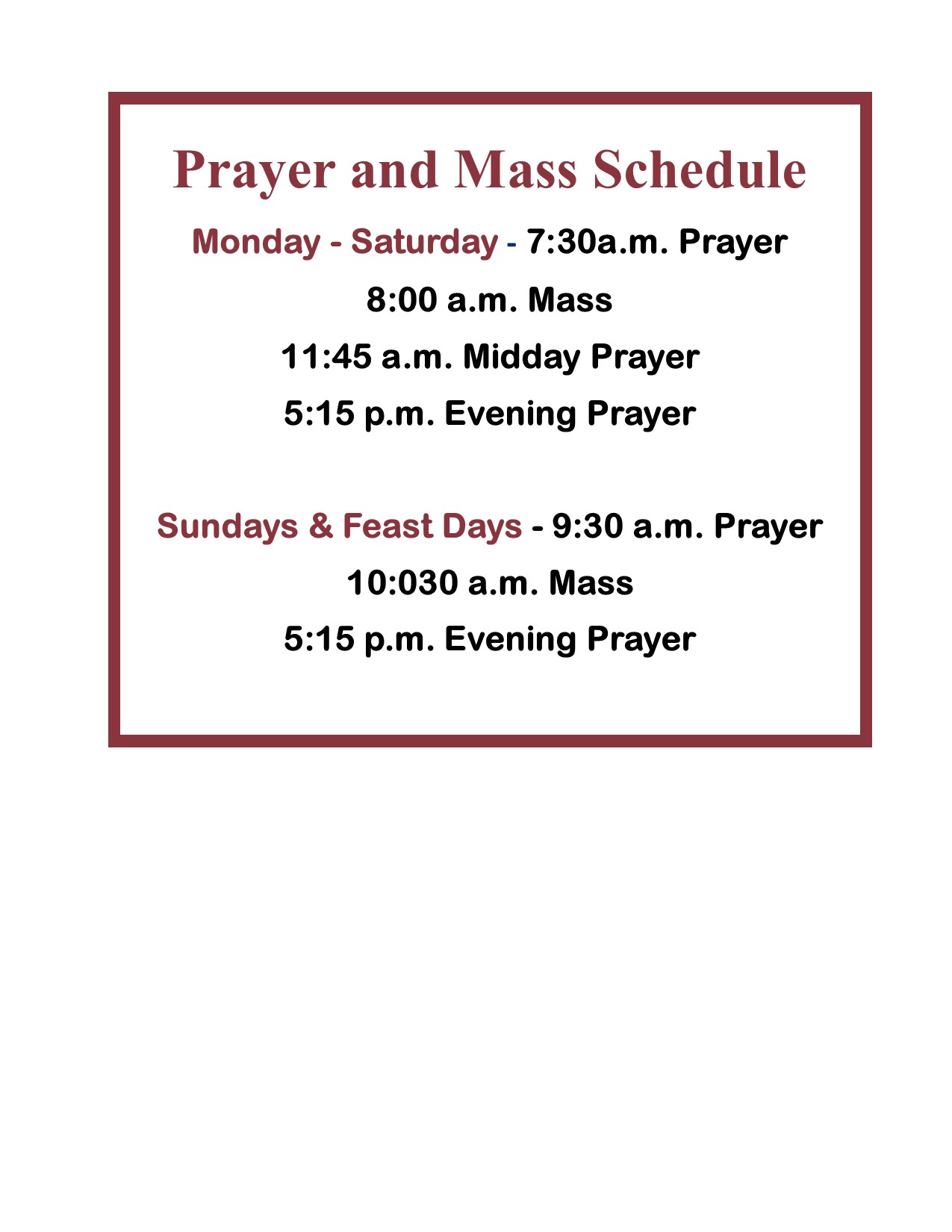
 Mass Schedule

Related Links

Copyright © 2026 · Benedictine Sisters of FL · Touching Lives Through Prayer and Service

Copyright © 2026 · Bendedictine Theme on Genesis Framework · WordPress · Log in