• Skip to primary navigation
  • Skip to main content
  • Skip to footer
Benedictine Sisters of FL

Holy Name Monastery
Founded 1889

Donate Now
  • Home
  • About Us
    • History
    • Being Benedictine
    • Benedictine Monasticism
    • Meet Our Community
    • Holy Name Academy-Alumnae
  • What We Do
    • Mission, Vision and Our Partners
    • Invitation to Retreat
    • Accommodations
    • Volunteer Programs
    • Oblate Program
    • Spiritual Direction
    • Aqua/Hydroponics
    • More of Our Ministries
  • What’s Happening
    • Articles of Interest
    • Events
    • Newsletters
    • Brochures
    • Links
  • Support Us
    • Gifts of Support
    • Wish List
  • Stories Shared
  • Galleries
    • Photos
    • Videos
      • Benedictine Sisters of FL Videos
      • Other Videos
  • Contact Us

Articles of Interest

History Tells the Rest of the Story: WE’RE STILL HERE.

August 23, 2021 by Holy Name Monastery 1 Comment

This incident found in John’s Gospel reminds us that not everyone took to Jesus positively, even those who seemed to be quite close to him.  Some of the people, not unlike today, were murmurers and grumblers – folks not too keen on what they were hearing.  Following Jesus was going to be no picnic (despite the way he’d fed the five thousand people).  The idea of total commitment was a disturbing concept.

We hear it in that sad and haunting verse: “From that time many of his disciples went back, and walked no more with him.”  Obviously hurt by this defection, Jesus turns to Peter and the others who are closest to him and asks them if they’ll be taking off too – “Will you too go away?”  Peter, as was his style so often, seems to speak on behalf of all Jesus’ loyal followers – “Master, to whom would we go?  You alone have the words of eternal life.”  For Peter, at this time, it’s unquestionable – “If Jesus said it, it must be true.”  If you’ve looked ahead to the First Reading, you’re aware the Church reminds us that Jesus’ experience of rejection was not unique.  1500 years earlier, Joshua, disciple of Moses, gives voice to a similar tribulation.  He addresses all the people – “If it does not please you to serve the Lord, decide today whom you will serve.”  The people answer in the same vein as Peter – “Far be it from us to forsake the Lord.”

One of my brother, Bill’s favorite books was This Tremendous Lover by the Irish Trappist monk-priest Eugene Boylan and first published in 1946.  In 2002, I sent him a replacement copy for the one he’d given away.  On his death four years later, it was returned to me.  I had inscribed on the fly page – “Bill, I hope this is as inspirational as you remember.  The bookstore that special ordered for me said it was the last one in the United States.  Imagine that!”  Boylan writes in his book: “Our Lord was not looking for an enthusiastic public reception… his miracles were not a ploy to grasp temporal power.  The wonder of his public life is not the marvelous works He actually did, but the many and more wonderful works which He could have done and did not.  All He did and said and allowed to happen to him was part of the plan.”

What Jesus has to say is so important that he does not consider changing his message to please the people.  In fact, we can accurately say that a “Jesus” who doesn’t offend isn’t the real Jesus.

Our hearts go out to Jesus, and those who stuck with him.  If you have ever had anyone walk out on you, you can empathize with Jesus.  I recall the mixed feelings I had when in the late 60s and early 70s, we had five deaths in one year.  It was not customary for those of us who were away for studies to come home for funerals, so there was a void for farewell until we got to visit the cemetery.  Then what some writers refer as the “Exodus” began to happen when several of our peers felt the calling to leave community.  Some gave us a chance to say good-bye; others quite literally disappeared in the night.  These were good people – some were rising leaders in community.  What did they know that I did not?  My feelings were not of betrayal like Jesus suffered – but confusion and loneliness, yes.  Were the shrinking numbers the handwriting on the wall and I was too blind to read it?  History tells the rest of the story: WE’RE STILL HERE.

What does Jesus do when his ranks shrink?  Does he cajole the people, “Oh, I’m sorry that what I said was so hard to take.  Maybe we can compromise.”  Not at all!  Jesus does not let human opinion sway his proclamation of divine truth.  “The words I have spoken to you are spirit and they are life.”

When God asked Aaron why he built the golden calf, his only defense was, “The people made me do it.”  What was Peter’s knee-jerk response a couple years later.  Remember when Jesus was on trial?  The inquisitive young girl asked him if he was one of Jesus’ followers?  Peter’s leadership in the upper room was easy, he was with friends.  But outside the rank and file of unfamiliar faces he fell apart.  Which life-style will you lead – people’s opinion driven, or God-focused?

If our ears are open to the voice of the Spirit, we hear daily Jesus’ quizzing us, “Who do people say I am?”  He asks us, like he does all his friends about our personal conviction – “Who do you say I am?”  The question also comes to us as a community.  Are we swayed by “public conviction” forming the community we think the public wants us to be?  Or are we formed by “personal and communally discerned convictions” – helping to lead the world where it needs to go?

~Reflection by Sister Roberta Bailey, OSB


First Reading:   Joshua 24:1-2a, 15-17, 18b          Second Reading:   Ephesians 5:21-32
Gospel:   John 6:60-69
Continue Reading

Filed Under: Blog, Front Page, Homily Tagged With: God, God-focused, Gospel, History tells the Rest of the Story, Jesus, John, Life in the Spirit, Peter, Spirit, We're Still Here

Practicing God’s Presence: A Contemplative Retreat – A 3-day Retreat at Holy Name Monastery

August 20, 2021 by Holy Name Monastery Leave a Comment

Practicing God’s Presence: A Contemplative Retreat


Continue Reading

Filed Under: Prayer Tagged With: 3-day retreat, A Contemplative Retreat, Cotton, Holy Name Monastery, Practicing God's Presence, Rickey and Anna Cotton, Sept 17-19 2021

Kansas Religious Groups Confront Climate Change

August 19, 2021 by Holy Name Monastery Leave a Comment

Heartland Farm near Great Bend is operated by the Dominican Sisters of Peace.

By Brian Grimmett, Kansas News Service

The sisters at Heartland Farm mark just one of several religious communities in Kansas turning their attention to a modern crisis — climate change. Motivated by their religious beliefs, they make a faith-based case for environmentalism.

GREAT BEND, Kan. — The Dominican Sisters of Peace have been farming with their faith in mind for more than three decades.

In the middle of a state where large-scale commodity and livestock farming has transformed the landscape, the order of nuns aim for a lighter touch on the land.

“If you don’t have a life-sustaining planet, you don’t have life,” said Sister Jane Belanger, who’s lived on the farm for about 13 years. “And if I could quote scripture, ‘I came to bring life and bring it more abundantly.’”

The sisters at Heartland Farm mark just one of several religious communities in Kansas turning their attention to a modern crisis — climate change. Motivated by their religious beliefs, they make a faith-based case for environmentalism.

Four sisters live at Heartland Farm. They’re joined by a rotating group of volunteers who earn room and board by helping out with chores. The sisters offer camps and classes on how to grow organic crops and spin fiber. (The raw wool comes from the alpacas the sisters keep on the property). They also sell what they don’t eat at a local farmer’s market.

“That speaks to people,” Belanger said. “We’re not coming in to solve your problems or tell you what to do, but we are offering an alternative way.”

Still, the message can draw opposition. Belanger recalled a conversation she had with a member of Heartland Farm’s advisory committee — someone she described as a “good Catholic man” — who said that as much as he admires what they’re doing, there’s no way he could do it on his farm.

She said people can, understandably, be set in their ways, including doing things that contribute to climate change.

Other religious communities that focus on the environment say they face similar resistance.

“We have some churches that are good at promoting ecological ideas and some that aren’t,” said Helen Mueting, one of the nearly 100 Benedictine sisters at Mt. St. Scholastica in Atchison, Kansas. “We’re kind of like the squeaky wheel. We have to keep saying it.”

The sisters at the monastery try to live the principles found in Pope Francis’ 2015 encyclical Laudato sí, which focuses on the environment and its destruction.

The sisters grow an organic garden, harvest honey from several beehives on the property and have installed a 150-kilowatt solar system to help offset their electricity needs. They’ve also issued a statement calling for political leaders to support climate friendly legislation and a transition to renewable energy.

Mueting said those and other actions they’ve taken are driven by faith and a sense of responsibility for all of God’s creations.

“If we destroy the environment, we’re morally responsible for the people of the future as well as for the poor who are most devastated by climate change,” she said.

Making a connection between the impacts of climate change and care for the poor, she said, will be key to convincing more people of faith to act on climate change.

Some religious leaders hope that the moral appeal for action will even help combat theological based opposition built on the idea that there isn’t a need to care for the environment because God gave man dominion over the Earth and that Jesus Christ will one day come and renew it.

“To say it’s all ending anyway or even let’s bring it about, is like, to me, theologically really wrong,” said Cathleen Bascom, the bishop for the Episcopal Diocese of Kansas.

Bascom is also part of the left-leaning advocacy group known as Kansas Interfaith Action. It’s members often testify on climate issues to committees at the state Capitol.

“This is shepherding,” she said. “Because I want our children and grandchildren to be able to drink and be able to have crops and we’ve got to see this as holy.”

Religious communities can play a unique role in addressing climate change, said Rabbi Moti Rieber, the executive director of Kansas Interfaith Action. He said people of faith who view climate issues as moral issues are able to reach those that otherwise would only see it through a political lens.

“It’s up to us to demand that our political leaders take this conversation seriously and begin to address these issues,” Rieber said.

And while there’s still a long way to go to convince people of the seriousness of the climate crisis — including getting more religious leaders to talk about the issue from the pulpit and during Sunday school — Rieber said caring for God’s creations is a sacred duty.

“One of the reasons why we do this is because we’re convinced that it matters to God,” he said. “So therefore it should matter to us.”

Continue Reading

Filed Under: Blog, Front Page, Homily Tagged With: Brian Grimmett, climate change, Dominican Sister of Peace, Great Bend, Heartland Farm, Kansas News Service, sisters

Contemplating the Assumption of Mary

August 16, 2021 by Holy Name Monastery Leave a Comment

Contemplating the Assumption of Mary

From Fr. Ed Lamp – August 15, 2021

Original Author Andy Alexander, S.J. – January 1, 2000

Mary looked over at John writing at his table and smiled.  He had always looked so young and the years had not aged him very much.  She could understand why Jesus had such a special place in his heart for John, with his gentle ways and his easy love for people.

She gathered her cloak around her against the cold and closed her eyes as she thought about the many years of her life.  So much of it was beyond understanding and yet she believed it and accepted it.  She had been given a courage, faith and humility that could only be a gift from God.  How else could she have overcome her fears and said “Yes” when Gabriel asked her to be the mother of the Savior?  Her son, Jesus, had been a wonder in her life.  She had not always understood all of what he did but she knew he had a special role on earth.  Their hearts had been bound together in faith and an unbreakable love.  She had watched him leave home, teach, heal and challenge the authorities.  Her heart had been pierced with such sorrow when he was arrested and tortured and finally put to death.  Her faith in the Father had carried her through those days, and the incredible joy-filled days that came after.

“Imma?” John, said using the most intimate Hebrew form of “mother.”  He laid a gentle hand on her shoulder.  “You are so quiet these days.”  She smiled at him with affection.  “Dearest John, my life has been long and I have so much to be grateful for.  These years together have been so full.”

It was true.  In the weeks after he had risen, Jesus had spoken to them of a new order, a new way of life.  She had resisted the urge to cling to him and not let him go again.  She had to trust.  “I will be with you always,” he had said.  In her heart, she knew it was true and once again opened her life fully to God’s will.  She had watched with joy as Jesus was taken up into the clouds.  In the years that had followed, his message and life had given hope and meaning to a growing number of followers.  She had spoken to so many of the disciples and followers in those times.

Jesus was in her life, too, in a vivid and very real way.  She felt his presence with her as she grew tired.  She spoke to him from her heart constantly, just as she did when he was on earth.  She felt a strong connection that was as unexplainable as it was real.  She closed her eyes again in thought.

“Imma,” came the familiar loving voice.  “Blessed are you among women.”   She knew it was different.  She was not in John’s house but with Jesus, standing in a place that filled her with a different kind of joy.  “My son,” she said softly as they embraced.  She felt his cheek firmly against hers.

She did not know how or why.  There were no questions and no answers for this.  He had promised her she would be with him and the Father.  She touched her body in wonder and knew she had been drawn to a different place by power not her own.  It was her same body and yet different, more vibrant.

“You said ‘Yes’ to the Father’s request, Imma,” Jesus said to her.  “Your life was prepared in a special way and you followed it with such faith.  You made my work possible.”

Mary knew that somehow she was experiencing the resurrection in a way others would have to wait for.  As she had so many times before, she paused and opened her heart in prayer.  “The Almighty has done great things for me.  Holy is his Name.”


In your prayers please remember the people of Haiti.  Early reports say that the earthquake there (7.2 magnitude) caused catastrophic damage with many people still trapped in the rubble.  We pray for the health and safety of everyone impacted and for the emergency responders and medical teams as they work during this devastating time to help people in the aftermath.

Continue Reading

Filed Under: Blog, Front Page, Homily Tagged With: Andy Alexander S.J., Assumption of Mary, Fr. Ed Lamp, Gabriel, God, Imma, Jesus, John, Mary, Son

Hire a Verteran

August 12, 2021 by Holy Name Monastery 1 Comment

Pray for our Military


Continue Reading

Filed Under: Prayer Tagged With: Hire a Veteran, Honor a veteran, Military, prayers, Veterans

“I AM the BREAD of LIFE”

August 9, 2021 by Holy Name Monastery Leave a Comment

Kindly remember our community in your prayers this week as we engage in prayer and participation in our annual community planning days.

Our 2021-2027 directional goals (here summarized) will guide us:

We will:

  • be an authentic contemporary Benedictine community attentive to relationships within community and beyond.
  • will work to increase awareness of our community and invite others to share in our vision and mission.
  • will use the Restructuring Process we designed to discern how viable our future is as a community.
  • we will intentionally work to insure our economic and environmental sustainability.


“I AM the BREAD of LIFE”


I think we probably could all agree that the Gospel of John can be difficult to understand.  So we can’t blame Jesus’ critics who are confused and ask for a sign when he says, “I am the bread that came down from heaven.”

This incident happened the day after the feeding of the 5000.  The crowd followed Jesus to a new location and were joined by many more curiosity seekers.  Remember, when John speaks of “the Jews” he is referring to a class of people: the religious authorities, the religious insiders of the day.  It is to this mixed group of people Jesus begins to explain the loaves and fish.

He gets pretty direct with them: “I am the bread of life.”  This makes the Jews – the religious insiders – angry.  Now, Benedict would tell them, “Don’t murmur.”  Their mothers might say “Stop your whining!”  Jesus lays it on the line, “Do not complain among yourselves.”  But, do they go directly to Jesus with their questions?  (Do you go directly to the source with your questions?)  No, they do what is fairly common (even in our house).  They go to one another and begin complaining, grumbling, and murmuring.  “Can you believe what he said?  Who does she think she is?  Where does she come up with that stuff?  Who gave her the right to change the schedule?”  And, the assignment of motivation for the person’s actions – well, all you can do is chuckle when you overhear another’s explanation about why you did something.  “You know why she did or said that?”  Like the Jews who were sure Jesus was the son of Joseph, so how could he be the Son of God?

The people were partially right – they did know Jesus.  But they only knew him through historical facts.  Now, we need to know the facts but too often the facts, the other’s history – and we are so sure we know all the pieces – about Jesus, about other persons, even ourselves.  But what little we know can be used to limit possibilities.  You can almost hear the Jews saying, (sometimes it’s our refrain, too) “We’ve never done it like this before.”  It is both amazing and sad that it is the Jews, the religious insiders, who do this.  They go to the synagogue, say their prayers, keep the fasts and dietary laws and try to live faithfully.  And yet they have a habit of accepting only historical knowledge.  Doing this limits not just our understanding – it also narrows our world, closing us to wonderful possibilities, great opportunities and enriching relationships.

The Spirit calls to us “A feast of life has been prepared for you.  The table is full, ready and waiting.  God is drawing, pulling, wooing, and loving you to the table.”  This sentiment is expressed in many of our Communion hymns such as: “We Come to Your Feast,” “Remember Me,” “Table of Plenty,” “One Communion of Love.”

Sometimes the history of our fears, regrets, pain, and losses become so established we are deceived into believing that we are not even hungry for new relationships, for the Bread of Life.  Maybe it’s a history of things done or left undone – or words said or affirmations left unsaid.  Perhaps we have a history of a particular way of thinking, believing, seeing the world, each other or ourselves.  You know the saying: Insanity is when you keep doing the same thing, the same way and expect a different result.

Jesus teaches us how to focus on the heart of the issue. He says, “No one can come to me unless drawn by the Father who sent me …”  Here Jesus reminds us that it is an act of God that in the first place brought us to the table and continues to gift us with the power to risk entering into the Christian life, into monastic life.  The God-image, PAPA, in THE SHACK movie – says to Mack: “Faith does not grow in the house of certainty – faith is a risk.  The good news is that God is willing to be present and teach us.”

So, let us be a people who dare the risk, and enjoy the daily privilege to respond to and consume the Bread of Life.  Remember, faith is a verb, not a noun … it is a way of life.  It’s not a once and forever thing – it needs to be nourished at the Table.  Let us share in the joys and challenges of being the Body of Christ for a hungry world, and drink for those who thirst for justice, peace, fullness of life, and even eternal life.

~Reflection by Sister Roberta Bailey, OSB, Prioress


First Reading:   1 Kings 19:4-8           Second Reading:   Ephesians 4:30—5:2
Gospel:   John 6:41-51
Continue Reading

Filed Under: Blog, Front Page, Homily Tagged With: Benedictine, Bread of life, Community, community planning days, I am the Bread of Life, Jesus, possibilities, prayers, Spirit

  • « Go to Previous Page
  • Page 1
  • Interim pages omitted …
  • Page 63
  • Page 64
  • Page 65
  • Page 66
  • Page 67
  • Interim pages omitted …
  • Page 132
  • Go to Next Page »

Footer

Prayer / Newsletter / Info

 Contact Info

Benedictine Sisters of Florida

PO Box 2450
12138 Wichers Road
St. Leo, FL 33574-2450
(352) 588-8320
(352) 588-8443

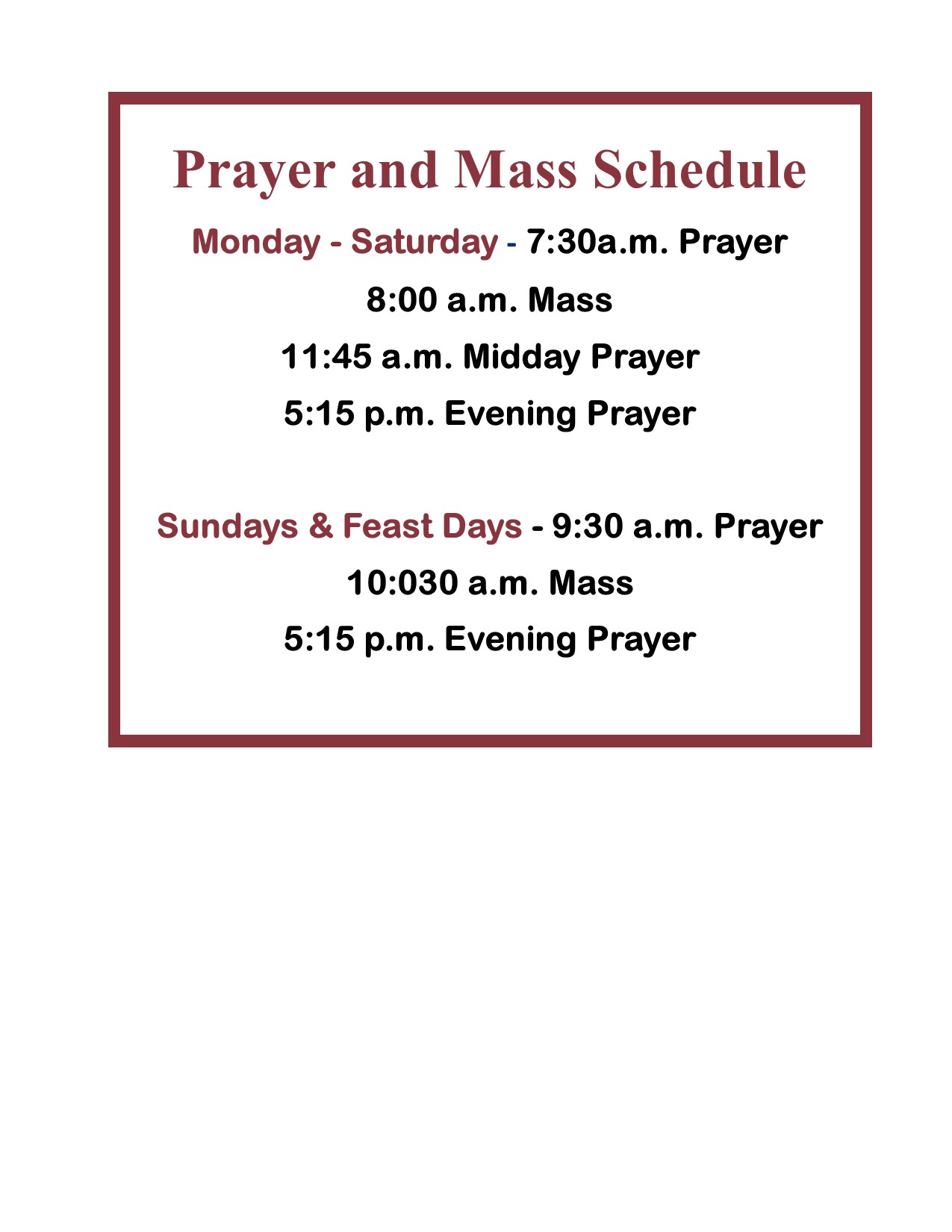
 Mass Schedule

Related Links

Copyright © 2026 · Benedictine Sisters of FL · Touching Lives Through Prayer and Service

Copyright © 2026 · Bendedictine Theme on Genesis Framework · WordPress · Log in