
Continue Reading

Holy Name Monastery
Founded 1889
 Most persons eat some kind of bread almost every day. By calling Himself the Bread of Life, Jesus identifies himself and his ministry with a basic component of life. Manna, that mysterious feathery substance, had offered the Israelite wanderers in the desert enough food value to sustain them from one day to the next. Now, Jesus declares He is more than prophet or a miracle worker. He is the BREAD of LIFE, the manna in our desert. He feeds us with love and hope and grace and mercy and forgiveness. This is the very food we need to live the full lives God designed for us. As we consume Jesus His indwelling presence nourishes us spiritually and energizes us to put faith into action.
This week the liturgy asks us to share the bread of life. Not the only vaccines and medicine or the vitamins; not the chocolate cake, the animal crackers, the donut holes, the Cheez-Its or chicken or steak, but the very Bread of life -the substance of life, something essential for life itself. The smile, the wave, the “G’mornin” that warms the heart.
The Gospel calls us to be peacemakers, to see similarities rather than differences. We are called to share the unconditional love and acceptance of Jesus. He reminds us: “…it wasn’t Moses who gave you bread from heaven. It was ABBA, my Father who gives you TRUE BREAD.”
What kind of “bread” can we offer our weary world? We can be like the blind lady, who waits three times a week at a corner bus stop in a busy city. She labors to climb aboard the bus and is warmly greeted by the driver. She sits down right behind him. In fact, she knows that he had saved this spot for her. They carry on an animated conversation. She asks how his family is. Then she tells him she is scared about losing her Social Security benefits and Meals-on-Wheels. When they reach her stop, the driver helps her off the bus and leads her across the busy street. When he returns to the bus, the woman is still standing where he had left her. “She won’t move till she knows I got back safely,” he explains to other riders. He honks the horn three times and she smiles and waves her thanks.
A blind lady and a lowly bus driver, two seemingly insignificant persons who had scarcely “five loaves and two fish” between them. Yet, Jesus blesses what little they have and hands it back to them. Each made a contribution from what little they had. They could have cursed and complained about having so little and hoarded their meager gifts to themselves. But, instead they fed each other from their small store of compassion and caring. Jesus tells His disciples on the hillside: “Bring me your loaves and fish and do not back off saying, ‘What can you do with so little’? I know your resources are tiny, but don’t give up. Bring them to me to be blessed.”
And, consider the old man who goes daily to the local diner and orders the soup of the day. One day he speaks up and asks for a little more bread. So the next day the manager tells the waitress to give him four slices of bread instead of just two. But that day the old man once again asks the manager if he could have “a little more bread.” So the following day the manager tells the waitress to give him eight slices of bread. The owner asks: “How was your meal today, sir?” The old man ponders a moment: “It was good…But you could give a little more bread?”
So…the next day the manager tells the waitress to give him a whole loaf of bread with his soup. And when the manager once again asks how the meal was, the old man replies by saying: “It was good, but you could give just a little more bread.” The manager is now puzzled but determined to hear this customer say that he is satisfied with his meal. So he goes to the bakery and purchases a six-foot-long loaf of bread.
When the elderly man comes in as usual the next day, the waitress and the manager cut the loaf in half, buttered the entire length of each half, and lay it right next to his bowl of soup. The old man devours both the bowl of soup, and both halves of the six-foot-long loaf of bread. The manager was sure he would get the answer he is looking for. So when the old man came up to pay for his meal, the manager asks “How was your meal TODAY, sir?” The old man replies: “Oh, it was good as usual, but I see you are back to giving only two pieces of bread.”
Doesn’t that sound just like us? Like the Isoraelites in the desert? And the people who chased after Jesus looking for more bread? We’ve a lot in common – hard to please. No matter how many pieces of bread…it’s never enough. It’s easy, so easy – to fall into the “more-more-more trap.” To be self-centered and self-absorbed with a ME agenda. This Gospel calls us to “look around” – goodness is happening! You’re the one that’s missing it. Notice and whisper thanks to God for the BREAD you’ve been overlooking.

July 6, 2021
by Patty Cook
I am a white nun, 86 years old, who was spurred by George Floyd‘s murder last year to immerse myself in anti-racist learning. Although my religious order, the Sisters of Mercy of the Americas, has put overcoming racism at the heart of our mission, the more I read about, pray about and study it, the more I see my own blind spots. An encounter I had a few months ago with Wendian Davis, a young Jamaican nurse practitioner, made me realize how little I understand my white privilege — or what anti-racism work is about.
Ms. Davis gave me permission to share this story. We spoke on the phone at length when I first started writing this essay, and she kindly reviewed its many drafts.
Ms. Davis came to my Connecticut home last fall for a wellness visit that I receive annually through the state, thanks to my former chaplaincy ministry in a maximum-security men’s prison. As she was finishing her session, with its helpful wellness tips, she asked what I had been reading lately.
I told her about my immersion into anti-racist literature and how I was especially moved by the books of Ibram X. Kendi and Isabel Wilkerson. I had just finished Kendi’s How to Be an Antiracist and was taken with his ideas about how space is “racialized” in our society and given resources (or not) according to its perceived worthiness by those with power. Ms. Davis was interested and intrigued, full of questions.
She then asked if she might share something personal. “Of course,” I said.

She told me that when she goes home in the evenings, as she is driving up her driveway, she sighs a deep breath of relief and gratitude because she leaves white space and enters her own Black space. She puts down her imaginary spear, takes off her invisible helmet and protective armor, divests herself of the high-energy focus of her day spent in white space and re-enters the Black space of her home. Since she is arriving late, her Black husband and Black children are already fixing the dinner and setting the table. Now, she can unwind, eat, laugh, rest, enjoy her life. As Ms. Davis shared these things with me, she smiled behind her mask and shield. But her smile was betrayed by her wet eyes.
She went on, telling me that her exhaustion had nothing to do with her nursing work, which she loves, or with driving around suburban Connecticut to visit patients. (Almost all her house-call clients are white people, as our health care system in the United States is so skewed against people who live in poverty, many of whom are people of color.) Her fatigue was about the energy she must exert to navigate white space.
She told me: “Sister, your white ears would fall off your white head if you heard some of harsh things that people say to me.” Over the years, she said, she has learned to pause and take a breath when blindsided by white patients’ racist words and attitudes. Most of her patients do not see their racism or think of themselves as racist, Ms. Davis emphasized. But to survive in white space, she must work with her guard up — way, way up.
As I listened to Ms. Davis, I realized with shocking clarity that my white skin meant I could never fully understand the pain of racism that she and countless Black people in our country suffer daily. I also saw that I had missed what it means for me and my white brothers and sisters to become anti-racist and to work for an anti-racist society until Ms. Davis pulled back the veil in her sharing.
Anti-racism must be about justice. It must be about building a society where Black people and other people of color can flourish as full citizens without being impeded, harmed or killed by white people. If anti-racist learning doesn’t lead to white people like me helping with humility to bring about a complete reordering of our society through systemic and personal change — what the Rev. William Barber II and Jonathan Wilson-Hartgrove call the Third Reconstruction — then we are just wringing our hands and perpetuating injustice.
I ponder the anti-racism work that is mine to do despite my advanced years and limitations. I’m aware that my long life has spanned nearly a quarter of the four centuries that Black people in this country have suffered from racism’s evils. I pray that I can be part of a Third Reconstruction of justice with my Black brothers and sisters and all people of color and that I will continue to be open to having my blind spots around racism pierced.
Deep is my gratitude to Ms. Davis for lighting my path.
Mr. Floyd — my dear brother — you have touched my world and rocked it. May you rest in the peace and glory of God.
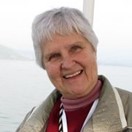 Patty Cook is a member of the Sisters of Mercy of the Americas living in East Haven, Connecticut. Presently, she is a spiritual director and retreat director at Mercy by the Sea retreat center.
Continue Reading
 Did you know that today’s story of the miraculous feeding is recorded in all four New Testament gospels? It is the only one of Jesus’ miracles that all four evangelists relate. It must have held great import for each of them: Matthew, Mark, Luke and John tell the story of the day when Jesus fed five thousand with five loaves of bread and two fish. Each embellishes his version with their own details and emphases. Mark and Matthew tell us Jesus commands the people out there in the wilderness to sit down on the green grass. Why this reference to the color of the grass? To know the answer one will have to wait until the day we see those fellows in heaven. It reminds me of Psalm 23: “He beckons me to lie down in green pastures.”

John’s version of the event is probably the one we learned as children. We could relate to the generous young boy who shared his five barley loaves and two fish. We’re not told how it happened that the boy had the fish and the loaves. I like to project my thinking that he, like most people at that time, would not dream of going out into the wilderness without at least a little something to eat and drink.
So the story, it seems to me, continues in a “pay it forward” style. You know, similar to the Dairy Queen drive-thru customer who paid for the car coming up behind him. That started a chain reaction that lasted for three days, 200 thankful Dairy Queen customers! Like the generosity of the young boy on the green grass at Jesus’ feet. He started a chain pay-it-forward reaction that enabled Jesus to feed the hungry crowd. Some evangelists say it was 5,000 people; others 5,000 not counting the women and children. I find it interesting that in John’s version Jesus tells the apostles to have the people recline and John says the men reclined. What were the women doing? I would venture a guess they were doing “women’s work” – rounding up the kids, wondering if there’d be enough bread and what they were going to give the men to drink???
What trust! What faith in Jesus the apostles showed in telling the people to relax! Be patient. Sit down! Surely they could not fathom how all these people could be fed. Even pooling all their supplies, they certainly did not have the resources to feed this crowd. What were they to do now that they had people seated and waiting to see what would happen next? That’s what you call FAITH! That’s obedience – trusting the wisdom of God to do the impossible! We just need to take the first step: Listen and obey the prompting of the Spirit: tell the people to be seated.
No doubt Jesus could have multiplied the available supplies if he wanted to. But, as John asks, to what end? John asks and answers that exact question. The very next day the people would again be hungry. They’d be looking for something to fill their bellies. They’d not be clamoring “Speech! Speech! Share a good word! Let’s hear it!” Likely they’d be waiting for the apostles to open Jesus’ food distribution center.
On this day, out in the wilderness, John tells us that the people ate and were satisfied. Which would be more satisfying to you, a full belly for a single afternoon, or a glimpse, a vision of what life looks like when lived in the company of generous people under the reign of God?
What would our world be like if people acknowledged that they are called to be transformed? What if we were truly as open-handed with our possessions as the young boy on the hillside was with his? What would be the status of the pandemic if everyone followed CDC advice: get vaccinated, wear a mask, wash your hands? And, what if we really believed that Jesus still has the power to take the gifts we offer and to create from our generosity, widespread outbreaks of sharing? As I watched the Olympics opening ceremony I was thinking “This is lovely – a testament to the ingenuity of computer whizzes, but with the millions spent in the production and given by sponsors – so much good could have been done. But quickly it seemed God said, yes, that may be true. But wouldn’t you rather see all those dollars and tech savvy spent to amaze and inspire people than on cyber-crimes and weapons of violence? With positive, other-directed thinking and actions, I daresay that the world could be transformed, and over 3.1 million children a year (one child every 10 seconds) would not die of hunger. More people would reflect the attitude and model the efforts of the Benedictine Sisters of Florida, our Oblates and our supporters in their ministry to respond “with the compassion of Christ to the hungers of the people of God” (BSofFL Corporate Commitment).


Pope Francis has established throughout the Church the celebration of the World Day for Grandparents and Elderly beginning in 2021 on the fourth Sunday of July, near the liturgical memorial of Saints Joachim and Anne, the grandparents of Jesus. The announcement of this celebration coincides with the celebration of the Year of Amoris Laetitia Family.
 The Catholic Grandparents Association is a global organization of the faithful. An integral part of the organization is establishing and working with Grandparents ministries at the parish level.
If you are interested in starting this Ministry, www.catholicgrandparentsassociation.org/, info@catholicgrandparentsassociation.com

www.usccb.org/topics/natural-family-planning/national-nfp-awareness-week
National NFP Awareness Week provides an opportunity to spread the word about Catholic teaching on marriage, conjugal love, and responsible parenthood. Sharing basic information about the methods of NFP and why they support God’s design for love and life is at the heart of this national campaign.
 It seems to me we would be hard put to find a more appropriate Gospel for people preparing to travel in COVID times. Jesus invites us: Come away by yourself to a deserted place and rest awhile. “Ah, but Jesus,” you might be thinking: “most of us are tired of “deserted places.” But the idea of “rest while” from all the restrictions, the tangible fears, the ZOOM meeting. Now, that’s appealing.”
And, we’d think it bizarre for a traveler not to be prepared for their journey. We’d feel pity for the poor traveler who never read his/her itinerary and knew what the changing CDC requirements for the day of travel and at the destination. Which of these hundreds of aircraft might go where I want to go is the most safety conscious? Another summer the journey might not be the destination. We might be looking forward to the great feeling of just relaxing and enjoying a drive. Without wondering are we there yet? Does this motel look clean? Does this station have gas? Another summer we might view a crowded restaurant parking lot as a sign of “good food.” Today, we search for a place “not too crowded” for social distancing.
This week Jesus invites us, forget all that and “come away to a deserted place all by yourselves and rest a while.” There are four parts to that statement – each one means something on its own: Come away. To a deserted place. All by yourselves. And rest a while.
Some people (surely not any of us) wear a badge of busyness as if it were a badge of honor. You might hear: “How are things going?” “Well, it been pretty crazy, I’ve been busy all day. Not enough time for everything.” The implicit message being: “I’m worthwhile because I’m busy.” But, you and I know it’s not really a badge of honor – it a sign of an imbalanced life … Remember the little saying: “all work and no play makes Jill a dull person.” There’s a better one: “Never get so busy making a living that you forget to make a life.”
Listen closely to Jesus’ words of invitation. He says precisely: Come away. He doesn’t say “get away” or “go away.” No, he says: “Come away.” An invitation that implies companionship” with the one whose yoke is easy. The One who promises His burden is light.
To a deserted place. I’m reminded of a message a few years ago from our retreat director Abbot Primate Gregory Polan: “It is my conviction that monasteries are among the most important places to our world today … what we offer is a warm welcome, whoever you are and whatever your story in life tells; we say, ‘come and be with us and find healing in the Word of God that we offer you’.” During COVID times our message from Holy Name may have been less “come away” but it was nonetheless sincere. Our Development Staff, with the input of some of the Sisters has reached out through Eblasts, website posts, snail mail and ZOOM opportunities. These were, and will continue to be invitation to our readers to recharge their spiritual batteries – to take time out of their self-made busyness trenches to keep company with God.
The view from the street here at the monastery offers sight of our grounds that are seen as an oasis for world-weary guests. But the seeds we plant must be sown more deeply than the grass. How good would a farm be if the owners only painted the silos and mended the fences? But never sowed seeds: no veggies, no fruit = no dinner.
Just in case you missed it, the invitation Jesus extends is to be “All by yourselves.” Jesus really means it. We have to find and take advantage of moments of quietness and prayer. The traffic can be whizzing by but in the quiet in the car I’m driving – maybe with gentle music in the background – can afford us time for “tightening the bonds that bind us ever closer to God and each other.”
And finally, Jesus says: Rest a while. This isn’t laziness. It’s not a perpetual state. It’s temporary. It’s for a while. But, for that while, it’s about rest. We cannot just minister to others day by day, month by month. We won’t be able to take care of others if we don’t make time to cater to ourselves and our own needs. We need to embrace the spiritual practice of rest. And, while some may think you’re a little crazy (or lazy)…you’ll be crazy in all the right ways.
First, forget technology exists – except maybe for some soft, calming music. Build in down-time to explore your feelings and get to the core of changes you need to make. Seize the opportunity to enjoy nature, the glorious sky, the rolling clouds and that rainbow. Take time to just BE.
Little by little you’ll discover that these “desert times” when you “come away awhile by yourself” with God can lift you out of life’s ruts and be restorative balm for body and spirit.
