• Skip to primary navigation
  • Skip to main content
  • Skip to footer
Benedictine Sisters of FL

Holy Name Monastery
Founded 1889

Donate Now
  • Home
  • About Us
    • History
    • Being Benedictine
    • Benedictine Monasticism
    • Meet Our Community
    • Holy Name Academy-Alumnae
  • What We Do
    • Mission, Vision and Our Partners
    • Invitation to Retreat
    • Accommodations
    • Volunteer Programs
    • Oblate Program
    • Spiritual Direction
    • Aqua/Hydroponics
    • More of Our Ministries
  • What’s Happening
    • Articles of Interest
    • Events
    • Newsletters
    • Brochures
    • Links
  • Support Us
    • Gifts of Support
    • Wish List
  • Stories Shared
  • Galleries
    • Photos
    • Videos
      • Benedictine Sisters of FL Videos
      • Other Videos
  • Contact Us

Articles of Interest

Rarely One “Right Way”

September 4, 2018 by Holy Name Monastery Leave a Comment

In this Gospel, Mark provides a significant amount of information about the Jewish observance of ritual-purity laws.  Most Scripture scholars believe that Mark’s purpose was to educate the Gentile Christians in his audience since they would have had little or no experience of these laws.

Jesus first criticizes the Pharisees for putting human tradition above God’s Law – for making the tradition of ritual purity equal to and as binding as the Law of Moses.

Next, Jesus comments on the meaning behind the Pharisees’ language of holiness – clean and unclean.  He teaches that a person is not defiled by the food that enters our bodies, but rather by the sin that emerges from our words or actions.  In this teaching, Jesus unmasks a deeper question behind the one posed to him by the Pharisees.  The real issue is holiness, which is not found in external acts alone.  Holiness comes from within and is evidenced in the actions and attitudes that emerge from a person’s life.

If we read today’s Gospel carefully, we will see a pattern in Jesus’ teaching method that will be repeated in the liturgical weeks ahead.  Jesus’ first teaching is directed to the Pharisees who questioned him.  Then He directs his words to the whole crowd, teaching that a person is defiled by their own words and actions – remember it’s not the food we take in but the words we spout out.  In the verses omitted in today’s reading, we learn that Jesus returned home with his disciples, who in turn quizzed him about what he had taught.  The words at the conclusion of today’s Gospel are addressed specifically to His disciples and challenge us as well.  In our desire to show that we are holy, we might also give too much credence to externals, following rules without thinking about the intention behind them.

Here’s where we need to really perk up and listen to the message in this Gospel: “Hear me, all of you, and understand.  You disregard God’s commandments but cling to human tradition.”  It seems to me Jesus’ underlying message to us, in this day and age and community, is that line about “teaching human precepts as divine doctrine.”  It’s a great temptation for many of us to elevate our wishes to the “right way” of doing things.  There is rarely only one RIGHT WAY in everyday matters.  Even Emily Post changed her mind about the “right way” to eat fried chicken. 

Jesus reminds us that we do not make ourselves holy by our actions.   Rather, we become holy when we allow God’s Spirit to transform us. Our actions should be an expression of the conversion of our hearts.

~ Reflection by Sister Roberta Bailey, Prioress, OSB
First Reading  Deuteronomy 4:1-2,6-8            Second Reading  James 1:17-18,21b-22,27
Gospel Mark 7:1-8,14-15,21-23
Continue Reading

Filed Under: Blog, Front Page, Homily Tagged With: God, holiness, Jesus, Pharises, Scripture, teaching

What bread will you and I eat today?

August 6, 2018 by Holy Name Monastery Leave a Comment

We live: hungry people in a hungry world.  Everyone is looking for something that will sustain and nourish their life, something that will feed and energize them, something that will fill and satisfy.  Everyone is looking for bread.  The problem is not that we are hungry, but the kinds of bread we eat.

Think about the variety of bread we eat at our own table: wheat, multi-grain, plain white; pita pockets, hoagie rolls, English muffins, French bread and Jewish bagels and Challah bread; And, oh my goodness, the homemade varieties we get: biscuits and scones, crescent rolls, pull bread, sliced bread …. Toasted, warmed, plain, garlic sprinkled, seeded or stuffed bread… Banana bread, raisin bread, cheese bread and don’t overlook all the gluten-free breads available in the markets.  The list goes on and on.  This is a short-list representative of the varieties of bread being eaten in our lives and in the world today.

In war-torn countries both sides are eating the bread of violence and war.  In our country in the political world Republicans and Democrats, share the bread of negativity, hostility, and name-calling.  In the social-corporate world both sides are eating the bread that objectifies and depersonalizes another human being.  Many eat the bread of having to be right and get our own way.  We eat the bread of hurt feelings and resentment.  Sometimes we eat the bread of loneliness, fear, and isolation.  There are times we eat the bread of sorrow or guilt.  Other times we eat the bread of power and control; or the bread of revenge or one-up-manship.  We eat all kinds of bread.  The bread we eat reveals something about the nature of our appetites.

The world is full of bread and yet far too many live hungry, empty; searching what will fill their bellies and sustain them; waking day after day disappointed, asking God for a miracle.  It’s a sure sign that the bread we have eaten cannot give real life.  It is perishable bread that nourishes only a perishable appetite so it leaves us wanting more, more, more.

The bread we eat may fill our belly, may even bloat us but it’ not of lasting value – it passes through our bodily system.  Not all bread is nutritious.  If you want to know the nutritional value of bread, you have to look beyond the bread.  Where did it come from?  What are its ingredients?

That’s what Jesus is teaching in this gospel.  The people have shown up hungry.  But, just yesterday Jesus fed 5000 of them with five loaves and two fish.  Today they show up and their first question is, “Rabbi, when did you come here?”

They do not marvel at yesterday’s miracle and give thanks for Jesus’ generosity, or even wonder who this rabbi is.  They’re just worried they might have missed the next meal, that Jesus started without them and they are too late.  They did not perceive the meaning of the sign, the miracle, in first feeding.  They saw just fish and bread.  They either refused or were unable to see beyond the fish and bread.  They are interested only in their own appetites and Jesus knows it.

“Very truly, I tell you, you are looking for me, not because you saw signs, but because you ate your fill.”  They are concerned for their bellies.  Jesus is concerned for their lives.  The people want to feed themselves with bread.  Jesus wants to feed them with God.  “Do not work for the food that perishes,” he tells them, “but for the food that endures for eternal life.”

The food that endures is Jesus himself.  He is the bread that is broken and distributed for the life of the world.  He is the bread that is broken and yet never divided.  He is the bread that is eaten and yet the value is never exhausted.  He is the bread that consecrates those who believe in and eat him – his flesh, his blood.

When we believe in Jesus, eating, ingesting, and taking him into our lives, we live differently.  We see ourselves and one another as persons created in the image and likeness of God.  We trust the silence of our prayer life.  We choose love and forgiveness and reconciliation.  We relate with intimacy and vulnerability.  We listen with “the ear of our heart” for God’s voice.

“I am the bread of life,” Jesus tells us.  “Whoever comes to me will never be hungry, and whoever believes in me will never be thirsty.”  Jesus is offering us himself – the imperishable bread that nourishes and sustains imperishable life.

So, what bread will we offer our guests and co-workers? What bread will you and I eat today?

~Reflection by Sister Roberta Bailey, OSB, Prioress
First Reading Exodus 16:2–4, 12–15                        Second Reading Ephesians 4:17, 20–24
Gospel John 6:24–35
Continue Reading

Filed Under: Blog, Front Page, Homily Tagged With: Bread of life, broken bread, fish, God, Jesus, Miracle

Is Your Badge a Badge of Busyness?

July 23, 2018 by Holy Name Monastery Leave a Comment

It seems to me we would be hard put to find a more appropriate Gospel to lead into our annual retreat at Holy Name.  Jesus invites us: “Come away by yourself to a deserted place and rest awhile.”

We would think it bizarre for a traveler not to be prepared for a journey.  We would feel pity for the poor traveler who never read his/her itinerary.  Which of these hundreds of aircraft is my flight?  Usually we have a destination in mind when we set out.  It is rare that the journey is the destination.  But it is a great feeling to just relax and enjoy the drive without wondering “are we there yet?”

This week Jesus invites us, “come away to a deserted place all by yourselves and rest a while.”  There are four different parts to that statement – each one means something on its own:  Come away.  To a deserted place.  All by yourselves.  And rest a while.

Some people (surely not any of us) wear a badge of busyness as if it were a badge of honor.  “How are things going?”  “Well, it’s been pretty crazy, I’ve been busy all day.  Not enough time for everything.”  The implicit message being: “I’m worthwhile because I’m busy.”  But, you and I know it’s not a badge of honor – it a sign of an imbalanced life … Remember the little saying: “all work and no play makes Jill a dull person.”  There’s a better one: “Never get so busy making a living that you forget to make a life.”

Let’s pick apart Jesus’ invitation.  Come away, he says. It’s not just “going away,” but it’s “coming away” with Jesus, the one whose yoke is easy, whose burden is light; the embodiment of refreshment.  Come away from the daily grind whatever that may be.

To a deserted place.  Our retreat director, Abbot Primate Gregory Polan has written: “It is my conviction that monasteries are among the most important places to our world today …  what we offer is a warm welcome, whoever you are and whatever your story in life tells; we say, ‘come and be with us and find healing in the Word of God that we offer you’.”  During our days of retreat we have the opportunity to recharge our spiritual batteries – to get out of the busyness trenches – to keep company with God.

From the street our grounds are an oasis for world-weary guests.  But the seeds we plant must be sown more deeply than the grass.  How good would a farm be if the owners only painted the silos and mended the fences?  If the farmer never sowed seeds: no veggies, no fruit, no dinner.  Retreat is a time to steep ourselves in Scripture and the words of the retreat director, to have a head-conversation with an author you’ve been anxious to meet or take time to get better acquainted with a confrere.

In case you missed it, the invitation Jesus extends to us for this time of retreat is to be “All by yourselves.”  Jesus really means it.  Thus especially during retreat we foster an environment of quietness and prayer, alone and together in chapel, so that each of us can delve into spiritual practices that “tightened the bonds that bind us ever closer to God and each other.”

And finally, Jesus says: Rest a while.  This isn’t laziness.  It’s not a perpetual state.  It’s temporary.  It’s for a while.  But, for that while, it’s about rest.  We cannot just minister to others day by day, month by month.  We won’t be able to take care of others if we don’t make time to cater to ourselves and our own needs.  We need to embrace the spiritual practice of rest.  And, while some may think you’re a little crazy…you’ll be crazy in all the right ways.

So, how will you prepare for your journey into our annual retreat?

First, forget technology exists – except maybe for some soft, calming music.  Use the down-time in the retreat schedule to explore your feelings and get to the core of changes you need to make.  Seize the opportunity to enjoy nature, try new exercises physical and spiritual, time to just BE.

The retreat time gives you the excuse to try something different, to step out of your comfort zone and experience something new – to read about, pray about new things, new ways of living, and give yourself options for how you may want to make changes when you get back to “the real world” of everyday.  In other words, a retreat can lift you out of a rut and be restorative for body and soul.

During these graced days of retreat let us pray for each other – and for all who will benefit from our “time apart by ourselves.”

~Reflection by Sister Roberta Bailey, OSB, Prioress
First Reading  Jeremiah 23:1-6           Second Reading  Ephesians 2:13-18
Gospel Mark 6:30-34
Continue Reading

Filed Under: Blog, Front Page, Homily Tagged With: Come Away, Gospel, holy name, Jesus, pray, rest a while, Retreat

Stay the Course

July 16, 2018 by Holy Name Monastery Leave a Comment

Luke and Matthew relate the same story heard in this gospel from Mark.  With Luke, you realize, it was hearsay …  he was not there to give an eye-witness account.  It’s interesting to see the minor, but specific differences in the three accounts.  For example, where Mark says, “take no money,” Matthew specifies, “take no silver, gold or copper coins.”  He was covering all the bases, not just the currency in current use.  He notes other details that let you know he was there and must have been a high sensate on the Myers-Briggs scale.  He begins the story with Jesus reminding the disciple-missionaries: “You received without paying, so now give without being paid.”  Where Mark says, “whatever house you enter,” Matthew is more aggressive: “Look for someone to welcome you.”  And, if when you wish them peace and it is not returned, “take back your greeting.”  Both Luke and Matthew, in the list of what not to take on their journey, quote Jesus saying: “take no beggar’s bag.”  They were to live dependent on the hospitality of the community, just as Jesus depended on others to provide for his needs.  Remember what he told one of his potential followers – “Foxes have dens and birds have nests, but the Son of Man has no place to lay his head.”  Jesus expected his disciples to “eat what is served, be satisfied with the bedding provided, follow their schedule, and don’t try to go it alone.”  Remind you of Benedict’s norms?

But, that’s enough about what NOT to take on your life’s journey.  Let’s look at what Jesus says is appropriate for our journey in order to carry on the mission of Jesus.

The first thing Jesus recommends that we travel two by two – life is not a solo venture.  He is reminding us not to try to go it alone.  We need a good support system as we experience life’s ups and downs.  Sharing the good times is as important as it is to share the not so great times.  Benedict recommends the same when, in the first chapter of the Rule, he describes the kinds of monks:  “First, there are the cenobites, those who belong to a (community) a monastery.”  Jesus sent the twelve in pairs not only for safety but for companionship, encouragement and help.

Remember that God is always with us, so we are never really alone.  But Jesus acknowledges that just as he is a member of the trinity, so we humans, social creatures made in God’s likeness draw life from companionship.

Jesus recommends sandals for our feet and a tunic, but not a second one.  Jesus asks us not to carry so much.  Take off that extra tunic – the worries that we carry can bring us down.  Stuffing them in our gunny sacks does nothing to change the situation – just adds wrinkles to our brow and sours our spirit.  Do what Jesus says: “shake the dust off your feet” and don’t look back and wonder what might have been, or might you have done.

Jesus asks us to carry and use a walking stick, so we can keep moving when we encounter ruts and pebbles in the road or to hold us up when we became worn out, tired and weary.  Maybe we even wander off the edge of the road until we hear the sound from the rumble strips.  A good walking stick helps us stay upright and get past mistakes which could hinder our spiritual growth and practice of conversio.  And, beyond that, it’s a fact that in order to do what we say in our Corporate Commitment (that is) “to meet the hungers of the people of God with the compassion of Christ” we must first be compassionate with ourselves.

Today Jesus sends us out again, with authority over unclean spirits … over the rancor, the violence, the rudeness, the degrading language and actions, the insensitivity …  the list can go on and on …  we can conquer the darkness with a refusal to lower our behavior, language and standards.  We can “shake that dust from our feet” and support actions on behalf of justice and peace because we are traveling “two by two,” with the sturdy walking stick of community and prayer, and wearing the sandals of our vows.  Like the disciples, we heed Jesus’ admonition to stay put in the house where they took us in, we can anoint others with inclusivity and peace.  Pray God we stay the course…

~Reflection by Sister Roberta Bailey, OSB, Prioress
First Reading    Amos 7:12-15                      Second Reading  Ephesians 1:3-14 
Gospel Mark 6:7-13
Continue Reading

Filed Under: Blog, Front Page, Homily Tagged With: Benedict, gosel from Mark, Jesus, life's journey, Luke, Matthew, pray

Are You Who You Say You Are?

July 10, 2018 by Holy Name Monastery Leave a Comment

This Gospel tells us that Jesus is hampered from performing miracles in Nazareth because of the people’s lack of faith.  We see a very human side of Jesus.  He seems to be taken by surprise.  His family seems to be sending the message every child dreads to hear, especially from mom or dad: “Stop embarrassing us.  Act your age.”

Can you recall a time when a parent, teacher, novice mistress or maybe a friend seemed surprised by your words or an action that showed a level of maturity beyond their expectations?  In family life, and hopefully in our community, we rightfully expect a safe place to discover who we are and who God is calling us to be.

Does a time come to mind when you were surprised by someone you thought you knew saying something really wise, insightful or maybe just plain “off the wall” but so smart?  Why were you surprised?  Or was it not surprise, but impressive and pleasant to see a different aspect of that person.  It happens in my role frequently – A Sisters’ sharing gives me a peak into her depth of lectio, her expression of a deep spirituality puts me to shame or at the very least reminds me what a treasure we have in community.

Now it is interesting to note, that where the evangelist uses the word “offense” the Greek origin is “stumbling block.”  And that it seems to me is closer to what is happening here.  Jesus’ audience were scratching their heads and tripping over themselves trying to understand how this young whippersnapper from Nazareth could be so wise.  Up to this point, like most good Jews, he had kept a low profile.  Jesus’ family and friends were scared for him.   There was an emotional stumbling block interfering with them openly being a Jesus follower.

What stumbling block sometimes prevents you from speaking up in defense of Jesus, of our faith or our Benedictine values?

I was drawn back to the first reading from Ezekiel.  I wanted to say to Jesus when he seemed stymied by the crowd’s reaction to his teaching – Remember what Ezekiel said: The spirit entered into me and set me on my feet, and I heard the one who was speaking say to me: Son of man, I am sending you to the Israelites…  whether they resist or rebel or are obstinate of heart, it is you I am sending.  Say to them, whether you heed or resist, it is I whom God has sent – I am a prophet among you.”

The crowds used all the time-honored dismissive ways …  we know them, we have been targets – or sadly we may have employed them: belittling remarks, the covert laugh, the rolled eyes, the turning away of attention, or making light of the other’s knowledge – the attitude that says: who does she think she is?

Ultimately, what didn’t happen in Nazareth: no healings, no mighty deeds, is not much of a surprise.  After all a miracle is not just an event but it is an interpreted event.  If Jesus is not reputed to be capable of healing, any healing that does take place won’t be attributed to him.  So the crowd’s attitude is “there’s nothing here to see.  Let’s just move along, move along… and find some other excitement.”

Such is true with us, with our community.  Our guests don’t experience peace and harmony, generosity of spirit and light-heartedness, beauty in nature and liturgy if they don’t find it in each of us.  They come expecting a miracle – the miracle happens in our interactions – first with each other, then between us and our guests.

Remember Jesus question to this disciples: Who do people say I am?  And, you: who do you say I am?”  Who do you say these Benedictine Sisters of Florida are?

If I remembered well the music, I’d sing to you the tune from the rock opera popular in the 1970’s –

“Jesus Christ, Superstar – Do you think you’re what they say you are?”

Benedictine Sisters of Florida, do you think you’re what they say you are?

Are you really who you say you are?

Are you really who they say you are?

~Reflection by Sister Roberta Bailey, OSB, Prioress
First Reading  Ezekiel 2:2-5                Second Reading  2 Corinthians 12:7-10
Gospel Mark 6:1-6
Continue Reading

Filed Under: Blog, Front Page, Homily Tagged With: Ezekiel, Faith, God, Jesus, Miracle, Nazareth, stumbling block

Ever brought to your knees?

July 2, 2018 by Holy Name Monastery Leave a Comment

This Gospel reports two stories of healing.  One story tells us about a father’s great love for his dying daughter.  The other story, the one I have chosen to focus on, tells us about a desperate woman who risks much in a courageous act of faith to seek healing from Jesus.  This woman has lost everything to find a cure to a condition that has separated her from the community.  We women can commiserate with her.  We may have memories of “those days” or know someone who understood why some referred to a woman’s “gift of God” as “the curse of Eve.”

This woman’s is a true story, not one of Jesus parables.  This woman had suffered from bleeding for 12 long years.  Whether this hemorrhaging was constant or irregular, it caused the woman much suffering, and with the loss of blood much weakness as well.  She also suffered a great deal at the hands of the many doctors she consulted for a cure.  Not only didn’t she get better, she actually got worse.  In addition, she didn’t have good health insurance so now she was broke and wasn’t eligible for food stamps.

We need to realize, too, that this woman would have been quite isolated:  lonely, shunned and shamefully treated because she was considered ceremonially unclean under the Law of Moses.  She could never perform the rituals that would have reconnected her with society.

What a suffering!  Broke.  Required to live as unclean, in isolation and shame.  She had very little hope for a better future.

I have to tell you, earlier in the week I had gotten this far in putting thoughts on paper when God literally dropped a reflection on this Scriptural episode into my lap …  the book I’m reading here in chapel by Basil Pennington, fell open to a chapter entitled “Who Touched Me.”   Here is an adapted summary of Pennington’s reflection.

Jesus was setting out for the house of Jariaus where he had promised to see the desperate man’s daughter.  He and his apostles are being knocked about from every side.  Suddenly Jesus stops and asks: “Who touched me?”

Peter in his usual obtuse way responds: How can you ask, who touched me?  Everyone is touching us.  Everybody is pushing us about.

 On our part (says Pennington) The increase of media and people contact – the over-scheduled day, the relentless demands on our time – almost necessarily means a decrease in spiritual contact, unless all our contact is grounded in contemplation and the operation of the gifts of the Spirit that are set free to work in our lives by contemplative prayer.

 We do not need to go out and about to find meaning.  It is all here within.  And when we go out, we find the same Reality.  Whether within or without, it fills us with presence, joy, and completeness.  Grounded in prayer, we can truly touch the lives of others and be touched by them. (Basil Pennington)

So, it seems to me, the final fact in the woman’s story – remember it’s a true story – is Jesus’ affirmation of her faith and daring.  Jesus knew she had touched him and his power had healed her.  The woman knew what had happened.  The power of the miracle dropped her to her knees.  The response of Jesus is so encouraging.  He calls her “daughter” affirming that she is very precious to him.  He reminds her: your faith has healed you.”  Many others that day touched Jesus, jostled him, shoved him but only this one woman touched Jesus with faith.  Finally Jesus tells her: Go in peace and be freed from your suffering.”

What incident in your life brought you to your knees knowing that you were healed … and more than that, assured that you are loved?

~Reflection by Sister Roberta Bailey, OSB, Prioress
First Reading  Wisdom 1:13-15; 2:23-24     Second Reading 2 Corinthians 8:7,9,13-15
Gospel Mark 5:21-43 ( shorter form, Mark 5:21-24,35b-43)


Continue Reading

Filed Under: Blog, Front Page, Homily Tagged With: apostles, Faith, Hemorrhagic Woman, Jesus, suffering

  • « Go to Previous Page
  • Page 1
  • Interim pages omitted …
  • Page 110
  • Page 111
  • Page 112
  • Page 113
  • Page 114
  • Interim pages omitted …
  • Page 132
  • Go to Next Page »

Footer

Prayer / Newsletter / Info

 Contact Info

Benedictine Sisters of Florida

PO Box 2450
12138 Wichers Road
St. Leo, FL 33574-2450
(352) 588-8320
(352) 588-8443

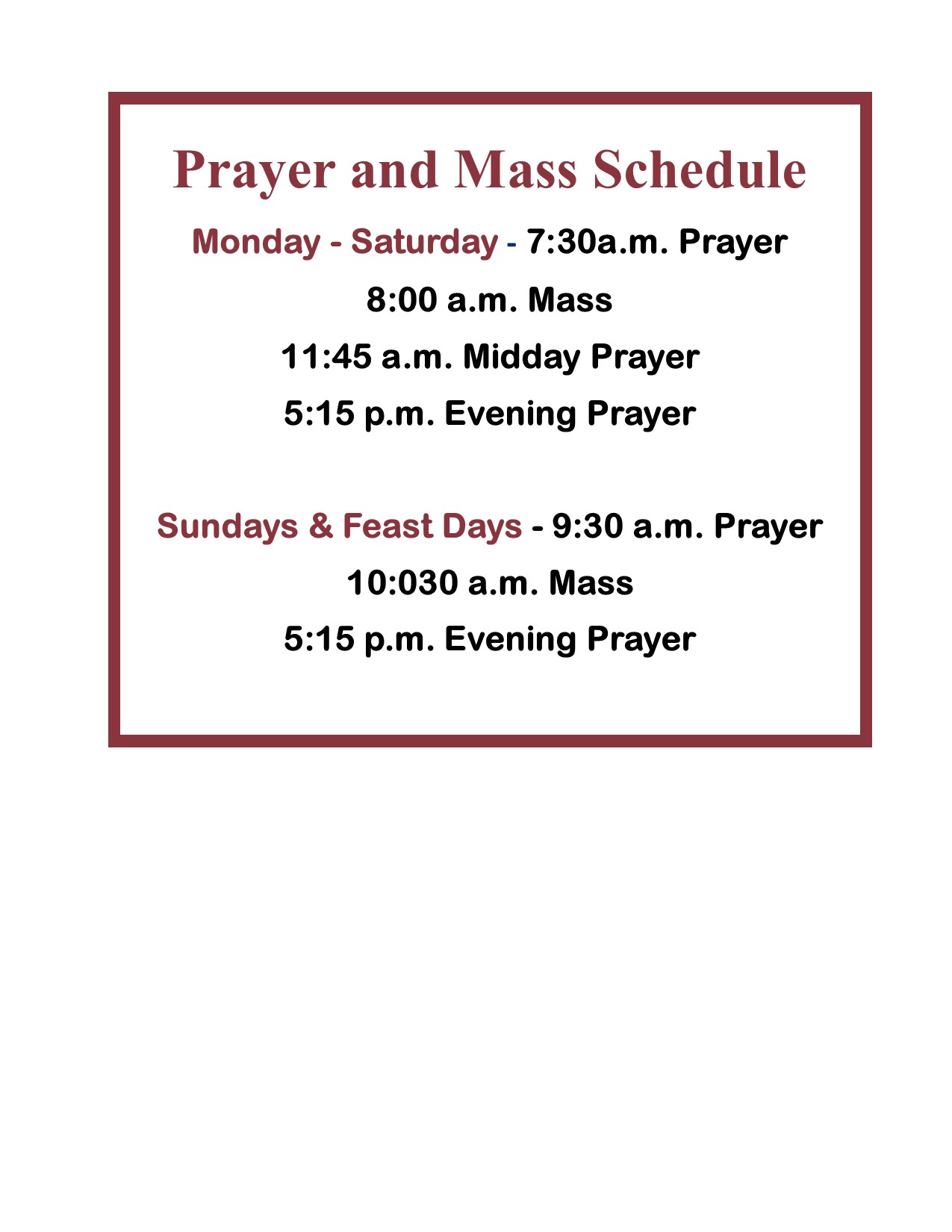
 Mass Schedule

Related Links

Copyright © 2026 · Benedictine Sisters of FL · Touching Lives Through Prayer and Service

Copyright © 2026 · Bendedictine Theme on Genesis Framework · WordPress · Log in