• Skip to primary navigation
  • Skip to main content
  • Skip to footer
Benedictine Sisters of FL

Holy Name Monastery
Founded 1889

Donate Now
  • Home
  • About Us
    • History
    • Being Benedictine
    • Benedictine Monasticism
    • Meet Our Community
    • Holy Name Academy-Alumnae
  • What We Do
    • Mission, Vision and Our Partners
    • Retreats
      • Invitation to Retreat
      • Accommodations
    • Volunteer Programs
    • Oblate Program
    • Spiritual Direction
    • Aqua/Hydroponics
    • More of Our Ministries
  • What’s Happening
    • Articles of Interest
    • Events
    • Commemorative Bricks
    • Newsletters
    • Brochures
    • Links
  • Support Us
    • Gifts of Support
    • Wish List
  • Stories Shared
  • Galleries
    • Photos
    • Videos
      • Benedictine Sisters of FL Videos
      • Other Videos
  • Contact Us

Pope Francis

Message of His Holiness Pope Francis

May 8, 2017 by Holy Name Monastery Leave a Comment

[An adaptation of excerpts from] Pope Francis’

MESSAGE FOR THE 54th WORLD DAY OF PRAYER FOR VOCATIONS

Sunday, May 7, 2017


In the last few years, we have considered two aspects of the Christian vocation: the summons to “go out from ourselves” to hear the Lord’s voice, and the importance of the ecclesial community as the privileged place where God’s call is born, nourished and expressed.

Now, on this 54th World Day of Prayer for Vocations, I would like to reflect on the missionary dimension of our Christian calling. Those drawn by God’s voice and determined to follow Jesus soon discover within themselves an irrepressible desire to bring the Good News to their brothers and sisters through proclamation and the service of charity.

Commitment to mission is not something added on to the Christian life as a kind of decoration, but is instead an essential element of faith itself. A relationship with the Lord entails being sent out into the world as prophets of his word and witnesses of his love.

In the depths of their hearts, all disciples hear this divine voice bidding them to “go about,” as Jesus did, “doing good and healing all.”

To be a missionary disciple means to share actively in the mission of Christ. Jesus himself described that mission in the synagogue of Nazareth in these words: “The Spirit of the Lord is upon me, because he has anointed to bring good news to the poor. He has sent me to proclaim release to the captives and recovery of sight to the blind, to let the oppressed go free, and to proclaim the year of the Lord’s favor.” This is also our mission: to be anointed by the Spirit, and to go out to our brothers and sisters in order to proclaim the word and to be for them a means of salvation.

Our mission might appear to be mere utopian illusion or at least something beyond our reach. Yet if we contemplate the risen Jesus walking alongside the disciples of Emmaus, we can be filled with new confidence. Jesus transformed the disciples’ discouragement. He made their hearts burn within them, and he opened their eyes by proclaiming the word and breaking the bread. In the same way, we do not bear the burden of mission alone.  We come to realize, even amid weariness and misunderstanding, that “Jesus walks with us, speaks to us, breathes with us, works with us”.

The seed of the Kingdom, however tiny, unseen and at times insignificant, silently continues to grow, thanks to God’s tireless activity.  God surpasses all our expectations and constantly surprises us by his generosity. He makes our efforts bear fruit beyond all human calculation.

With this confidence born of the Gospel, we become open to the silent working of the Spirit. There can be no promotion of vocations apart from constant contemplative prayer.  Our life needs to be nourished by attentive listening to God’s word and, above all, by the cultivation of a personal relationship with the Lord in the Eucharist, our privileged encounter with God.

I wish heartily to encourage this kind of profound friendship with the Lord, above all for the sake of imploring from on high new vocations to the priesthood and the consecrated life. I ask parish communities, associations and the many prayer groups present in the Church, not to yield to discouragement but to continue praying that the Lord will send workers to his harvest.

Dear brothers and sisters, today too, we can regain fervor in preaching the Gospel and we can encourage young people in particular to take up the path of Christian discipleship. Despite a widespread sense that the faith is listless or reduced to mere “duties to discharge,” our young people desire to discover the perennial attraction of Jesus, to be challenged by his words and actions, and to cherish the ideal that he holds out: a life that is fully human, happy to spend itself in love.

Mary Most Holy, the Mother of our Savior, had the courage to embrace this ideal, placing her youth and her enthusiasm in God’s hands. Through her intercession, may we be granted that same openness of heart, that same readiness to respond, “Here I am,” to the Lord’s call, and that same joy in setting out, like her, to proclaim him to the whole world.

~Reflection by Sister Roberta Bailey, OSB, Prioress
Continue Reading

Filed Under: Homily Tagged With: Christ, Christian, God, Jesus, Pope Francis, Prayer, World Day of Prayer for Vocations

What is the Astuteness of the Christian?

January 24, 2017 by Holy Name Monastery Leave a Comment

3rd Sunday in Ordinary Time

 Right to Life (January 23)  St. Paul (January 25)

First Reading   Isaiah 8:23-9:3          Second Reading  1 Corinthians 1:10-13,17
Gospel Reading  Matthew 4:12-23

In this Gospel the power of Jesus’ call is immediately evident – Peter, Andrew, James and John dropped everything to follow Jesus immediately.  Jesus doesn’t have to pitch the idea to these individuals nor does he need to persuade them.  Each has little reason to leave their current way of life.    Each seemingly has a steady job.  Most importantly they have familial ties to their vocations as family men and fishermen.  Now, in the new lifestyle they were inaugurating, their security would come from life in a mutually supporting community, where the needs of each one were taken care of.

Having begun to assemble his company of companions, Jesus turns to his ministry, as the Gospel describes it: teaching in the synagogues, proclaiming the gospel of the kingdom, and curing every disease and illness among the people.   He moved quickly and determinedly from one place to another … planting dreams, raising expectations, and opens doors of possibility.  His followers witnessed a dramatic alternative to the emptiness and despair that filled the lives of the people immersed in an atmosphere devoid off their trust and hope.

Whether man or a woman, when one joyfully responded to Jesus’ call to follow, and entered Jesus enterprise, their lives were dramatically changed.  They became agents of new possibility for all who came into contact with them – beacons of encouragement for the discouraged – inviting the stranger to faith in God and purpose in life.

The late Speaker of the House “Tip” O’Neill loved to relate a valuable lesson he’d learned early in his career. During his first political campaign, one of O’Neill’s neighbors told him: I am going to vote for you tomorrow, even though you didn’t ask me to! O’Neill was surprised and said: Why, Mrs. O’Brien, I have lived across from you for eighteen years, I cut your grass in the summer, I shoveled your walk in the winter; I didn’t think I had to ask for your vote! Mrs. O’Brien replied: Oh, Tommy, let me tell you something … people like to be asked!

A vital faith community will always be asking … inviting followers just as Jesus did.
It is never enough to simply welcome people when they happen to visit, we must also invite them to join us in our worship and ministries.  Without a direct “ask” a vocation may be stifled or a prayer-partner lost.  My mother spoke with great admiration for the Benedictine Sisters who were her teachers in elementary school.  I asked her once when she didn’t become a Sister – she replied “None of them asked me – so I figured I was not worthy.”  Of course, I would not be here telling you this story if she’d been asked and said YES.

Tomorrow (Monday, January 23) the church leads us in prayer for the sanctity of all life: for an end to abortion, euthanasia and the death penalty.  And more than that: to honor, respect and love all God’s people without reservation.  I invite you to listen to these words of Pope Francis (adapted slightly to be gender inclusion):

The Christian cannot allow her/himself the luxury to be an idiot, that’s clear. We don’t have the luxury to be fools because we have a very beautiful message of life and we’re not permitted to be fools.  For that reason, Jesus says, “Be astute, be careful.”  What is the astuteness of the Christian?  In knowing how to discern who is a wolf and who is a sheep. 

And when … a wolf disguises itself as a sheep, (the Christian) knows how they smell. “Look, you have the skin of a sheep but the smell of a wolf.” And this, this mandate that Jesus gives us is very important. It’s for something very great.  Jesus tells us something that attracts our attention, when someone asks him: “Well, why did you come into the world?” “Look, I come to bring life and for that life to be in abundance, and I am sending you so that you can advance that life, and so that it will be abundant.”

Jesus didn’t come to bring death (of the body), but rather, the death of hatred, the death of fighting, the death of slander, that is, killing with the tongue.  Jesus came to bring life and to bring the abundant life, and he sends us out, carrying that life, but he tells us: “Care for it!” Because there are people bringing us today the culture of death.  That is, life interests them insofar as it is useful, insofar as it has some kind of utility and if not, it doesn’t interest them.  And throughout the world, this weed has been planted, of the culture of death.

How beautiful is caring for life, allowing life to grow, to give life like Jesus, and to give it abundantly, not to permit that even one of these smallest ones be lost.  That is what Jesus asked of the Father: “that none of those whom You have given me be lost, that all of the life that You gave me to care for, might be cared for, that it might not be lost.”  And we care for life, because He cares for our life from the womb.

Caring for life from the beginning to the end. What a simple thing, what a beautiful thing.  Father, is that why there are so many wolves who want to eat us?  Is that why, tell me?  Who did Jesus kill? No one.  He did good things. And how did he end up?  If we go down the road of life ugly things can happen to us, but it doesn’t matter. It’s worth it.  He first opened the way.

So, go forth and don’t be discouraged.  Don’t be fools, remember, a Christian doesn’t have the luxury of being foolish, I’m going to repeat this: an idiot, a fool – you can’t give yourself that luxury.  You have to be clever, be astute!     Care for life. It’s worth it! “

~ Reflection by Sister Roberta Bailey, OSB, Prioress
Continue Reading

Filed Under: Blog, Homily Tagged With: astute, Christians, Faith, God, Gospel, Jesus, Pope Francis, Prayer

Palm Sunday 2016

March 21, 2016 by Holy Name Monastery Leave a Comment

palm-sunday1There’s a saying you’ve surely heard:  “something just has to be said.”  In our Palm Sunday readings we discover those who are eager to say it, those who would say it if no one else did, and we see those who were determined that it not be said.

Let’s start with those who were eager to say it. The crowds who had seen Jesus’ ministry, his miracles, heard his teaching, even partially comprehended the meaning of what he was saying. Their lives had been touched and they were eager to speak and cry out “Blessed is he who comes in the name of the Lord.”  Their words were an acknowledgment that they were placing their hope in Jesus – their future, their security, their salvation.  They expressed that hope by throwing their cloaks in front of the donkey Jesus was sitting on. Loud words were on their lips in acknowledgement of Jesus as the Chosen One, the Messiah come to deliver them.   The palm branches that padded the path were, in and of themselves, but a symbol; their worship was in their words and actions.

We know there were also those in the time of Jesus who were determined that some things not be said – those who just had no stomach for acknowledging that Jesus was the Messiah – the one who deserved what they considered a bunch of “hoopla.”

That spirit is in our culture today to. We hear voices that say “Just keep your religion to yourself. And, whatever you do, don’t be loud about it.”   We hear it expressed in choices to ignore history, disbelieve the evidence of global warming, choose to turn their backs, or worse their hearts, against persons of other cultures, upbringing, and color. Modern-day Pharisees have learned not to listen to it; to remain silent – to let the chips fall where they will as long as they don’t land in their back yards.

Thank God for the Thomas Mertons and the Joan Chittisters and Pope Francis in our day; for websites and blogs like “Climate change” and others that keep us alert to issues of injustice and crimes against humanity and the very earth itself: immigration and trafficking and fracking and the list goes on.  If those who are divinely gifted with the ability to speak remain silent, then the voice-less gifts of creation will cry out in “silent speech.”   We recall that Scripture tells us that when Jesus died on the cross, the Pharisees did not want it acknowledged that this Jesus they’d crucified was the Son of God. Even the disciples had turned silent, fled and hid.

But, what did happen? The Sun cried out the only way it could – by becoming dark from the 6th to the 9th hour.  The rocks cried out the only way they could, the earth shook, graves were opened and saints arose to give glory to God.  The temple cried out in the only way it could by tearing in two, top to bottom, the curtain that separated the holy from the unholy rendering it a useless monument to a ministry that was no longer valid.

Even the cross on which Jesus was hanging spoke out, proclaiming to all who saw it:  “This is the king of the Jews.”  Now unbelievers like the Centurion would cry out “surely this was the Son of God

The point is this: If we remain silent, as they say: “to keep the peace” – if we refuse to put our faith into words, creation will have to speak out. Some things just have to be said, and they will be said even if we do not say them.  Will those who are gifted with words use that gift, or will the rest of creation have to do it the only way that it can, by upheaval?

Palm Card PicWhen you participate in the Palm Sunday procession, pray for those who have no sense of who Jesus is and what marvelous things He has done for us.  We’ll wave our palms: We’ll sing Hosanna and look ahead to the Easter miracle.  Keep the palm and use it to remind yourself of who you were on Palm Sunday.

Gaze on your palm frond this week as you take assessment on your personal Lenten resolutions.  Note its color, its tapering shape, its flexibility – think about what it can become: a decorative cross, a floweret or hat to shield us from the sun’s penetrating rays.  Did you see a difference this year in your participation in our community activities?  Was it as whole-hearted as it might have been?  Did you make generous donations to our collections for Daystar and AIM?  Did the Corporal Works of Mercy get a little more attention this Lent?  How do you foresee yourself carrying forward the changes that, with the help of God’s grace, you have practiced for 6 weeks – that’s how long it takes to form new habits.  So the question is: Did it take?  Will it be a lasting change?

When times get tough, gaze at your palm frond to remind yourself of who you could be. Not the person in the crowd who yells out what everyone else is yelling, but that person who believes what she said on Palm Sunday, and who will follow Christ on the journey wherever it leads.

~Reflection by Prioress, Sister Roberta Bailey, OSB
Continue Reading

Filed Under: Blog, Homily Tagged With: God, Jesus, Lent, Messiah, palm frond, Palm Sunday, Pope Francis

27th Sunday in Ordinary Time

October 9, 2015 by Holy Name Monastery Leave a Comment

I think it a shame that pastors have the option of omitting the last portion of the Gospel just proclaimed – the part about the children.  I hope they don’t exercise that option especially after Pope Francis’ display of affection and regard for children.

In this Gospel the people were bringing their children to Jesus, much like they did to Pope Francis.  It was the children (urged on by their parents) who could manage to break through security the lines and approach Pope Francis – the preoccupied attention of the disciples to get to Jesus.  Again the disciples just don’t get it.  This has been demonstrated in the readings for the last two Sundays. Jesus has summed up his lessons pointing out the value and importance of these “little ones” in the Kingdom of God.

But once again in today’s Gospel, the disciples try to prevent people from bringing their children to Jesus. Jesus reprimands them and welcomes these children.  Jesus offers the children as an example of the kind of complete trust and dependence upon God that ought to be the attitude of all believers.

The popular spiritual writer, Henri Nouwen, in his powerful meditations on Rembrandt’s painting of the Prodigal Son – says:

I saw a man in a great red cloak tenderly touching the shoulders of a disheveled boy kneeling before him.  I could not take my eyes away.  I felt drawn by the intimacy between the two figures, the warm red of the man’s cloak, the golden yellow of the boy’s tunic, and the mysterious light engulfing them both.  But, most of all, it was the hands – the old man’s hands – as they touched the boy’s shoulders, that reached me in a place where I had never been reached before.”

His attention moves to the elder brother and finally to the father’s role in the family dynamic.   Nouwen came to the realization that in life we all must mature from son (or child) to father (or parent and adult).   But, he says, there is a subtle pressure in church and society to remain a dependent child.   Who is it (in life) that truly challenges us to liberate ourselves from immature dependencies to accept the burden of responsible adults?

It would be comfortable, wouldn’t it, to remain in the warm embrace of childhood – on Jesus’ lap in the place of blessing.  But, we don’t really want to be a child all our lives using our role as child to keep us in a safe place distanced from others.  We grow in recognition that we have had blessings bestowed on us and now it is our turn to offer God’s immense love to others.

So how can we heed Jesus injunction to accept the kingdom of God like a child – or risk never entering it?  What does it mean to be childlike, and not childish?  What qualities is Jesus asking us to hang on to in order to enter the kingdom not only beyond the “pearly gates” but right here on earth, in our community, where God’s kingdom exists?

A few qualities I think he might encourage would be:

  • Live Spontaneously – taking in every moment and the opportunities in unplanned instants.
  • How about never letting a lack of qualifications deter you –If you’ve never done something before, be fearless like a child who pulls out a kitchen drawer to scramble up to the cabinet to get the peanut butter.  Isn’t this how Olympic gymnasts start?
  • Kids Know Exercise Can Be Fun –It’s just a matter of finding an active, healthy activity we actually enjoy doing.
  • Keep an Open Mind –  Keep a childlike wide open mind and you’ll learn something new every day – maybe more than one thing.  Don’t let force of habit slow you down.   Ask questions: you’ll never get an answer if you never ask.  So, she might say NO – but did you give her a chance to say YES?
  • Express your feelings – nurture and value relationships – Open, honest, direct face-to-face expression of feelings makes communication easier, maintains sincerity and integrity in your life.  Children like nothing better than to “hang out” with their friends.  Do you look forward to unstructured time with community members – your “sisters?”
  • Use Your Imagination –  Robert Kennedy get credit, but Walt Disney said it first::  If you can dream it, you can do it!  If you have a creative idea, share it.  If its aster, smarter or better and see what happens.  You’ll never know unless you try.
  • Learn by Imitation – have you ever seen a little boy walking behind this father, trying determinately to imitate his father’ stride?  Or a little girl who has practiced putting on make-up just like Mommy?  St. Benedict was a firm believer in the axiom: “fake it til you make it.”  Live monastic traits until they become part of you.
  • Play  – Sometimes it’s healthy to fool around and engage in recreation for the sole purpose of having fun.

Paul in his letter to the Corinthians says: When I was a child I used to speak like a child, think like a child, reason like a child; when I became an adult, I put away with childish things.  Jesus might respond: Yes, put away childish ways but hang on to the delightful child-like traits that are the keys to the kingdom.

Continue Reading

Filed Under: Homily, Prayer Tagged With: child-like, children, God, Jesus, Kingdom of God, Pope Francis

Being Opened Minded Enough To Listen

July 6, 2015 by Holy Name Monastery Leave a Comment

This reading reminds us that God sends prophets into our midst for our benefit.  The question is: Are we open-minded enough to listen to new ideas and insights, to allow our attention to be re-directed to things we have ignored or taken for granted?   Can we listen to Pope Francis’ invitation to care for all of creation, human and non-human?  Normally, papal documents are addressed to the bishops of the Church or the lay faithful. But, similar to Pope Saint John XXIII’s Pacem in Terris, Pope Francis addresses his message to all people.

In the few weeks since the release of the papal encyclical there has been much debate – surely more to come – about whether the pope has any place speaking out on issues that some consider should be no concern of his because they are not about religion.     But, keep listening because more and more are expressing the opinion that environmental issues are not simply scientific, or economic, or political issues — they are moral issues as well. There is a connection between changes in our earthly environment and what happens to human life and dignity around the world – especially to the poor and vulnerable.

You’ve heard the expression: “You can’t tell a book by its cover.”  All too often we judge the “cover.” We get so bogged down in appearances, in the humanity of the proclaimer that we refuse to listen to the proclamation.  Who does she think she is?

This was the unanimous reaction recently by the judges on “America’s Got Talent.”   Three fellows looking like they’d just rolled out of bed came on stage.  When they opened their mouths, spell-binding tenor music poured forth into the auditorium where hundreds sat open-mouthed, on the edges of their seats realizing what a terrible presumptive judgment they’d made.

Perhaps what is even worse is when we view ourselves in such a negative way that we say: “Who am I to tell anyone what to do or not do, when I know that often I do things far worse?”   The reality is that every one of us, simply because of our baptism, has been called to be a prophet. There are some things over which we cannot compromise. There are some times when we cannot keep silent.  We cannot be dissuaded by our own shortcomings.  God will stand by us and give us what we need when we need it. We don’t have to live tomorrow on today’s graces.

No one wants to be seen as self-righteous. But we don’t claim that the wisdom of the Gospel is a product of our own.  We humbly proclaim what we have received. Not to proclaim it would be ungrateful to God who revealed it to us. We need to hand on the heritage that has been passed down to us. Without a heritage, every generation has to start over.  If we fail to share the prophetic message of the Gospel other louder voices will be happy to impose their godless vision of society on us.

It’s difficult to be a prophet because we’re afraid of appearing to be judgmental.   Keep in mind the message Fr. Joseph preached last week: “It is better to be loving than to be right.”  Mentally, step back and ask yourself – in the overall view for eternity, is what you are insisting on even worth the so-called “hill of beans.”

It’s not easy to prophetic. It never has been and it never will be, but nevertheless that’s what God calls us to be and He promises a prophet’s reward for fidelity to our mission. On the other hand if we prefer not to rock the boat, as Aristotle said “To avoid criticism…say nothing, do nothing, and be nothing.”

When Jesus preached, His words were filled with divine authority. He did not speak like the local rabbis. When the people of Nazareth heard Jesus speak, they were amazed.  But, his enemies could not explain Him, so they rejected His message.  They thought they knew everything there was to know about Him. They knew that He had never been to divinity school. They knew that He had no formal training.

They also knew His occupation. They saw Him as a common craftsman. They looked at Him and said, “You are no better than we are! Why should we listen to you?”  They knew everything there was to know about Jesus, or so they thought!   To them, Jesus was just another boy from Nazareth.

These people did what all people do when they cannot understand someone. They resort to rejection or ridicule – the final refuge of a small mind! They called Him “the son of Mary”. This was never done in that society! A male was always referred to as the son of his father, even if his father was dead. To call a boy the son of his mother was to imply that His mother had been a harlot.

Jesus was amazed that these people had heard the truth, seen the truth and still turned a deaf ear and a blind eye to that truth. As a result, He left Nazareth, and there is no record that He ever returned there.

We may sum up the story in the words of William Barclay: “There can be no preaching in the wrong atmosphere. The listeners are responsible for at least half of every sermon. In an atmosphere of expectancy, the least effort will catch fire. In an atmosphere of coldness or indifference, the most spirit-filled of sermons will fall flat.”

To be a prophet is difficult because the message of the Gospel is challenging and sometimes controversial, but it’s a message that people (we) need to hear whether or not we want to hear it.


                                                                                                               Sister Roberta Bailey, OSB
Continue Reading

Filed Under: Homily, Prayer Tagged With: God, Jesus, Open Minded, Papal Encyclical, Pope Francis

  • « Go to Previous Page
  • Page 1
  • Page 2
  • Page 3
  • Page 4

Footer

Prayer / Newsletter / Info

 Contact Info

Benedictine Sisters of Florida

PO Box 2450
12138 Wichers Road
St. Leo, FL 33574-2450
(352) 588-8320
(352) 588-8443

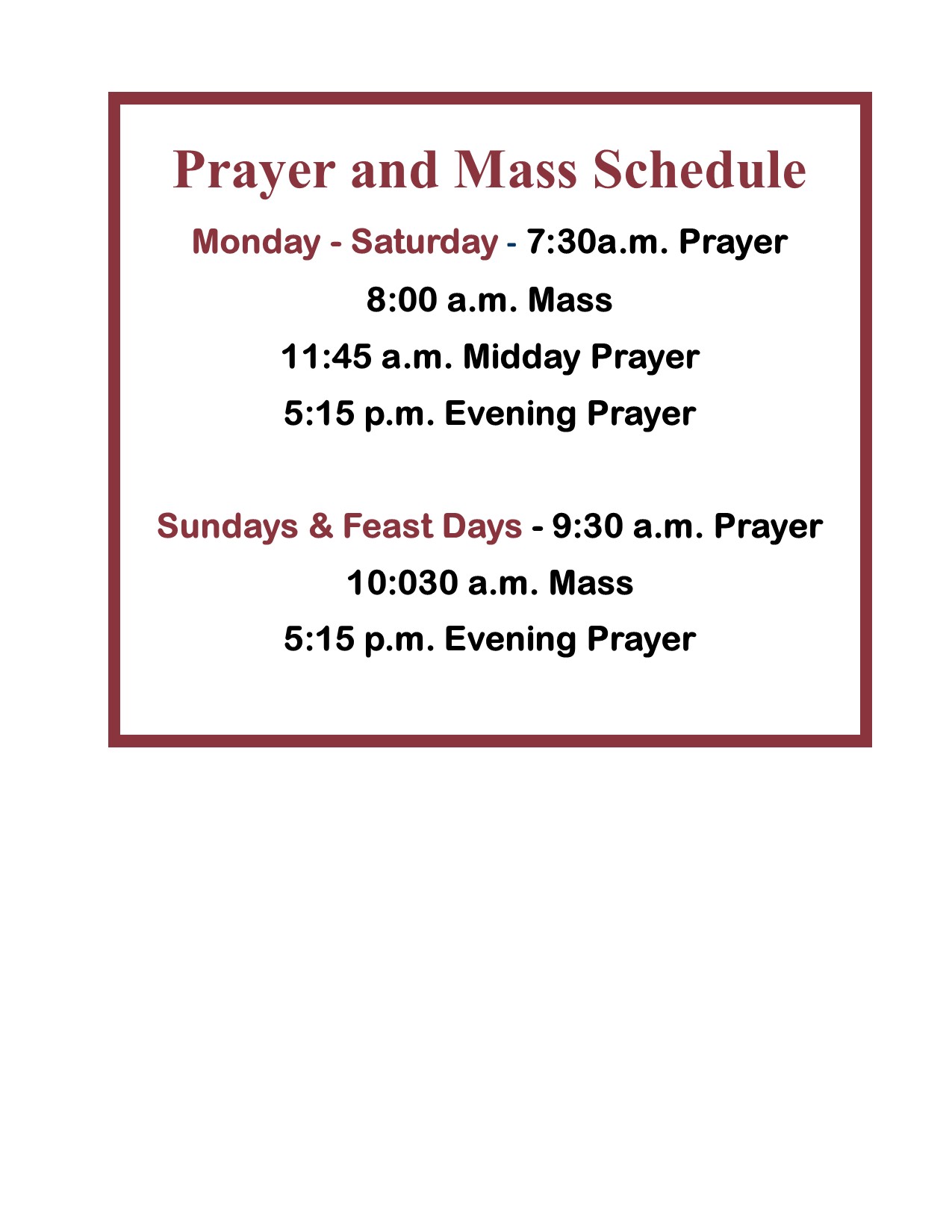
 Mass Schedule

Related Links

Copyright © 2026 · Benedictine Sisters of FL · Touching Lives Through Prayer and Service

Copyright © 2026 · Bendedictine Theme on Genesis Framework · WordPress · Log in