• Skip to primary navigation
  • Skip to main content
  • Skip to footer
Benedictine Sisters of FL

Holy Name Monastery
Founded 1889

Donate Now
  • Home
  • About Us
    • History
    • Being Benedictine
    • Benedictine Monasticism
    • Meet Our Community
    • Holy Name Academy-Alumnae
  • What We Do
    • Mission, Vision and Our Partners
    • Retreats
      • Invitation to Retreat
      • Accommodations
    • Volunteer Programs
    • Oblate Program
    • Spiritual Direction
    • Aqua/Hydroponics
    • More of Our Ministries
  • What’s Happening
    • Articles of Interest
    • Events
    • Commemorative Bricks
    • Newsletters
    • Brochures
    • Links
  • Support Us
    • Gifts of Support
    • Wish List
  • Stories Shared
  • Galleries
    • Photos
    • Videos
      • Benedictine Sisters of FL Videos
      • Other Videos
  • Contact Us

Mary

Mary and Elizabeth Rejoicing

December 26, 2018 by Holy Name Monastery Leave a Comment

It is appropriate in the season of Advent that we consider the role of Mary in God’s plan of salvation.  Mary’s faith enabled her to recognize the work of God in her people’s history and in her own life.  Her openness to God allowed God to work through her so that salvation might come to everyone.   Because of this, Mary is a model and symbol of the Church.

The story on the fourth Sunday of Advent is about two pregnant women, the first one 6 months along is already experiencing the movement of the child in her womb.  The baby leaps when her cousin calls out to her.  This is a story of utter delight of a meeting of mothers and infants.  The babies, John and Jesus – both of whom got their names directly from angels of God.  They were to be friends and fellow prophets, recognized each other when they were still in the womb.

First, we hear about Mary and her journey.  When left her Mary eagerly goes dancing over the hills (well, maybe not quite “dancing” after all the distance she traveled was close to 50 miles).  Did she tell anyone on her way about the angel, the message or why she was hastening to her cousin?  I’m guessing she might have shared her experience and her concerns with her mom, Anne.

Rushing to share her secret with her cousin, Mary found another surprise: old Elizabeth was expecting a child of her own!  God was up to something big here!  Elizabeth greets Mary with full recognition of the roles that they and their unborn children will play in God’s plan for salvation.  If we were to continue to read the verses that follow in Luke’s Gospel, we would hear Mary respond to Elizabeth’s greeting with her song of praise, the Magnificat.  Both women recall and echo God’s history of showing favor upon the people of Israel.

To me, in this part of the Nativity story, Elizabeth is the star of the show and we do well not to overlook the significance of Elizabeth’s role in our salvation history.  She is the “amazed saint.”  She is exemplary in her response to her baby’s movement in her womb.  She is so in tune with her own body, she appreciates that something new and wonderful is going on here.  Elizabeth then broke out in joyful exclamation!  “Why am I so favored?”  Hers is humble amazement at being able to participate directly in God’s plan.  How muted Zechariah must have wished he, too, could sing with his wife over Mary’s news!  We who have a role in God’s plan should share this wonder.

Some of you may recall Fr. Simeon sharing a one-minute nugget of a Fourth Sunday of Advent homily in which you’ll find these lines:


Two women, cousins.

Girls giggling gladness, dancing delirious dream,

Marveling mystery, barely hearing –


He ended with this question: “Can God enter earth if there are no women?”

~Reflection by Sister Roberta Bailey, OSB, Prioress
 

First Reading  Micah 5:1-4            Second Reading   Hebrews 10:5-10
Gospel Reading  Luke 1:39-45              Intention   Christmas Novena
Continue Reading

Filed Under: Blog, Front Page, Homily Tagged With: Advent, Elizabeth, God, Jesus, journey, Mary, nativity

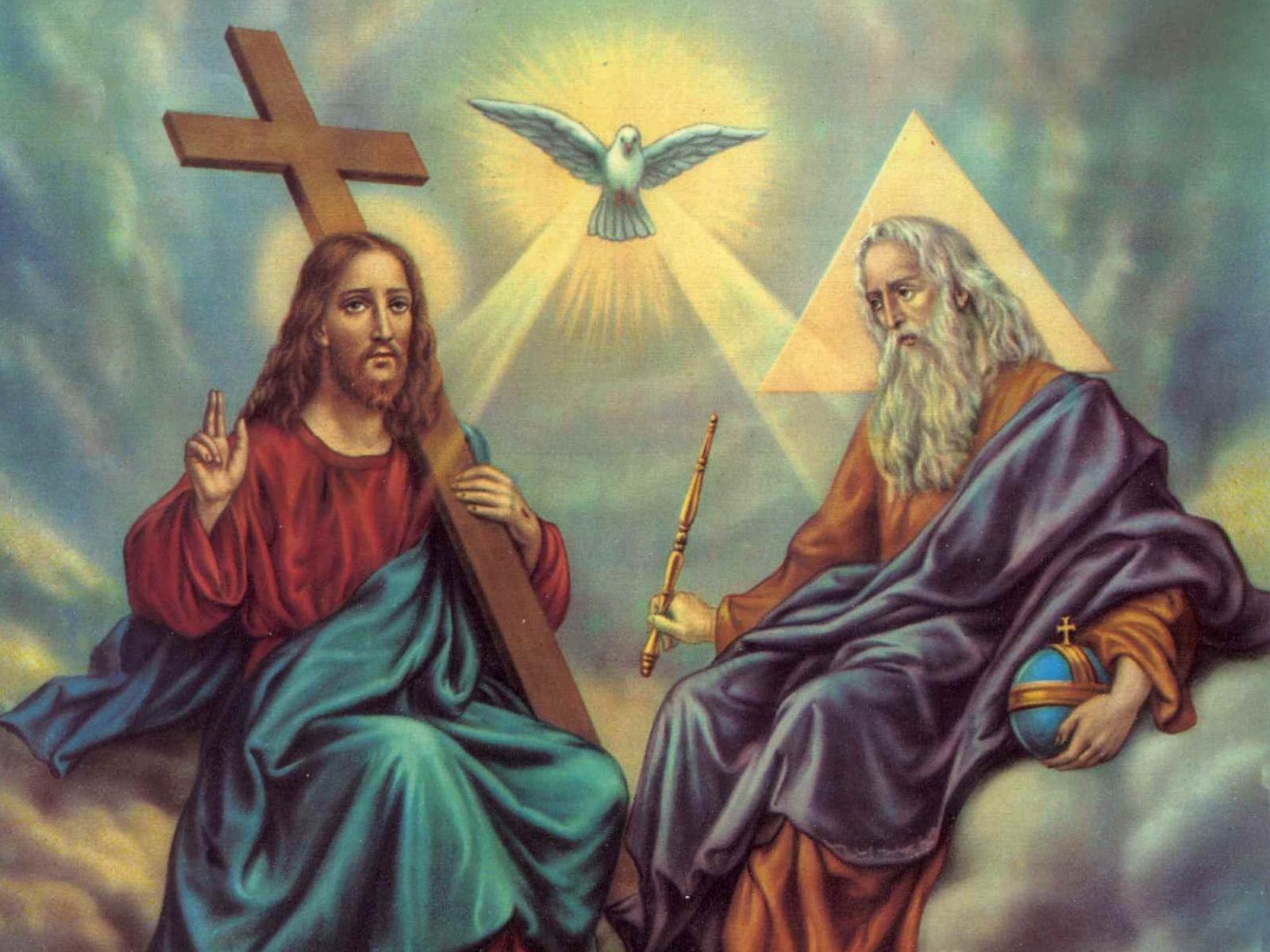
SOLEMNITY of the TRINITY

May 29, 2018 by Holy Name Monastery 1 Comment

May 27, 2018

You may have heard the expression, when referring to age: 70 is the new 50.  Well, in Scripture seven is considered to be a sacred, perfect number.  But today’s feast, the solemnity of the Trinity, tempts me to say “3 is the new 7.”

Some say that “Two’s company; three’s a crowd” but today’s feast would have it otherwise.  In this instance, the figure three symbolizes completeness and perfect symmetry.  The Holy Trinity is a mystery beyond the grasp of human reasoning.  It reminds us of some key moments of the Christ story.  For example, when Jesus stood before John in the River Jordan, the Spirit hovered and the Father’s voice was heard: “This is my beloved Son.”

Recall the Christmas nativity scene.  There were three figures: the Holy Family – Mary, the mother, Joseph, the guardian, the stand-in father, and the infant Jesus.  And, according to tradition, who tracked them down through the desert and into Egypt – the three wise men.  33 or so years later, when Jesus was preparing for his public life he went back to a desert.  And, there he was tempted three times by the devil.

All of us like a good story.  And, Jesus was a story-teller par excellence.   He learned early on at his mother’s knee, or watching her bake bread for the day, or from his favorite bedtime stories that every good story has a beginning, a middle and an end.

We see this in Jesus parables.  The story of the Prodigal Son is about a father and his two sons.  How many passersby were in the story of the Good Samaritan?  A priest, a Levite and the Samaritan.  And, what about the farmer who went out to sow his seed?  Jesus talks about three different types of terrain yielding three different levels of harvest.

At the end of Jesus’ life, like at the beginning, we see the three motif.  During his Passion, Peter denied him thrice.  On the road to Calvary, he fell three times.  In the Crucifixion scene, you’ll recall we see three figures, Christ between two thieves.  At the foot of the cross stood Mary, his mother, and two other Mary’s.  Before his resurrection, he spent three days in the tomb.

Scripture does not explicitly teach the doctrine of the Holy Trinity; it is rather assumed especially through the story of Jesus’ baptism.  The early Christians struggled to explain their understanding that Jesus was God on earth as a human being.  “Trinity” or ‘tri-unity’ was the term that developed in an attempt to explain the relationship between God, Jesus Christ and the Holy Spirit.  The Apostles Creed predates the Nicene Creed which was decreed in AD 325, to formalize the teaching about the Trinity.  Either Creed is approved by the Church to be recited during the Eucharistic liturgy.  “We believe in one God.  We believe in one Lord, Jesus Christ, the only Son of God.  We believe in the Holy Spirit, the given of life.”

This inner relationship of the Father, Son and Holy Spirit is such that each of them is fully and equally God, yet there are not three Gods but one God.  This is incomprehensible to the human mind.  It is a mystery.  Together the three Persons in the Trinity, the Father the Son and the Holy Spirit represent the fullness of love.  The Father loves the Son, the Son loves the Father.  The Holy Spirit is their love for each other.

But love is only a word until someone gives it meaning.  We are made in the image of a triune God – God the Father, who created us, his Son who saved us, and the Holy Spirit who continues to guide us.  To be true to our calling we must be the ones who give meaning to Love in our world.  As Paul says in the second reading to the Romans: We did not receive the spirit of slavery, but of adoption …  we are heirs of God with Christ and destined to be glorified with him.”

A “Trinitarian- like movement” in our prayer life echoes the rhythm of our whole lives.  In Lectio we go up the mountain with Jesus, we have conversation with Him there, and we return to life among his people.  In our community prayer, (again a three-fold movement) we bow, we sit, we stand.  In our chants, we don’t always have to harmonize but we do strive to keep our voices in harmony with each other – one heart, one voice.

In tomorrow’s Responsorial Psalm we will sing: “Blessed the people (that’s us) the people the Lord has chosen to be His own!”  Our lives, individually and as a community, reflect the Trinity.  We are called to be creative like the Father, compassionate like God the Son, and, like the Holy Spirit to use our gifts and talents in service to others.

For “There are three things that last: faith, hope and love.  And the greatest of these is Love!”

~Reflection by Sister Roberta Bailey, OSB, Prioress
Continue Reading

Filed Under: Blog, Front Page, Homily Tagged With: Father, God, Holy Spirit, Jesus, Joseph, Mary, Son, Trinity

What if …

May 21, 2018 by Holy Name Monastery Leave a Comment

Pentecost  2018

This weekend, for the Solemnity of Pentecost, between the Vigil Mass and the “During the Day” Mass there are eleven (11) selections for readings.

We’re all familiar with the Pentecost story.  The Apostles, along with Mary the mother of Jesus, had locked themselves in an upstairs room.  They were frightened by all that had happened, anxious and terrified that at any minute the authorities would come crashing through the door.  Looking back on the mystery of Pentecost, Paul wrote to his followers exhortations to live by the Spirit.  He reminds them “no one can say, ‘Jesus is Lord’, except by the Holy Spirit.”  He tries to unravel the mystery in terms they can relate to.  He speaks of gifts of the Spirit, forms of service, different workings, and the fruits of the Spirit.  He explains how those who are filled with the Spirit will conduct themselves and what vices they will refrain from.

In this reflection I’ll circle through the readings from the Letters of Paul to the Galatians, the Romans and the Corinthians.  I wonder what would Paul say to us today?  I suspect he would say much the same things he wrote to his audience of his time.  He might personalize it a bit to highlight the gifts present particular body of people he was addressing  – gifts that manifest the Spirit for the edification and benefit to the community.

He might say: You do know that to all of you, and each of you is given the gift of faithfulness to prayer, stability to each other and an endeavor for life-long learning.  To one may be given the aptitude of expressing psalmody in musical settings; to another the skills to lift the notes off the page in song and to another the gift of prayer in poetry.  To one is given the gift of sensitivity to the needs of the poor and to others the gift of touching the heart of the weary.  One may have the gift of never knowing a stranger, and another the flair and daring to entertain the community with her ability to emcee a party.  To one is given the gift of calligraphy and to another the proficiency and insight to write icons.   To one is given the gift of fingers that dance across the keyboard and to another a green thumb that provides food for the table; to a gardener the knack that raises flowers from the dirt and another the gift of arranging bouquets that inspire prayer.  To some there is given a volunteer’s heart with a seamstress skill or a caterer’s aptitude.  You are witness to a woman’s response to begin a journey in community and you are daily graced to witness each other’s perseverance in a life-long commitment to community and a combined effort to feed the hungers of the people of God.

Paul speaks again: “There is diversity of gifts, but the same Spirit distributes them. There are different kinds of service, but the same Lord.  There are different kinds of working, but in all of them and in everyone it is the same God at work. Now to each one the manifestation of the Spirit is given for the common good.”

“But, what if,” you may ask, “I haven’t found my gift yet.  Or my gift seems to be changing over the years?”  Listen to the voice in your heart: “My child, you always have the gift of prayer …  that doesn’t change … the expression of prayer, the words you use, the method you practice are all conversation with God, spoken or unspoken.”  Remember the old Chinese proverb: “A Bird Does Not Sing Because It Has an Answer.  It Sings Because It Has a Song.”  Fr. Ed Lamp recently shared this message inspired by a poster with that saying that he saw in a family’s home in Merida.  He wrote:

When it comes to living our lives, we seem to always be looking for a purpose – a reason for everything, and a reason to do anything.  We seek fulfillment through love, and our family, through jobs and careers, and through our friends and hobbies.  We’re desperate to have a purpose and to understand the meaning of all of it – the meaning of life.  Why are we here and why do we do what we do?

But what if you let go of the idea that everything needs a purpose?  What if you let go of all the “musts” for a moment, just to be present right here and now?  What if you decided to sing, just to sing, but not necessarily because you have an answer?

Because I’m not so sure that we really need an answer, if we can find a way to just enjoy where we are at this moment.  Isn’t it enough to just be alive, and to be here, experiencing the full beauty and wonder of life?

“A bird does not sing because it has an answer, but because it has a song.”  It sings simply because it wants to, and to share something beautiful with its surroundings.  And what other purpose do we humans really have, other than to be alive and enjoy the moment that we are in, making ourselves and the people around us happy; doing what comes naturally to us, and to just live in the present and enjoy the beauty of life.

So try to release the stress of finding a purpose.  You are living your purpose right now.  …Singing a song with your life for no special purpose …  just “because” you have a song – a part in the grand harmony of the miracle of Pentecost – They were filled with Holy Spirit and began to sing in different voices, as the Spirit enabled them to proclaim the mighty acts of God.

~Reflection by Sister Roberta Bailey, OSB, Prioress


Continue Reading

Filed Under: Blog, Front Page, Homily Tagged With: apostles, God, Holy Spirit, Jesus, Mary, Paul, Pentecost

From Holy Week into the Rest of our Lives

April 10, 2017 by Holy Name Monastery Leave a Comment

Excerpts from “Opening Doors to Jesus & with Jesus”

A reflection inspired by a homily by St. Pope John Paul II

The liturgy of Palm Sunday is a kind of solemn entrance into Holy Week. Yet Holy Week itself is an entry into something greater. Palm Sunday combines a welcoming of Jesus and a welcoming of Jesus into our most sacred place. This is a place more our own than Jerusalem.   Jesus came to the so-called “city of peace” and was welcomed by a great crowd. In a certain way this city can symbolize the human race and its ambivalent reaction to the coming of Christ.

Today we want to belong to the crowd of welcomers. But if we welcome Jesus as our Lord then we must remember that he is Lord of truth, freedom, justice and love. We welcome him precisely as Lord insofar as we also welcome these realities with faith and joy, not just outside but inside ourselves. If we know what we are doing, we realize we are being called to work with Jesus, and one another, to build peace and justice and truth and love. That begins with our opening of ourselves to Jesus’ coming, and involves committing ourselves to work with him to build these realities within ourselves. This, at least, is the first step. But all are not ready to do this. So we have to be ready also to accompany Jesus to the cross. Who can guide us as we too climb the hill of Calvary with our Divine and Human Teacher? There is no better guide than Mary. What she teaches is part of the gift we receive when in accepting her as our spiritual Mother.

St. John has to open his home; we have to open ourselves, our most sacred inner place. We start by welcoming her but that will lead us to welcome others. Will we respond as generously as Mary to the Lord’s call? Will we persevere with joy and fidelity in the mission to others that this implies? Will we let Mary teach us this? O Mary, give us your eyes so that on the face of the crucified Jesus we may recognize that of the Risen One, the one who fears nothing when doing what the Heavenly Father has called him to be and do.

The first lesson is that of standing at the cross and joining Jesus’ love and forgiveness. The second lesson is that of opening our heart to all those who need love and forgiveness. This is our path into Holy Week and it is the path of our entire life as we come from Holy Week into the rest of our lives.

~ by Sister Roberta Bailey, OSB, Prioress
Continue Reading

Filed Under: Blog, Homily Tagged With: Christ, Holy Week, Jerusalem, Jesus, Mary, Palm Sunday

Advent – Guadete (Rejoice) Sunday

December 12, 2016 by Holy Name Monastery 1 Comment

This past week we celebrated some feasts that are frequently connected in our minds to the customs of Christmas time: St. Nicholas shoes, the Immaculate Conception of Mary, and next week we’ll honor our Lady of Guadalupe (roses in the snow) and St. Lucy, patron of the sight-limited and blind, with crowns of lit candles and cat cookies.  And, this weekend the liturgy says: “take a breather – we’re halfway to Christmas.”

Two figures, John the Baptist and Mary the Mother of God, stand out in the Advent Gospels as we prepare for Christ’s birth.  John’s purpose in preparing us for Christ is fourfold: to bring knowledge of salvation, to bring forgiveness of sins, to give light in the darkness, and to guide us in the way of peace.

First, John models for us simplicity.  He lived a simple life, keeping his focus on Christ in everything he did.  We, too, strive to keep our focus on the true purpose of Christmas – the celebration of the birth of our Lord – much more than gift-giving.

Second, John lived a life of fasting.  We too can make little sacrifices for others during Advent, thereby keeping the focus off of consumerism and placing it on relationships – with Christ and with others.

Third, John forgave others.  We too can make a commitment to forgive others this Advent.  In forgiveness therapy there is a belief that anger is due to a lack of forgiveness and a lack of forgiveness is due to anger.  The two feed off each other.  Thus, if you are feeling angry, practice forgiveness.  What a great time to offer the gift of forgiveness to a love one, a confrere, or a coworker.

Fourth, John lived a virtuous life.  We too can focus on increasing the positive in our lives and letting go of the negative. Following John’s lead is a great way to our lives peaceful.

The Blessed Virgin Mary is the other figure that prepares us for Christ’s birth.  Mary’s face in many sculptures, icons and images exemplifies the peace she must have exuded in her life.  Her peace came from putting Christ at the center of all she did.  Like Benedict says (in his Rule): put nothing whatever ahead of Christ.”  Mary’s “yes” was the ultimate gift she could give and she offered it peacefully.

We ask ourselves: what is my best?  What can I give to God this advent season?

This story, told in this month’s Catholic Digest illustrates the lesson that God cannot not be undone is generosity.  I quote:  When I was a child, my parents would have my siblings and me create a list of Christmas gifts we wanted that year.  Then, they would find children in need who were the same age and gender as we were.  My parents then asked us to give our No. 1 item to that child and cross it off our list.  It was a huge sacrifice for us – and a lesson in giving our best to God.

One year my brother wanted an action figure and was very upset that he was being asked to give that same action figure to another boy who had very few, if any, toys.  He balked at giving this best and did it only reluctantly that year.  Once it was gone, he knew it was off his list for the year, at least from my parents.  However, our aunt, not knowing our family practice, or what my brother’s best gift was and that he had given it away, gave him that same action figure for Christmas.  The joy on his face was radiant, as he exclaimed: “I’m giving God my best gift every year!”

What is your best give?  Just like the Blessed Virgin Mary, what can you give to Christ this year, knowing that the reward for giving is beautiful?

In tomorrow’s Entrance Antiphon (from Paul to the Philippians)  the Church exhorts us: “Rejoice in the Lord always; again I say, rejoice!”  The antiphon reminds me of a hymn made popular by S. Miriam Therese Winter, with her peppy guitar rendition of “God Loves a Cheerful Giver.”  You may remember it – if so, sing:

God loves a cheerful giver, give it all you’ve got,
He loves to hear you singing when you’re in an awkward spot,
When the odds are up against you,
It’s time to stop and sing – Praise God,
to praise Him is a joyous thing!

Do what the church says, “Rejoice in the Lord always; again I say, rejoice.”

(Disclaimer: in this reflection, I’ve borrowed a good bit from an article in this month’s Catholic Digest “Creating Advent Peace in Your Life” by Lisa Kiewicki)
~Relection by Sister Roberta Bailey, OSB, Prioress
Continue Reading

Filed Under: Blog, Homily Tagged With: Advent, Christ, Christmas, God, John, Mary, Peace

Second Sunday of Easter

April 4, 2016 by Holy Name Monastery Leave a Comment

christ is risen w tombWelcome to the Second Sunday of Easter.  Notice it’s “of”, not “after” .. because, you know this, Easter’s not a single day, or even an octave but a season of 50 days.

There’s no question that we know how to do Easter as an even: the question is … How are we at Easter as a way of life?

The great Easter truth we celebrate is not that we are going to live anew after death, but, by the power of Jesus’ resurrection we are new here and now!

“Here and now” – that’s easier said than done. If it’s any consolation, the first Christians: those who had the direct experience of our risen Lord don’t seem to have been much better at it than we are.  During the Easter season we’ll be reading a series of “post – resurrection” stories: the women at the tomb who seemed to have forgotten the “punchline”: that Jesus told them he would rise after three days. It took the angels to remind them of that rather important detail. And then they ran back to tell the disciples, but, the men didn’t believe them!  And, Mary in the garden?  She thought Jesus was the gardener

Imagine today’s Gospel scene.  It’s a week later.  Without warning, Jesus is in their midst – no time to run and hide under the table.  He’s THERE.  Someone’s first reaction was probably, who left that door open?  Immediately, Jesus “breathed on them”.

Some things we just can’t see. But we know they’re there anyway. Like the air when a gentle breeze caresses our cheek.  God’s love is sort of like the air, isn’t it? It fills us up –  even though we can’t see it – we can feel it in our hearts.  When Jesus breathed on them, Thomas who had missed Jesus’ first visit and wants to see Jesus with his very own eyes, expresses his belief. But Jesus reminds him of something very important.   Sometimes we just have to believe in things that we can’t see. We have a special name for that. We call it “faith.”

You may recall the words of several hymns that refer to the spirit breath of God: “Be our breath,” “fall afresh on me,” “whose breath is seed outpoured –  calling all things to birth,” “with your breath melt the frozen, warm the chill,”        One of my favorite Marian hymns often heard at Christmas, is sung by Amy Grant, entitled “Breath of Heaven.  It’s the story of Mary’s pondering the workings of the Incarnational Spirit within her.  Mary’s prayer becomes mine: “Breath of heaven, Hold me together, Be forever near me, Breath of heaven – Be with me now, lighten my darkness, Pour over me your holiness, for you are holy, breath of heaven.”

It has become for me a prayer: to be filled with the breath of God … And, that’s what Easter as a way of life is all about. And it’s a way of life we live one day at a time: one step at a time — trusting that even if we take a mis-step, we never journey so far from God that the life-giving breath of that Spirit is beyond our reach: even when that seems impossible to believe.

That’s the lesson we learn from Thomas who has gone down in history as “doubting Thomas” because he refused to accept the testimony of others, but demanded his own experience.  He has borne the brunt of almost two millennia of bad press because of His skepticism about the resurrection and Jesus’ appearance to the other disciples.  Yet, what did Thomas ask for that the others had not received?  They had seen Jesus. They had maybe had a chance to touch His wounds.  Why is Thomas ridiculed for his insistence that he see for himself?

I’m a little intrigued, actually, about how quick we are to make Thomas the poster child for faithless doubt. As a matter of fact, the rest of the bunch didn’t do any better.  Remember:  the women at the tomb, the men who didn’t believe the women’s story, Peter who runs back to see for himself …. and here are the “faithful” disciples, after the appearance of Jesus: still locked in the upper room.

Think about it:  why did Thomas come back at all. Whatever had taken him away from the community, he came back. And it was in the midst of the community that Jesus came to him, and without so much as a confession or absolution, offered him what he needed to believe: “Touch, me Thomas. Do not be faithless, but believing.”

One of Thomas’ great virtues was that he absolutely refused to say that he understood what he did not understand, or that he believed what he did not believe. There was an uncompromising honesty about him: he would never still his doubts by pretending they did not exist.

But, he refused to surrender to the fear, too, which kept the other disciples shut up in that locked room. He ventured out and then had the courage to come back – to face a community which had had an experience that he had not shared.  At first he insisted on his own experience of God.   Jesus knew what he needed – He extended his hand to him – not a hand out; but a hand up, the nudge Thomas’ needed to bolster his faith “my Lord and my God.”  This is our challenge, and our privilege, to figure out what people need –  to offer the comfort, security and peace that will bolster their faith in a loving God.  This, too, is the challenge the Good Shepherd extends to us on Divine Mercy Sunday: to lead people to green pastures, where, surely goodness and kindness and mercy may follow them all the days of their lives.”

With Thomas, and all whose faith wavers:  we pray, “Breathe on me breath of God, until my heart is pure. Until with you, my will and Yours are one – not my will but yours be done.”

~ Reflection by Prioress, S. Roberta Bailey, OSB


Continue Reading

Filed Under: Blog, Homily Tagged With: 50 days, Easter, God, Jesus, Lord, Mary, risen, Second Sunday, Thomas

  • « Go to Previous Page
  • Page 1
  • Page 2
  • Page 3
  • Page 4
  • Page 5
  • Go to Next Page »

Footer

Prayer / Newsletter / Info

 Contact Info

Benedictine Sisters of Florida

PO Box 2450
12138 Wichers Road
St. Leo, FL 33574-2450
(352) 588-8320
(352) 588-8443

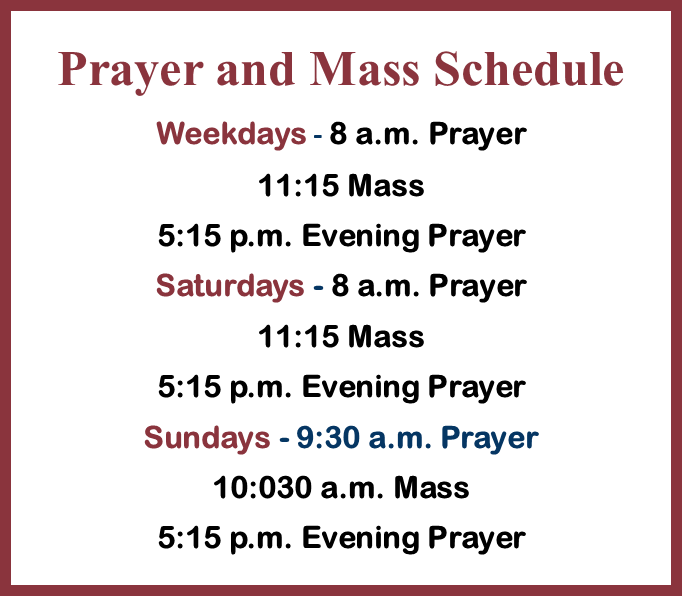
 Mass Schedule

Related Links

Copyright © 2026 · Benedictine Sisters of FL · Touching Lives Through Prayer and Service

Copyright © 2026 · Bendedictine Theme on Genesis Framework · WordPress · Log in