• Skip to primary navigation
  • Skip to main content
  • Skip to footer
Benedictine Sisters of FL

Holy Name Monastery
Founded 1889

Donate Now
  • Home
  • About Us
    • History
    • Being Benedictine
    • Benedictine Monasticism
    • Meet Our Community
    • Holy Name Academy-Alumnae
  • What We Do
    • Mission, Vision and Our Partners
    • Retreats
      • Invitation to Retreat
      • Accommodations
    • Volunteer Programs
    • Oblate Program
    • Spiritual Direction
    • Aqua/Hydroponics
    • More of Our Ministries
  • What’s Happening
    • Articles of Interest
    • Events
    • Newsletters
    • Brochures
    • Links
  • Support Us
    • Gifts of Support
    • Wish List
  • Stories Shared
  • Galleries
    • Photos
    • Videos
      • Benedictine Sisters of FL Videos
      • Other Videos
  • Contact Us

Homily

Message of His Holiness Pope Francis

May 8, 2017 by Holy Name Monastery Leave a Comment

[An adaptation of excerpts from] Pope Francis’

MESSAGE FOR THE 54th WORLD DAY OF PRAYER FOR VOCATIONS

Sunday, May 7, 2017


In the last few years, we have considered two aspects of the Christian vocation: the summons to “go out from ourselves” to hear the Lord’s voice, and the importance of the ecclesial community as the privileged place where God’s call is born, nourished and expressed.

Now, on this 54th World Day of Prayer for Vocations, I would like to reflect on the missionary dimension of our Christian calling. Those drawn by God’s voice and determined to follow Jesus soon discover within themselves an irrepressible desire to bring the Good News to their brothers and sisters through proclamation and the service of charity.

Commitment to mission is not something added on to the Christian life as a kind of decoration, but is instead an essential element of faith itself. A relationship with the Lord entails being sent out into the world as prophets of his word and witnesses of his love.

In the depths of their hearts, all disciples hear this divine voice bidding them to “go about,” as Jesus did, “doing good and healing all.”

To be a missionary disciple means to share actively in the mission of Christ. Jesus himself described that mission in the synagogue of Nazareth in these words: “The Spirit of the Lord is upon me, because he has anointed to bring good news to the poor. He has sent me to proclaim release to the captives and recovery of sight to the blind, to let the oppressed go free, and to proclaim the year of the Lord’s favor.” This is also our mission: to be anointed by the Spirit, and to go out to our brothers and sisters in order to proclaim the word and to be for them a means of salvation.

Our mission might appear to be mere utopian illusion or at least something beyond our reach. Yet if we contemplate the risen Jesus walking alongside the disciples of Emmaus, we can be filled with new confidence. Jesus transformed the disciples’ discouragement. He made their hearts burn within them, and he opened their eyes by proclaiming the word and breaking the bread. In the same way, we do not bear the burden of mission alone.  We come to realize, even amid weariness and misunderstanding, that “Jesus walks with us, speaks to us, breathes with us, works with us”.

The seed of the Kingdom, however tiny, unseen and at times insignificant, silently continues to grow, thanks to God’s tireless activity.  God surpasses all our expectations and constantly surprises us by his generosity. He makes our efforts bear fruit beyond all human calculation.

With this confidence born of the Gospel, we become open to the silent working of the Spirit. There can be no promotion of vocations apart from constant contemplative prayer.  Our life needs to be nourished by attentive listening to God’s word and, above all, by the cultivation of a personal relationship with the Lord in the Eucharist, our privileged encounter with God.

I wish heartily to encourage this kind of profound friendship with the Lord, above all for the sake of imploring from on high new vocations to the priesthood and the consecrated life. I ask parish communities, associations and the many prayer groups present in the Church, not to yield to discouragement but to continue praying that the Lord will send workers to his harvest.

Dear brothers and sisters, today too, we can regain fervor in preaching the Gospel and we can encourage young people in particular to take up the path of Christian discipleship. Despite a widespread sense that the faith is listless or reduced to mere “duties to discharge,” our young people desire to discover the perennial attraction of Jesus, to be challenged by his words and actions, and to cherish the ideal that he holds out: a life that is fully human, happy to spend itself in love.

Mary Most Holy, the Mother of our Savior, had the courage to embrace this ideal, placing her youth and her enthusiasm in God’s hands. Through her intercession, may we be granted that same openness of heart, that same readiness to respond, “Here I am,” to the Lord’s call, and that same joy in setting out, like her, to proclaim him to the whole world.

~Reflection by Sister Roberta Bailey, OSB, Prioress
Continue Reading

Filed Under: Homily Tagged With: Christ, Christian, God, Jesus, Pope Francis, Prayer, World Day of Prayer for Vocations

“Not the Kind of Perfect the Ninjas or Superman Display”

April 24, 2017 by Holy Name Monastery 1 Comment

First Reading  Acts of the Apostles 2:42-47   Second Reading   1 Peter 1:3-9
Gospel  John 20:19-31     Weekly Intention

The Frailty of Easter  Based in part on a reflection by John Slattery  (adapted)

We humans are a comparatively slow maturing and short-lived species. The average life-span in the United States hovers between 75 and 80.  The age of the earth, on the other hand, is around 4,500,000,000 years.  The age of the universe is around 13,800,000,000 years.  You and I inhabit just a small bit of that time, the tiniest morsel of space time lived out on a relatively small planet that orbits an average size star.  Our star, the Sun, is one of trillions upon trillions of stars, and our planet is one of trillions in the known universe.  But it’s ok.

Easter is all about smallness.   That’s why we are drawn to reading and re-reading the Easter accounts in the Gospels each year.  Despite the ocean of books, songs, sermons, and lectures written about Easter or on Easter-themes, our Scripture includes just four small stories about this Jesus who rose from the dead.  The combined resurrection stories encompass about 3500 words–the equivalent of about 15 pages, the length of an average term paper.

Jesus’ resurrection was such a humble thing.  There were no angel trumpeters or singers in the skies. It was more like the story in Psalm 119 that we prayed yesterday morning: “Without a word, without a sound, without a voice being heard, the message fills all the earth, resounding to the ends of the universe.”    First, Jesus surprised Mary in the garden.  She told a few other women,  then they told a few men and soon Jesus appeared to them.  He spoke about peace, about the Spirit of God, about hope.  He showed his wounds.  He ate some food and then he drifted up into the clouds.  He didn’t march on Rome or lead a rebellion against the priests who brought him to Pilate.  After his resurrection He didn’t heal anyone else or preach to vast crowds as He had done previously.  He didn’t cast out any more demons, trade barbs with rabbis, or visit the Temple.  The resurrection, in many ways, was quiet.

It challenges us to read that Jesus showed his followers his wounds.  “See,” he seems to say, “a broken body is not made whole by erasing the imperfections.  Feel this hole in my side,” he says to Thomas and to each of us.   “See, I have sanctified what the world calls spoiled.  A broken body is made whole not by removing the scars but by embracing the permanence of the wounds.”

We like this small and quiet resurrection where Jesus is not the definition of a contemporary superhero.  He doesn’t return triumphant and knock Pilate off his throne, bringing God’s wrath on the vicious Roman Empire.  He appears to his friends, simply showing his wounds and talking about love and peace.

This story today of Thomas illustrates our Christian experience. We are called to believe without seeing.    In fact, all Christians after the first witnesses have been called to believe without seeing. Thus, we sing “without seeing you, we love you; without seeing you, we believe.”  Thomas’ doubt is hardly surprising; the news of Jesus’ appearance was incredible to the disciples who had seen him crucified and buried. Thomas’ human nature compelled him to want hard evidence that the Jesus, who appeared to the disciples after his death, was indeed the same Jesus who had been crucified. Thomas is given the opportunity to act on that desire. He is our witness that Jesus is truly raised from the dead.  With him we proclaim: “We’ve been told, we’ve seen his face, and heard his voice alive in our hearts.”

Jesus wants us to be perfect, but not the kind of perfect that Ninjas or Superman display.  Jesus wants us to be perfect “as our heavenly Father is perfect.”  God’s perfection and the message of Jesus’ Resurrection calls us an unconditional embrace of frailty, pain, and brokenness.

It is an embrace that calls us to resist all forms of violence, power, and hatred.  There is growing acknowledgement of that fact that TV and video game violence, like second-hand smoke affects one’s lungs, permanently affects our brains.  Many families refuse to allow TV violence, fictionalized or news reports, to invade their living spaces.  Jesus did not arm his apostles with weapons for revenge — he armed them with prayer and baptized them in a spirit of hope and forgiveness.

We are surrounded today with so much sadness and fear and anger.  We who live in a peaceful community rejoice in the security and sanctity that empowers us to extend open arms in hospitality to those in the world who yearn for that same privilege.

At the end of our Gospel selection we read, “Jesus did many other signs that are not written in this book.  But these ARE written that you may come to believe …and through this belief you may have life in Jesus’ name.

We join the psalmist in singing: By the Lord has this been done; it is wonderful in our eyes.  This is the day the Lord has made; let us be glad and rejoice in it.”

~Reflection by Sister Roberta Bailey, OSB, Prioress
Continue Reading

Filed Under: Blog, Homily Tagged With: Easter, God, Jesus, Jesus' resurrection, John Slattery, unconditional embrace

From Holy Week into the Rest of our Lives

April 10, 2017 by Holy Name Monastery Leave a Comment

Excerpts from “Opening Doors to Jesus & with Jesus”

A reflection inspired by a homily by St. Pope John Paul II

The liturgy of Palm Sunday is a kind of solemn entrance into Holy Week. Yet Holy Week itself is an entry into something greater. Palm Sunday combines a welcoming of Jesus and a welcoming of Jesus into our most sacred place. This is a place more our own than Jerusalem.   Jesus came to the so-called “city of peace” and was welcomed by a great crowd. In a certain way this city can symbolize the human race and its ambivalent reaction to the coming of Christ.

Today we want to belong to the crowd of welcomers. But if we welcome Jesus as our Lord then we must remember that he is Lord of truth, freedom, justice and love. We welcome him precisely as Lord insofar as we also welcome these realities with faith and joy, not just outside but inside ourselves. If we know what we are doing, we realize we are being called to work with Jesus, and one another, to build peace and justice and truth and love. That begins with our opening of ourselves to Jesus’ coming, and involves committing ourselves to work with him to build these realities within ourselves. This, at least, is the first step. But all are not ready to do this. So we have to be ready also to accompany Jesus to the cross. Who can guide us as we too climb the hill of Calvary with our Divine and Human Teacher? There is no better guide than Mary. What she teaches is part of the gift we receive when in accepting her as our spiritual Mother.

St. John has to open his home; we have to open ourselves, our most sacred inner place. We start by welcoming her but that will lead us to welcome others. Will we respond as generously as Mary to the Lord’s call? Will we persevere with joy and fidelity in the mission to others that this implies? Will we let Mary teach us this? O Mary, give us your eyes so that on the face of the crucified Jesus we may recognize that of the Risen One, the one who fears nothing when doing what the Heavenly Father has called him to be and do.

The first lesson is that of standing at the cross and joining Jesus’ love and forgiveness. The second lesson is that of opening our heart to all those who need love and forgiveness. This is our path into Holy Week and it is the path of our entire life as we come from Holy Week into the rest of our lives.

~ by Sister Roberta Bailey, OSB, Prioress
Continue Reading

Filed Under: Blog, Homily Tagged With: Christ, Holy Week, Jerusalem, Jesus, Mary, Palm Sunday

Fifth Sunday of Lent

April 3, 2017 by Holy Name Monastery Leave a Comment

First Reading  Ezekiel 37:12-14           Second Reading  Romans 8:8-11
Gospel  John 11:1-45 (shorter version John 11:3-7,17,20-27,33b-45)

This story of Jesus raising Lazarus from the dead is so familiar I’m curious what I need to hear this Lenten season.  I feel the anguish of the sisters and friends of the deceased as they watched their loved one struggle with a terminal illness, and then watch the life drain from him.  I can feel their frustration when Jesus did not come at their call… hoping against all hope that he would get there in time to keep Lazarus from dying.

We’ve wandered into a scene of much confusion.  Two sisters of a dead man had sent word to Jesus that his friend, their brother, was ill. Jesus is said to love the three siblings:  Mary, Martha, and Lazarus, but he delays responding with the haste we and they might have expected.  To the puzzlement of his disciples it is two days later that Jesus finally declares that he will make the journey to Bethany.  His disciples fear for his life. Thomas even declares that he and the other disciples should be prepared to die with Jesus.

Jesus’ delay heightens the drama today.  Because we know the end of the story, we can recognize that the delay was deliberate.  Jesus had to wait until Lazarus had succumbed to his illness in order for Jesus to glorify His father through Lazarus’ resurrection.

Many elements of the story of raising of Lazarus foreshadow the good news of Jesus’ own Resurrection.  In raising Lazarus, Jesus shows his power over death so that when He dies, those who believe in him might remember that and take heart. Just as Jesus calls for the stone to be rolled away from Lazarus’ tomb, so too will the disciples find the stone rolled away from Jesus’ tomb.

Today, we see Jesus being fully human in relation to his friends.  This relationship was vividly portrayed In the Stations of the Cross we prayed last evening.   He was able to love these people and be loved by them. They were very special to him and his relationship to them made him a more fully human being.


Maybe what is even more important for us though, as we think about this humanness of Jesus, is how he had such deep compassion. When He stood there at the tomb, He was fully aware, as we become aware when we are burying someone close to us, that they’re gone, they’re dead, Jesus wept. He sobbed because he had such intimate love with Lazarus and Martha and Mary.  He shared in their suffering.

That’s important to know about Jesus, because there are those times where we have had to face the loss of someone very close to us.  For some, it’s in cruel and unexpected ways.  Or when someone dies after a long, slow illness, we think we are prepared but it’s still hard to accept.  In all these times, we can always know that Jesus shares our suffering and our sorrow and he weeps with us.

The other sign in today’s reading that is important is what Martha says about Jesus, “Yes, I know you are the Christ, the son of the living God. You’re the messiah, the anointed one, the one who is filled with the divinity of God.“

So we have the mystery of Jesus, fully human, one like us in every way except sin and yet also fully God.  He tells Martha, “Lazarus will rise again.” And Martha says, “Well, I know that!’  But she misunderstands Jesus. She thinks He’s talking a time in the far distant future, at the end of time, that Lazarus will rise. That’s when Jesus says to us the most important thing for us to hear today:  “I am the resurrection and the life, not just at the end of time but right now. Anyone who believes in me will live. If you believe in me now, you will never die. You have the life of God in you. The spirit of Jesus lives within you now.”

And, notice the sequence of events: Jesus has conversation with the two sisters, elicits a state of belief,  asks the guys standing around to roll away the stone … but Lazarus does not magically appear – his friends don’t enter the tomb to walk him out – Jesus, cries out in a loud voice  “Lazarus, come out!”  When we’ve buried ourselves beneath our doubts, our short-comings, our shame or guilt, from our family, our friends, our community – they can try all sorts of interventions including prayer … dispatch Benedict’s Senpectae, a member of mature years and wisdom to secretly console and counsel the distressed or disturbed member – but until we hear, recognize and respond to the voice of Jesus calling: “Come out!” what binds us can’t be untied.  We can’t “go free at another’s bidding alone.”  We have to close the gap to the hand reaching out to us.

We are wise to make a special effort to be in touch with that spirit of Jesus who assures us:  “I am the resurrection and the life. Anyone who believes in me will never die. And if you live and believe in me, you will have life forever” Jesus assures us.  What grave have I dug for myself?  Who will roll the stone for me?  In the recently released remake of the movie “Beauty and the Beast,” one of characters asks (actually sings):[ “How does a moment last a lifetime?” ??]  This is what happens when we dare to reach out to close the abyss we’ve created to be in touch with that spirit of Jesus who is within.

Like Thomas said to his companions: “Let us go with him.” Let’s go with Jesus and follow his way, the way of forgiveness, the way of love, the way of compassion, the way of goodness.  Don’t we promise that with our corporate commitment?  Let us then go with Jesus these last two weeks of Lent to discover the real love and life that can come to us through being joined to him by following his way – the way of nonviolence, peace, compassion and love.  We question ourselves: how can I live my life as a trusting witness to my faith and the embodiment of the sentiments expressed in our mission and corporate commitment?

Continue Reading

Filed Under: Blog, Homily Tagged With: compassion, human relation, Jesus, Lazarus, Mary and Martha, raining from the dead, resurrection, spirit of Jesus

2017 Fourth Sunday in Lent

March 27, 2017 by Holy Name Monastery Leave a Comment

First Reading   1 Samuel 16:1b,6-7,10-13a   Second Reading   Ephesians 5:8-14
Gospel John 9:1-41 (shorter form: John 9:1,6-9,13-17,34-38)


Today’s headline above the fold … and TV scrolling Breaking News:

It’s a Miracle! Man Born Blind Can Now See!

Earlier today a man, blind from birth, encountered the man they call Jesus of Nazareth and apparently now he can see! It was Jesus who stopped and spoke to the man, rubbed clay on his eyes, and then instructed him to go and wash in the pool of Siloam. Like magic, the blind man then could suddenly see! Of course, some of the authorities spoke out in dismay since this so-called healing took place on the Sabbath. Even his parents had very little to comment out of fear of repercussions. However, what’s the bottom line? Man born blind now can see!

Fake news for sure!  Like my mother always said, “If a story is too good to be true, it probably is.” There are just so many fake news stories nowadays it can be very difficult knowing truth from fiction. We need to be very careful.

I don’t blame those Pharisees for being overly cautious. Someone spreading such news could have really upset things to the point of creating chaos. But of course, everyone is drawn to sensationalism.

There is an overwhelming flood of news and information that can wash us away if we are not careful. Unfortunately, much of it is commentary disguised as factual news coverage. Then there is the phenomenon of fake news stories that so often mislead well-intentioned people. With all this inundating us, it is easy to become overly skeptical of anything we hear, or even simply deaf to all news, fake or real.

Of course, once you cut away all the junk you can find truth out there. In living out our faith, we are dependent on knowing truth. Yet too often we act like the facts of our faith story are up for debate. We begin to see the account of Jesus in the Gospels as just another series of tales like they were written for a grocery store aisle magazine.

The story of the healing of the blind man tells of an encounter with Jesus that leads to freedom and healing. Jesus was and is real and the fact that he can heal us should be undisputed. But too often we live our lives in desperation and despair, seemingly unaware that we can take our burdens to Jesus. We act like the Bible story is just a nice tale to be told at church and not one that exists to change our lives.

My fear is that too many Christians hear the stories of Jesus but they don’t listen to them. When we hear something we take in sound and physically react. When we really listen we internalize what we hear and then form a real opinion that can motivate us for a response. Indeed, in our world we are lacking a good bit of response to the Gospel.

These Gospel readings of the three weeks in which we find ourselves, from the Samaritan woman at the well to the raising of Lazarus, are proclaimed every year at the liturgies that feature Scrutinies for those in RCIA. They are meant to truly form and change the person who listens to them. They tell of a Jesus who offers us new life in him. Our Savior offers living water, dispels the darkness, and conquers the power of death. These are not simply the climaxes to good stories. This is real truth.

The Son of God is alive and well and we are all called to testify to that truth with our lives. We must step out of the shadows and be bold in our testimony. We must proclaim to a world in dire need that Jesus is Lord. We must take seriously the call to evangelize all who can hear and to spread the good news to the ends of the earth.

After all, it isn’t fake news. It isn’t alternate facts.   It isn’t even simply factual news. It is the GOOD news.

Borrowed mainly from LPI Reflection by Tracy Earl Welliver
Reflection by Sister Roberta Bailey, OSB, Prioress
Continue Reading

Filed Under: Blog, Homily Tagged With: 4th Sunday, blind man, Fake News, Jesus, Lent, Nazareth

Soul-shaking Change

March 20, 2017 by Holy Name Monastery Leave a Comment

2017 Third Sunday in Lent

First Reading  Exodus 17:3-7              Second Reading  Romans 5:1-2,5-8
Gospel  John 4:5-42

This unnamed but well-known woman experienced a major change in her life.  She was engaged in the longest recorded conversation with Jesus.  The most starting aspect of the conversation is that it happened at all.  Jesus, an observant Jew, was expected to avoid conversation with women in public.  Move than that, to begin with, the animosity between the Jews and the Samaritans would have prevented the conversation in the first place.  The woman herself mentions it, “How can you, a Jew, ask me, a Samaritan woman, for a drink?” Yet Jesus not only converses with her, he also asks her to share her drinking vessel, an action that, according Jewish law, makes him unclean.

The high point of the conversation is when Jesus reveals himself to her as the Messiah.  As this, the woman becomes a disciple.  She, an outcast and not a Jew, returns to her town to round up people to come meet Jesus for themselves.  This personal encounter has both a social and an educational dimension.  The woman became an evangelist to her own people and Jesus uses the incident to incident to teach the disciples a lesson in mercy.

Don’t you love how Jesus gently converses with this woman!  In the view of his disciples she was the wrong gender, from the wrong place, and lives a wrong life.  But, this day, Jesus is tired and thirsty.  Then, this lady (though her neighbors would never have called her a lady) approaches.  No one went to the well at high noon – it was just too hot.  She is skittish at the sight of a strange man.  She had to get her water when she thought no one else would be around.  She’s grown accustomed to suffering two extremes:  guys’ catcalls as she walked down the road or she’d been ignored.  Her defenses were up.  She wasn’t going to take any guff (she may have thought another word for it).  But, she wasn’t stupid; she was gutsy.  Despite the taboo of tradition, she talked back to Jesus.  And Jesus in the words of Psalm 34 “watched over the righteous and listened to her cry; He rescued her from her troubles and drew near to this one who was discouraged; He saved her who had lost hope.”  “Give me a drink.”

The exchange continued between the two of them.  He offered her living water.  This must have sounded GREAT!  She wouldn’t have to go to that well anymore!   She wouldn’t have to suffer the jeers, the whispers, the stares and finger-pointing.  She took in all Jesus said, pondered his words, digested it and then insisted the townspeople listen to her.  It was such an amazing, remarkable experience she couldn’t keep it to herself.  She ran shouting: “Come, see a man who told me everything that I did.  Can this be the Christ?!“    In the end, they answered for themselves, “This is indeed the Savior of the world.”

In Joan Chittister’s blog this week there is an excerpt from her book ILLUMINATED LIFE.  Joan reminds her readers that there is a lot more involved than may at first appear in making a soul-shaking change in our lives.  In Joan’s words:

Changing the way we go about life is not all that difficult. We all do it all the time. We change jobs, states, houses, relationships, lifestyles over and over again as the years go by. But those are, in the main, very superficial changes. Real change is far deeper than that. It is changing the way we look at life that is the stuff of conversion.

Metanoia, conversion, is an ancient concept that is deeply embedded in the monastic worldview. Early seekers went to the desert to escape the spiritual aridity of the cities, to concentrate on the things of God. “Flight from the world”—separation from the systems and vitiated values that drove the world around them—became the mark of the true contemplative. To be a contemplative in a world bent on materialism and suffocated with itself, conversion was fundamental. But conversion to what? To deserts? Hardly. The goal was purity of heart, single-mindedness of search, focus of life.

We do not need to leave where we are to become contemplative. “Flight from the world” is not about leaving any specific location. (Remember the Samaritan woman didn’t leave town – she ran back to the villagers. Joan continues:)  “Flight from the world” is about shedding one set of attitudes, one kind of consciousness for another. We simply have to be where we are with a different state of mind. We have to sit at home … with the good of the whole world in mind…

What needs to be changed in us? Anything that makes us the sole-center of ourselves. Anything that deludes us into thinking that we are not simply a work in progress… all of those professional degrees, status, achievements, and power are no substitute for the wisdom that a world full of God everywhere, in everyone, has to teach us.

To become a contemplative, a daily schedule of religious events and practices is not enough. We must begin to do life, to be with people, to accept circumstances, to bring good to evil in ways that speak of the presence of God in every moment.

[from Illuminated Life by Joan Chittister]

Continue Reading

Filed Under: Blog, Homily Tagged With: Flight from the world, Jesus, Joan Chittister, Lent, living water, Messiah, Soul searching, Woman

  • « Go to Previous Page
  • Page 1
  • Interim pages omitted …
  • Page 80
  • Page 81
  • Page 82
  • Page 83
  • Page 84
  • Interim pages omitted …
  • Page 92
  • Go to Next Page »

Footer

Prayer / Newsletter / Info

 Contact Info

Benedictine Sisters of Florida

PO Box 2450
12138 Wichers Road
St. Leo, FL 33574-2450
(352) 588-8320
(352) 588-8443

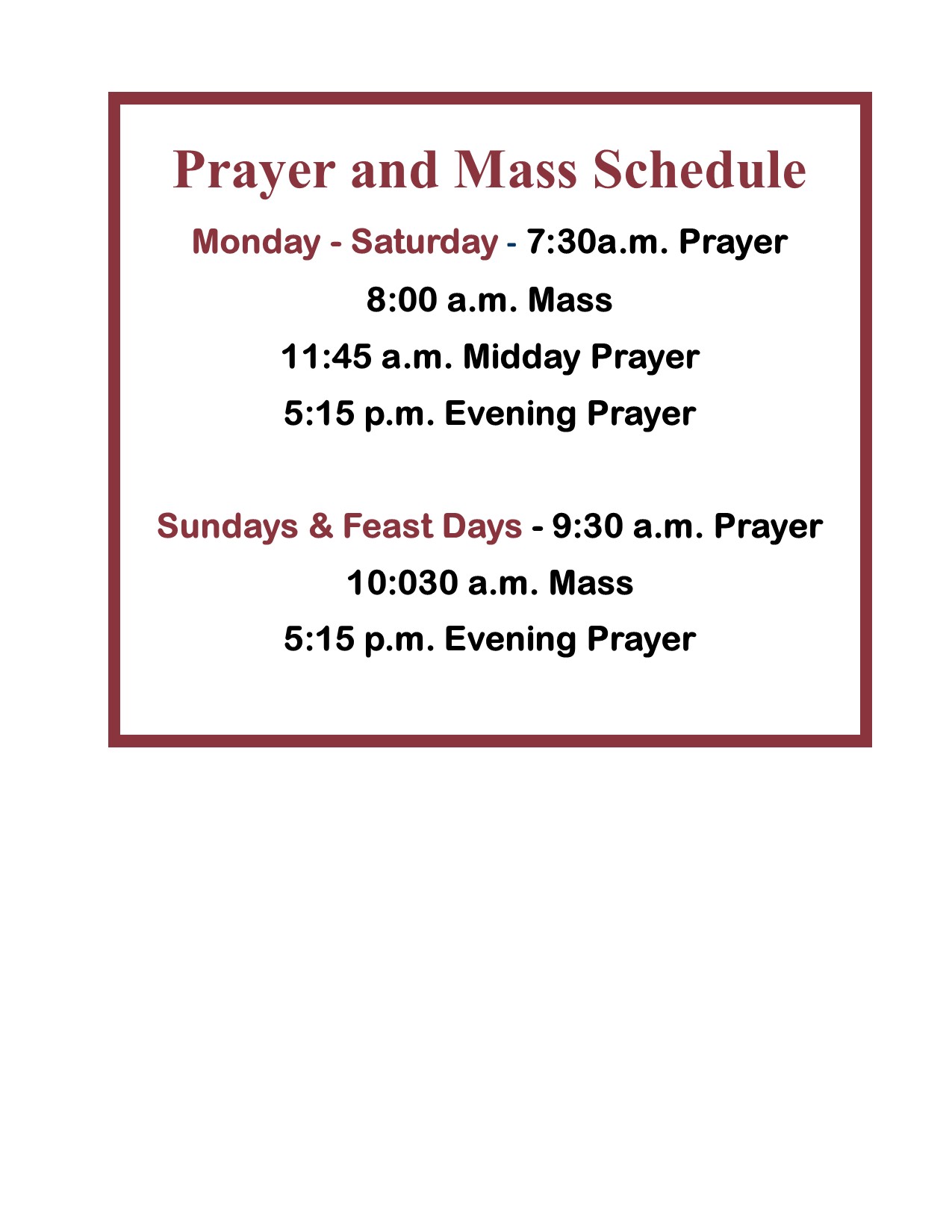
 Mass Schedule

Related Links

Copyright © 2026 · Benedictine Sisters of FL · Touching Lives Through Prayer and Service

Copyright © 2026 · Bendedictine Theme on Genesis Framework · WordPress · Log in