Easter Poem
by Sister Mary David Hydro, OSB
weave your pleading and
longing with gratitude and
wonder at God’s great
love and mercy that you find
deep in your heart—God is WIT * you!
*With you, In you, working Through you

Continue Reading

Holy Name Monastery
Founded 1889
by Sister Mary David Hydro, OSB
*With you, In you, working Through you
Continue Reading

The hour of Jesus’ death draws near.
WERE YOU THERE WHEN THEY CRUCIFIED MY LORD?
The sky grows dark, thunder rumbles and the air turns chill.
WERE YOU THERE WHEN THEY CRUCIFIED MY LORD?
The bickering among the soldiers stops, the murmuring crowd grows quiet.
WERE YOU THERE WHEN THEY CRUCIFIED MY LORD?
All attention focuses on Jesus.
In the silence His voice in utter anguish cries:
“My God, my God, why have you forsaken Me?”
WERE YOU THERE WHEN THEY CRUCIFIED MY LORD?
Refusing the sponge of wine which might numb his senses and dull his awareness,
He cries aloud as His spirit at last departs from His earthly body.
WERE YOU THERE WHEN THEY CRUCIFIED MY LORD?
Yes, were you there when they crucified my Lord?
Were you there when they nailed Him to the tree? WERE YOU?
WHERE WERE YOU?
Were you part of the jeering crowd; caught up in the mob emotion?
Were you a silent on-looker, trembling lest you be recognized (like Peter had been) for one of Jesus’ followers? Or were you one of the soldiers doing a task – not so tasteful but all in day’s work, required to collect that almighty silver coin?
WHERE WERE YOU?
Were you among the women quietly lending mutual support to each other; heart-broken and helpless to do naught but weep and hope for a miracle of deliverance for your Lord?
WHERE WERE YOU WHEN THEY CRUCIFIED MY LORD? Look into your heart . . .
The hour of His death has come. And, gone. Will you gather up your picnic cloth and go home to wait for another day’s excitement? Or, will you silently mourn His passing, confused but confident that He will rise again? He told you “this temple shall be rebuilt.”
WERE YOU THERE WHEN THEY LAID HIM IN THE TOMB?
When the sky was dark and the earth quaked; when spirits walked the earth and on-lookers beat their breasts in fear and withdrew from the scene.
WERE YOU THERE?
Were you there to help linen-wrap His broken body, to place it in the newly hewn tomb and set the stone at the entrance?
WHERE WERE YOU?
Were you among the women who went home to prepare spices and perfumes to anoint the body of Your Lord? Valiant women, strong in respectful silence for each other’s grief. Strong in the promise of Passover. Strong in the love of the Man of Nazareth, their Lord, and now their Redeemer.
WERE YOU THERE WHEN THEY CRUCIFIED MY LORD? WERE YOU THERE WHEN THEY NAILED HIM TO THE TREE? WERE YOU THERE WHEN THEY LAID HIM IN THE TOMB? Where were you?
~Reflection by Sister Roberta Bailey, OSB
Continue ReadingAfter the meal, Jesus took off his outer garments, tied a towel around his waist, poured water into a basin and began to wash his disciples’ feet and dry them. [John 13:4-5]
“That’s all it takes: Serve others. Yet we resist. We are lazy, too busy or too caught up in our own world and interests. Jesus shows us the example. Wash the feet of others. You don’t have to take it literally, but you do have to serve others. Better yet, serve someone who can’t repay you. Hold the door, let someone go first, clean up after someone. Just find a way to serve.” (Fr. Thomas J. Connery)

Continue Reading

In the Catholic tradition, cacti rather than flowers are placed at the alter during Lent. This is the time that signifies Jesus’ journey in the desert to meditate and prayer. We had a rather large ugly cactus in chapel last year. I meditated on it throughout the season. There were dead spots, thorns and some new growth. After Lent I decided to ask anyone who could, to bring a cactus to the Monastery to be in the chapel this Lent.
People are so good to us. Many brought cacti and they are now displayed in front of the altar. And once again in meditating, they have given me several ways to examine myself. For instance, one of the cacti has very large thorns which reminds me that I can be prickly with others. I’m reminded that people need to be handled as gently as I handle that cactus. Three of the cacti bloomed, bringing to mind the beauty that there is all around us. One has dead spots showing where I neglected them. How often do I neglect people? Looking upon the differences of the cacti makes me ponder the variety in God’s creation and wonder if I am doing enough to care for Mother Earth.
Having repotted the cacti right before the season of Lent began, it was a delight to see new shoots spout. Cacti soil with fertilizer was part of the repotting. Some have very tiny new shoots and one shoot is taller than the plant it came from! Each is growing the way God meant for them to grow. The cacti help me to grow in ways I think God wants me to grow.
Thank you for all the variety of cacti that you brought. My promise is to do my very best to keep them alive, nurtured and growing for Lent 2022!
Sister Dianne Wansley, OSB
Continue Reading
 Abbot Gregory J. Polan, O.S.B. is the Abbot Primate since 2016 of the 1500-year old Benedictine Order residing at Sant’ Anselmo in Rome. He serves the Benedictine community as its liaison to the Vatican and civil authorities to promote unity among the various autonomous Benedictine monasteries and congregations. Abbot Polan is the tenth Abbot Primate and the fourth American elected. We were pleased to have him with us directing our 2019 summer retreat week.

The following is from Abbot Polan’s recent Circular:
Greetings of Lenten peace, faith, hope and support in these uncertain times. Strong confidence in God’s inscrutable ways calls us to walk the path to Easter. In the midst of these times when we see a light beginning to shine with the roll-out of the vaccine to all parts of the world, we give thanks for what has been happening and we pray for a just and right distribution of these healing remedies. Let us remain strong in following the instructions given by the governments, the health professionals, and the Church leadership which calls for continued care, protection and proper protocols. It is clear, we will not be moving back to life as it was; there will be a new normal which will only develop with time, patience, practical wisdom, spiritual insight, sacrifice, generous service toward the needy and a deeper sense of care for one another. One of the graces that has come from this pandemic, has been the awareness of how this situation has touched the lives of all of us. The effects of the pandemic have marked our lives in uniquely different ways. Yet what has united us is that as brothers and sisters in the human family, children of God and as members of the Body of Christ, we are all striving to move forward. Our experiences are so vastly different, but we are unified in our endeavoring to find the way forward and to see how this will open for us in time, in grace and in hope. In the recent visit of Pope Francis to Iran, his words to continue working toward peace, mutual care for one another and a world that shows tolerance and mutual acceptance speak loudly to our hope of moving forward with confidence.
Continue Reading~Article by Sr. Christine Schenk for the Global Sisters Report,
a project of National Catholic Reporter
Women’s History Month is a great time to celebrate the “mothers” of our Christian church. Until recently, few realized that early female believers shaped our church’s future no less than their better-known brothers (aka the “fathers of the church”).
On Feb. 14, 2007, Pope Benedict XVI made the rather remarkable statement that ” without the generous contribution of many women, the history of Christianity would have developed very differently,” and that the female presence was not “in any way secondary.”
Some early church mothers are relatively well-known while others are all but forgotten. Early writings and funerary inscriptions testify that women served as prophets, evangelists, missionaries, teachers, deacons, presbyters, enrolled widows, and heads of house churches and monasteries.
Marcella, Paula, Melania the Elder, Melania the Younger and Macrina exercised considerable authority in ancient Christianity. Marcella founded a sort of urban monastery and study group in in Rome that greatly benefited — and benefited from — Jerome’s biblical erudition. When Jerome left for Jerusalem in 385, Rome’s priests began to seek out Marcella for help in understanding the biblical texts.
Paula financed and oversaw the building of two monasteries in Bethlehem, one for women and one for men. This is where, thanks to Paula’s financial support, Jerome completed his translation of the Greek Bible into Latin. Jerome tells us that Paula’s expertise in Hebrew exceeded his own.
Melania the Elder publicly reconciled 400 schismatic monks in Asia Minor, and her spiritual wisdom and authority led to the repentance of the renowned monastic writer Evagrius.
Melania the Younger publicly countered Nestorianism at the court in Constantinople, and Macrina’s authority as a spiritual director had a profound influence on her theologian brothers, Basil and Gregory, who went on to craft the doctrine of the Trinity.
In her fourth-century travel journal, Egeria ecstatically greets her “very dear friend,” the deaconess Marthana in Seleucia (Turkey), who governed (regebat) a double monastery of women and men at the shrine of St. Thecla. Here we see a rare fourth-century example of a female deacon exercising governing authority over Christian men as well as women. Macrina also seems to have governed both men and women at her monastery in Cappadocia.
Egeria meticulously chronicled the liturgical practices in Jerusalem during Lent, Holy Week, Eastertide and Pentecost. Her diary is valuable to scholars since it provides documentation of liturgical practices in Jerusalem in the fourth century.
Proba is another prominent — albeit nearly invisible — church mother. A wealthy, well-educated wife and mother of sons, Proba adapted a popular poetic form — the Virgilian cento — to highlight the heroism of Jesus and attract aristocratic young men to the faith. Her literary and biblical authority created a remarkably effective cross-cultural evangelizing tool that would influence Christian men and women for generations.
Tabitha of Joppa and Grapte of Rome are two important but barely known church mothers from the first and second centuries.
Widows played an important role in early Christian expansion. They supported the church’s mission as financial patrons and converted others to the Jesus movement. The support of wealthy widows for poorer widows and orphans was a powerful evangelizing witness in a culture that regularly exposed unwanted babies to die.
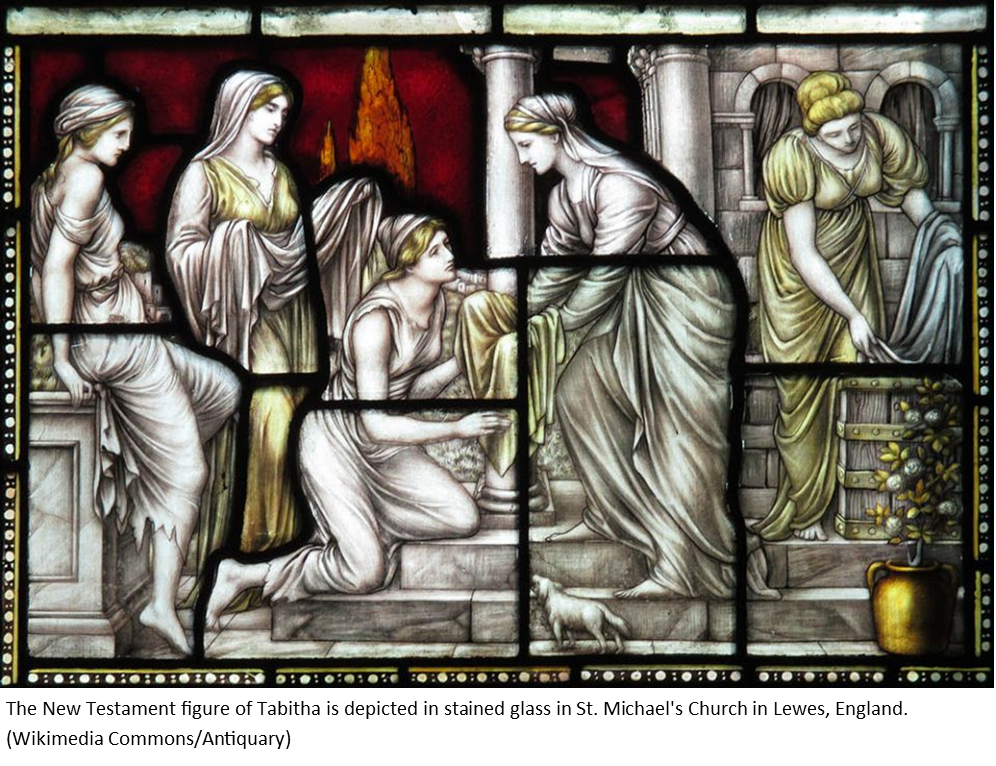
In Acts 9:36-43, we read of Tabitha, “a disciple” who led a house church in Joppa, just 30 miles northwest of Jerusalem. She fell ill and died, leaving “all the widows … weeping and showing tunics and other clothing she had made for them” (Acts 9:39). Luke shows Peter hastening to Joppa where, after he prays over her, Tabitha is raised from the dead.
Because she is the only woman given the grammatically feminine title of “disciple” (mathetria) in the entire New Testament, some commentators suggest Tabitha was one of the women in Jesus’s Galilean discipleship. Peter may have known her well.
Since no male relative is anywhere in evidence, Tabitha was probably a widow herself. Biblical scholars suggest she was a leader of a congregation of widows at Joppa and a foremother of the “order of widows” prominent in the church into the third century.
And then there is Grapte of Rome. In the second century, the author of an important Christian book, The Shepherd of Hermas, writes that Hermas had a vision in which he was told to write “two little books and send one to Grapte and one to Clement.” Grapte must “instruct the widows and the orphans,” and Clement is to send the other book “to all the foreign cities.” Hermas is also asked to read the book “to this city [Rome] along with the elders that preside over the Church.”
Clement is remembered in church history as a leader and communicator for the other house church leaders of Rome. Since Rome did not embrace a monarchical episcopacy as quickly as other urban communities, Clement’s letter was sent to Corinth on behalf of all the house churches of Rome, not on his own behalf.
The Roman church was not led by a monarchical bishop at this time but by what scholar Peter Lampe has called a “plurality of presbyters.” It is notable that the Shepherd of Hermas sharply reprimands Rome’s diakonoi (male deacons?) who “despoil the living of widows and orphans,” in contrast to Grapte who cares for and ministers to them. As Lampe sees it, Grapte “was entrusted with this work by all the communities of Rome.”
Both Grapte and Clement are identified as leaders whose responsibilities involve all the faith communities at Rome. While Clement is remembered in church history, Grapte is not.
Many early writings attest that for early Christians, care of widows and orphans was an ethical priority. What is less obvious is that this ministry was often, if not usually, carried out by women. A pattern emerges in which we find wealthier widows caring for other widows and, like Tabitha, welcoming them into their households. This pattern persists well into the fifth century.
Communities of widows, including the “widows called virgins” — named by Ignatius of Antioch in his second-century letter to the Smyrnaeans — became centers of evangelization and hubs of female leadership.
It is nothing short of inspiring that these “mothers of the church” exercised authority at a time when the “fathers of the church” forbade women to speak or teach publicly, preferred that women stay at home and judged women more susceptible to heresy than men.
Yet Christian women did not keep silent or remain enclosed. They spoke up about important ecclesial issues, served the marginalized, taught both men and women, and witnessed freely about the Christ with whom they had thrown in their lot. They are great role models for the women and men of today.
Mothers of the church, presente!
Continue Reading