• Skip to primary navigation
  • Skip to main content
  • Skip to footer
Benedictine Sisters of FL

Holy Name Monastery
Founded 1889

Donate Now
  • Home
  • About Us
    • History
    • Being Benedictine
    • Benedictine Monasticism
    • Meet Our Community
    • Holy Name Academy-Alumnae
  • What We Do
    • Mission, Vision and Our Partners
    • Invitation to Retreat
    • Accommodations
    • Volunteer Programs
    • Oblate Program
    • Spiritual Direction
    • Aqua/Hydroponics
    • More of Our Ministries
  • What’s Happening
    • Articles of Interest
    • Events
    • Newsletters
    • Brochures
    • Links
  • Support Us
    • Gifts of Support
    • Wish List
  • Stories Shared
  • Galleries
    • Photos
    • Videos
      • Benedictine Sisters of FL Videos
      • Other Videos
  • Contact Us

Articles of Interest

The Narrow Gate

August 22, 2016 by Holy Name Monastery Leave a Comment

gate21st Sunday in Ordinary Time, Sunday, August 21, 2016

First Reading  Isaiah 66:18-21                Second Reading  Hebrews 12:5-7,11-13
Gospel Reading  Luke 13:22-30

This Gospel may well be a loose collection of sayings of Jesus recalled by the author, uttered in several different contexts but brought together here under the general heading of “who will be saved?”

As this parable opens, Luke reminds us that Jesus is making his way to Jerusalem, teaching as he goes. When from out of the crowd he hears a question called out giving him a chance to make a prophetic statement. A few weeks ago, the question was “What must I do to inherit eternal life?” Today it’s “will only a few be saved?”

Jesus answers with two parables – referred to as the “narrow gate” and the “door” although the same Greek word is used for both gate and door.  It’s the translation that may be misleading.    It’s interesting to me that Jesus says many won’t be strong enough to get through the gate.  He doesn’t say slim enough.  It sounds as if the walls can be pressed aside if you just have enough strength.  To digress a moment … I thought of this image at the construction meeting earlier this week.  The discussion was about the well that has to be sunk to provide water for the fire sprinkler system.  The pipe will have a protective casing on it so it will not be subject to water erosion or enjoyed by underground rodents that visit our garden.  When drilling the well they ensure that the opening is wide enough to accommodate whatever diameter of pipe it takes to get the needed  water pressure ( 4’, 6’ 8’ pipe) before inserting the casing … in Jesus language, that it is strong enough to let the required flow of water get through.

Jesus says: “Many will seek to enter and will not be able” … so, maybe the overwhelming crowd will be too many all at the same time pushing and shoving to get through the opening?

This question to Jesus had people squirming: “Will only a few be saved?”  Will I be among them?  How can I be in that count?

The answer to the “will only a few be saved?” is no. In the end, many will be saved, but many who thought they would be saved will not be saved. The parable is a prophetic warning that it will take repentance, forgiveness, faith …   in order to be saved.  “Many are called but few are chosen.”

But, remember Jesus also said, “When once the master of the house has risen and shut the door, and you begin to stand outside and to knock at the door, saying, ‘Lord, open to us,’ then he will answer you, ‘I do not know where you come from.”  Don’t delay your planning to be among the chosen … what’s the saying: don’t put off to tomorrow what can be done today?  Lectio and personal prayer; some form of fasting whether from food, or technology or juicy gossip is a daily opportunity.

Jesus answer to the crowd lets his hearers (and us) know that the “door of opportunity” will not remain open indefinitely.  When the door is closed, it is closed and will not be reopened for persons whose only claim is that Jesus once visited their temple / their church, their town and village or preached in their streets or that they once saw Jesus in a crowd.   Remember the 10 virgins … 5 missed the boat due to a lack of “NRRO future planning.”  And, recall the Gospel lessons we heard this past week: the first shall be last … and the last will get the same reward as those who signed on to Jesus work crew early in the day.

We’ve all probably seen the famous painting of Jesus knocking at a door with knob …  the door to our hearts must be opened from the inside.   That’s true but there are also doors with visible knobs that we must have the courage to open from our side….  To let in the immigrant, the wanders, the seekers, the faithless, the weary.  Could we say we are on the inside listening for outsiders to lift the knocker asking entrance.  Or, there doors waiting for you to twist the knob on, or push aside, to get a glimpse of what’s on the other side? It takes courage, doesn’t it, to be on either side of the door:  A big breath before stepping up to knock on the door of a stranger and a gasp of apprehension to open the door to an unexpected knock, especially if there is no peep hole to reveal at least a shadowy shape of the caller.

Some years ago I belonged to a parish group that studied various styles of meditation.  One was “wall” or “gate” meditation.  I invite you to try it …  and then I will share my experience.

Get in a relaxed position … lying down risks dozing off but sitting runs that same risk … just don’t try this particular type of meditation standing up or walking …   So, relax your body, close your eyes and in your mind start walking along the edge of a wall or fence … not on it, beside it –  until you see an opening or door … walk through – who’s there – do you see Jesus? – who is with him?  What are they saying to each other or to you …  Just let the reflection go where it will …

In my first experience… as I crossed through a low stone wall, I sensed Jesus seated with a circle of 10 – 12 others – he motioned for me to come sit beside him …  looking around I recognized and could name all but one person …  I have no memory of who they were BUT several years later I was introduced to a Sister from another community and I startled and instantly realized she was the one who had been in that circle.

Here are some doors you may want to visualize, open and peer beyond  …  Lord, Lord, open to me.

church_cross-door doors brick1 old_door_double colored doors barn doors stone dooroffice door1
~Reflection by Sister Roberta Bailey, OSB, Prioress


Continue Reading

Filed Under: Blog, Homily Tagged With: Door, Gate, God, Jesus, Knocking, knowledge, Luke

Where do you find peace in challenging times?

August 8, 2016 by holyname Leave a Comment

 Praying Images Stock Pictures Royalty Free Praying Photos And Stock PhotographyExcerpt from a reflection by S. Susan Quaintance, OSB

Folks are unsettled. Between unprecedented levels of violence in our city and neighborhood, a presidential season revealing a deeply divided country, and climate change that brings never-before-seen threats, to name but a few current realities, I not something in people’s faces that I don’t really remember in my lifetime; sort of a mix of bewilderment, wariness and fear.

I wonder what my response should be as a Benedictine? Pondering this question, I make a mental dash to the Psalms.  They are, of course, the same Psalms prayed by Benedict and the communities he founded in the sixth century.  Their moment must have been similar in disease and anxiety. The collapse of the Roman Empire in 476 resulted in political instability and social chaos.  Sound familiar?

What do the psalms say about seeking peace? That text does a Benedictine spend more time with over the course of a lifetime than the Book of Psalms? The psalms are the river that flows over us, shaping our stony hearts into something closer to what they are supposed to be.  So I spent a Saturday morning looking at where the word peace shows up in the psalms and it reminded me of something I already knew and prompted my gratitude for something I didn’t.

The reminder: Peace is ultimately God’s work, not ours. Obviously that does not excuse us from whatever we can do to make peace (“Turn away from evil and do good; seek peace and follow after it.” Psalm 34:15).

Peace will be the hallmark of the reign of God’s anointed one (Psalm 72). This is an important truth to hold onto as we make our way in a world that is anything but peaceful. As we try to educate ourselves about global genocides and torture, as we search for the facts in the mudslinging of another presidential election, as we attempt to mend our sometimes fractured communities, we must acknowledge that our work alone will not be sufficient.

After a long day of doing what we do, saying what we say, living with whom we live, and humbly having to admit that it’s another day of coming up short, it is good to hear that God works through our small efforts, that God has the ultimate responsibility, that it is in and through God alone that the promise of peace is fulfilled.

The psalms are a primer for so many aspects of right relationship, and seeking peace is no exception. May we use them so. “Peace be upon Israel” (Psalm 125:5c)… and all of us.


Continue Reading

Filed Under: Blog

The Rich Fool

August 1, 2016 by holyname Leave a Comment

Rembrandt_-_The_Parable_of_the_Rich_Fool18th Sunday in Ordinary Time, Sunday, July 31, 2016

First Reading – Ecclesiastes 1:2; 2:21-23          Second Reading – Colossians 3:1-5, 9-11          Gospel Reading – Luke 12:13-21

This rich man’s world is small, just him and his possessions, and now he learns that he is to lose his life. What good are his possessions now? Jesus sums it up in two words:  You fool?”  And, continues with the reason – “This very night your life will be taken away. To whom will everything belong then?!”

The man is rankled over a continuing disagreement with his brother. He figures he can follow the customary practice of taking his dispute to the rabbi, the teacher he has heard everyone talking about. Of course, he expects a settlement in his favor. But Jesus refuses to take the case and instead gives the squabbling brothers a parable to “mull over.”  What is the point of Jesus’ story about a wealthy landowner and why does he call him a fool?

Jesus’ lesson holds a warning against covetousness – a wish to get wrongfully what another possesses or to begrudge others what God has give them. Jesus restates the commandment. The commandments are not a multiple-choice list of good ideas – they are to be applied to all. In this little parable Jesus probes the listener’s heart – where is your treasure? The thing we most set our heart on is our highest treasure.

In interpreting this parable to discover what it is we treasure most, it’s critical to assess carefully what the farmer’s error is. He is not portrayed as wicked – that is, he had not gained his wealth illegally or by taking advantage of others. He’s not portrayed as particularly greedy. Indeed, he seems to be somewhat surprised by his good fortune. So, what’s wrong we might ask with building larger barns, renting a storage unit, getting a POD in the back yard to store away some of today’s bounty for a leaner tomorrow?  Hanging on to clothing we’ve outgrown, rarely ever wear, haven’t seen since we moved in two years ago and persons who have less than we do would appreciate having it; or stockpiling furniture that serves only as a “catch all” because it’s just too nice to give away…Requesting more allowance than we actually need and giving none to charity – or accepting money gifts from lay people giving them the impression that our community does not take care of our needs. We might answer that none of this sounds so terribly wrong compared to the horrors of violence…except for two things.

First, notice what the farmer’s consistent focus is throughout the conversation – it’s all about himself. “What should I do, for I have no place to store my crops?” Then he said, “I will do this: I will pull down my barns and build larger ones, and there I will store all my grain and my goods.”

The relentless use of the first person pronouns “I” and “my” betray a preoccupation with self. There is no thought to using the abundance to help others, no expression of gratitude for his good fortune, no recognition of God at all. The farmer has fallen prey to worshiping the most popular of gods: the Unholy Trinity of “me, myself and I.”

This leads to, and is most likely caused, by a second mistake. This farmer is not foolish because he makes provision for the future; he is foolish because he believes that by his wealth he can secure his future.

There is danger in thinking this parable applies only to “those rich people.” To put the matter more pointedly, thinking of those rich fools enables me NOT to think of myself as a “rich fool.”

We cannot separate the warnings from the words of Jesus that follow. What’s his transition word? He begins with “therefore,” indicating that what He is saying is based upon what He has already said. Note, too, that in the text Jesus warned against “all kinds of greed” which suggests that greed has a variety of forms, some of which may tempt the rich and others that may tempt the less affluent.

Jesus’ response indicates that the man’s request was his error. But, what this man wants is a judge, not a teacher. Other teachers might be tempted to pronounce on such cases, but Jesus knew that this was not within the realm to get in the middle of a family squabble. This young man, itching for a flight, may have gotten the floor, but he did not get his request. What he got was far more than he asked for, but certainly what he deserved.

Jesus used the opportunity as a “teachable moment.” The whole exchange and the lesson stresses that life does not consist in things. It does not even consist in many things. The parable tells of a rich man, who is not rich enough. Jesus, the teacher, did not judge, but He did teach. In this parable He was not primarily teaching teachers how to teach, but rather teaching all of us how to live. To borrow the paraphrases Joe Biden’s words in his speech at the Democratic convention, referring to his wife who was a teacher: “teaching is not what Jesus did; it’s who He was.”

S. Roberta Bailey, OSB, Prioress

Continue Reading

Filed Under: Prayer

A Rorschach Test

July 18, 2016 by Holy Name Monastery 1 Comment

luke-10-38-42-2016Last weekend’s Gospel of the Good Samaritan was an example of how a disciple should observe their surroundings and act compassionately.  In this week’s story, Mary is an example of how a disciple should listen.  Like the Samaritan, Mary is a marginalized person in society.  And, both do what would not be expected of them. As a woman, Mary would be expected, like Martha, to do the “grunt” work of all that would be necessary to provide hospitality for a guest.  But, here once again Jesus breaks with the social conventions of his time. Just as a Samaritan would not ordinarily be a model for neighborliness, so a woman would not sit with the men around the feet of a Master Teacher.

The brief story (it’s only 5 verses) of Mary and Martha has become something of a Rorschach Test. Interpreters down through the ages have taken sides with one or the other. Some see Mary as a model of the contemplative life. She was taking the role of a male disciple, so she is the darling of Feminist interpreters today. She has become the role model for women in seminaries pursuing a theological education.

Like Martha, we sometimes get caught up into warped thinking.  We forget that the important thing is not in DO-ing but in BE-ing.  Jesus teaches us to sit – to listen – to learn – to love. Martha welcomed Jesus into her house, and then went to the kitchen to fix dinner. Mary, Martha’s sister, did NOT go to the kitchen to help, but instead “sat at Jesus’ feet and heard his word. That seems OK and typical, doesn’t it?  You can’t just seat the guest and then everyone abandon them to do all work in the kitchen. But it wasn’t OK with Martha. Luke says that Martha “was distracted with much serving.”  Have you had her experience?   Feeling like you are alone “in over your head” with the details of hospitality, or setting up for the workshop, or a concert gathering?

Martha needed help, but she didn’t know how to handle it.  Because, honestly she (and maybe you) did like to work, and you usually pitch in and do your part.  And, sometimes you end up working while others sit around chatting. So, you know how Martha felt.  Can’t you see it: Martha, angry at being abandoned in the kitchen, came to Jesus and said, “Lord!” Now don’t miss that little word – “Lord.” The first word out of Martha’s mouth acknowledges Jesus as Lord. Good job, Martha!

But then Martha, who has just acknowledged Jesus as Lord, rebukes Him. First, she asks if Jesus doesn’t care that Mary isn’t helping. Then she gives Jesus an order: “Tell my lazy sister to get into the kitchen to help me.” Well, those aren’t the exact words that Luke uses to report this incident, but that’s what Martha meant! Now that kind of outburst has a tendency to make everyone angry. If you are Mary, you wonder why Martha didn’t just say – to you, rather than to Jesus – “Mary, I need some help.”  And if you are the guest – like Jesus – it’s embarrassing to have your hostess blow up like that.

Now, we would not have handled the situation like Martha did.  We might have muttered and murmured but we’ve had all the communication workshops.  We could have coached Martha how to do it differently. She could have instead of stomping into the living room and chewing out Jesus and Mary, she could have taken a quiet minute in the kitchen and. prayed: “God, I’m so angry. Something is tempting me to go out there to spew my anger all over Jesus and Mary – but I know that’s wrong. Help me to feel love for Jesus, my guest, and Mary, my sister. And then help me to ask Mary nicely for help.”

We know that Mary’s focus on her relationship with Jesus was so right.  At the same time we recognize Martha’s anger was so disruptive. Jesus said as much. He said: “Martha, Martha, you are anxious and troubled about many things, but one thing is necessary. Mary has chosen the good part, which will not be taken away from her.”

We can be such busy people, and we live in such a busy world. It’s easy to miss the important things.  In light of all the violence in our world we may feel helpless… we can pray, yes and we can join the prayer crusade that stops one minute at 9 p.m. to pray for world peace but what else can we do?  We’ve heard, and truly believe, peace begins at home.  It begins with each one of us starting with our interactions with each other… in gentle direct communication.  Hopefully we don’t engage in fist fights but we need to be on guard that we don’t “slap” another in the face with our voice tone, volume or hurtful words?   We can quiet TV violence and noise pollution with the click of a remote button but once rude words escape our lips they reverberate in the atmosphere for all eternity.

The story of Martha and Mary reinforces our belief that there is value in sitting – in listening – in learning – in loving.  When we are tempted, like Martha, to think the important thing is doing – remember Jesus’ teaching to sit – to listen – to learn – to love.  Sit at God’s company to be quiet and listen – don’t fill every second with chatter.  Treasure the moment. We may live in a Martha-world, but we don’t need to let it invade our walls.  We need to take time to be Mary.  Time to commune with the One we profess to love about all others … time for personal lectio, spiritual reading … time to BE and ask ourselves, “Do I really put God first in my life?   Would my actions prove it?  Jesus says that that’s the one thing that’s needed. He says that’s the good part that won’t be taken from us.

~Reflection by Sister Roberta Baily, OSB, Prioress


Continue Reading

Filed Under: Prayer

One Minute of Prayer Every Night!

July 12, 2016 by Holy Name Monastery 2 Comments

This sounds like a worthy idea … we can’t imagine the power of prayer:

hands clasped in prayer over a Bible

During WWII, there was an advisor to Churchill, who organized a group of people who dropped what they were doing every night at a prescribed hour for one minute, to collectively pray for the safety of England, its people and peace. This had an amazing effect, as bombing stopped.

There is now a group of people organizing the same thing here in America. The United States of America, and our citizens, need prayer more than ever!!! If you would like to participate, each evening at 9:00 P.M. Eastern Time (8 PM Central, 7 PM  Mountain, 6 PM Pacific), stop whatever you’re doing, and spend one minute praying for the safety of the United States, our troops, our citizens, for peace in the world, the upcoming election, that the Bible will remain the basis for the laws governing our land, and that Christianity will grow in the U.S.

If you know anyone who would like to participate, please pass this along. Someone said if people really understood the full extent of the power we have available through prayer, we might be speechless. Our prayers are the most powerful asset we have. Thank you.

Please pass this on to anyone who you think will want to join us.

God Bless You!!!

~Sister Roberta Bailey, OSB, Prioress
Continue Reading

Filed Under: Blog, Prayer Tagged With: America, Christianity, Churchill, Daily, Night, one minute, Prayer

These Were Benedictine Women With A Dream!

July 11, 2016 by Holy Name Monastery Leave a Comment

St. Leo Township 125th Anniversary

July 9, 2016


20160709_140120We preserve our stories because we want never to forget that the opportunities we have today were not simply lavished upon.  They were purchased at the great price of travel from home; cold, cracked work-worn knuckles; study by the light of midnight oil; stomachs that ached with hunger; raking, hoeing and watering groves and gardens – saving, scrimping and salvaging.

What firm faith and incredible courage our founding sisters must have had!  The records in the Pittsburg archives remind us of how adventurous and of the bravery of these young sisters who in 1889 set out for a long journey into the unknown.  There were clearly told if the venture did not work, they were not to return to Pennsylvania.  An examination of the papers shows us that of the five women who signed their severance papers on the evening of February 22, 1889, one never made it to Florida.  However, one of the Sisters who had served as a witness, must have decided overnight to join the mission band – she is named in the group of our five founders.

Imagine what daring it took to venture south into a faraway place.  These were Benedictine women with a dream!  In 1889 Rome considered the church in America “missionary territory.”  In relative terms, the slaves had only recently been freed.  Had our Sisters ever seen a person of color in their northern neighborhood?  Surely not an Indian and most assuredly not an alligator!

There is some evidence that the pioneer band traveled from Allegheny County (PA) to the Benedictine house in Covington, KY – then southward by train which would have deposited them in south GA or north FL.  It seems safe to me to guess that someone from San Antonio would have met the Sisters at the train to bring them in wagons or on horseback down along what is now Hwy 19 and 41 – parts of the Seminole trail.  Perhaps they met cattle drovers bringing their herds to Tampa or Punta Gorda.  By the time they reached San Antonio, traveling through the Florida wilderness – in February, probably not too many mosquitoes but surely they’d have heard or seen black bears and panthers, “Strange” birds, and had run across a snake or two…

On Thursday, February 28, I bet they breathed a sigh of relief to at last be among people they may not have personally known but whose northern cultural practices and manners, whose speech patterns were similar to their own.

Next day, March 1, being a Friday, and most probably a Lenten Friday, would have been a day was meat was NOT on the menu.  The sister would have partaken of very little, if any, breakfast.  They’d have prayer the Little Office of the blessed Virgin, an abbreviated for of the Divine Office they’d back home.  And as we know from our annals: “the great work was begun.”  Perhaps they had a main meal of fish fresh caught from Lake Jovita?  Evening came, and morning came, their second day in the mission land called “Land of the Flowers.”

The Sisters first home was a three-story wood-frame hotel which was located on the city park in San Antonio.   In 1911, the building was moved on logs to a location parallel to the shore of Lake Jovita in St. Leo.  In 1960, the “new” monastery building, which is now called Benedictine Hall and owned by Saint Leo University, replaced the original wood-frame building which the Sisters and academy boarders had called home for 71 years.

By March 11, less than two-week after their arrival, the Sisters had opened Holy Name Academy for girls and were teaching in St. Anthony School and St. Joseph School.  From 1929-59 they operated St. Benedict Preparatory for young boys.

In their history since 1889, the Sisters have served as town mayors and commissioners. At Saint Leo University, they have served as administrators, instructional staff, board members, campus ministers, directors of residential life and director of library services, archivist, clerical staff and food service managers.  From 1962 until 1997 they provided housing for university students.  Florida Benedictine women have staffed schools in Texas and Louisiana.  In Florida, they have been teachers and school principals, and worked in parish ministries, in San Antonio, St. Joseph, Lecanto, Jacksonville Beach, Miami, Quincy, Sarasota, Ocala, Lakeland, Venice, Beverly Hills, Apopka and Tampa.

The Benedictine Sisters have conducted summer religion programs at three diocesan camps.  They taught in summer Bible camps in DeLand, Plant City, Leesburg, Bartow and Naples, Florida.  Weekly religion (CCD) classes were taught by the Sisters in cities where they staffed schools and in Floral City, Brooksville, New Port Richey, Eustis, Arlington, Ponte Vedra, Masaryktown, Belleview, Reddick, West Ocala, Fruitland Park, Gainesville, Clermont, Dade City, Zephyrhills and at the Girls’ Detention Center in Ocala.

At the turn of the 20th century they attempted the founding of another motherhouse in Quincy, FL (which did not thrive) and within 10 years they had been invited to start a house in the Diocese of Birmingham, AL.  A year later 5 of “us” from FL joined with 5 Benedictine sisters from Kentucky to found the Benedictine convent in Cullman, Al.

At the present time, the Florida Benedictine Sisters continue to work on public, private and parochial school boards, and at Saint Leo University.  Individual Sisters are volunteers and serve on the boards of Catholic Charities, the Chamber of Commerce, Habitat for Humanity, Sunrise Spouse Abuse Shelter, Hospice, St. Vincent de Paul Society, soup kitchens and thrift stores.  Some of the Sisters minister within their community in administration, recruitment and formation of new members, business affairs, hospitality and retreat ministries, direct services to the poor, food service, horticulture.

And, now here we are at day 46,516 in the 127th year of our history – yes we were here before St. Leo was St. Leo Township!  And the Sisters have continued to happily be residents of St. Leo for all 125 years of the town’s incorporation.  And the GREAT WORK goes on.

As long as there are gaps between our ideals and our reality, there will always be great work to be done.  Our founding sisters, and the women who followed them into community, knew that they probably would not live to see all the changes they promoted.  Little did they know the hotel-turned-convent they so carefully hauled to the shores of Lake Jovita would be demolished in 1961, a new priory (as it was called then) erected and eventually sold to Saint Leo University.

We face challenges our foremothers could not have imagined.  And, our “daughters” will face challenges unimaginable to us.  This is part of our Florida Benedictine women’s experience – we still remember in the beginning our founders were told: if it doesn’t work, don’t come back.  We work to compassionate and caring, to preserve the earth and steward our resources, to keep faith with our founding ideals and to enflesh them into a reality worthy of those who will inherit what we build today.

~ Reflection by Sister Roberta Bailey, OSB, Prioress
Continue Reading

Filed Under: Blog, Homily Tagged With: 1889, Benedictine, Faith, journey, motherhouse, Saint Leo, San Antonio, St. Leo

  • « Go to Previous Page
  • Page 1
  • Interim pages omitted …
  • Page 122
  • Page 123
  • Page 124
  • Page 125
  • Page 126
  • Interim pages omitted …
  • Page 132
  • Go to Next Page »

Footer

Prayer / Newsletter / Info

 Contact Info

Benedictine Sisters of Florida

PO Box 2450
12138 Wichers Road
St. Leo, FL 33574-2450
(352) 588-8320
(352) 588-8443

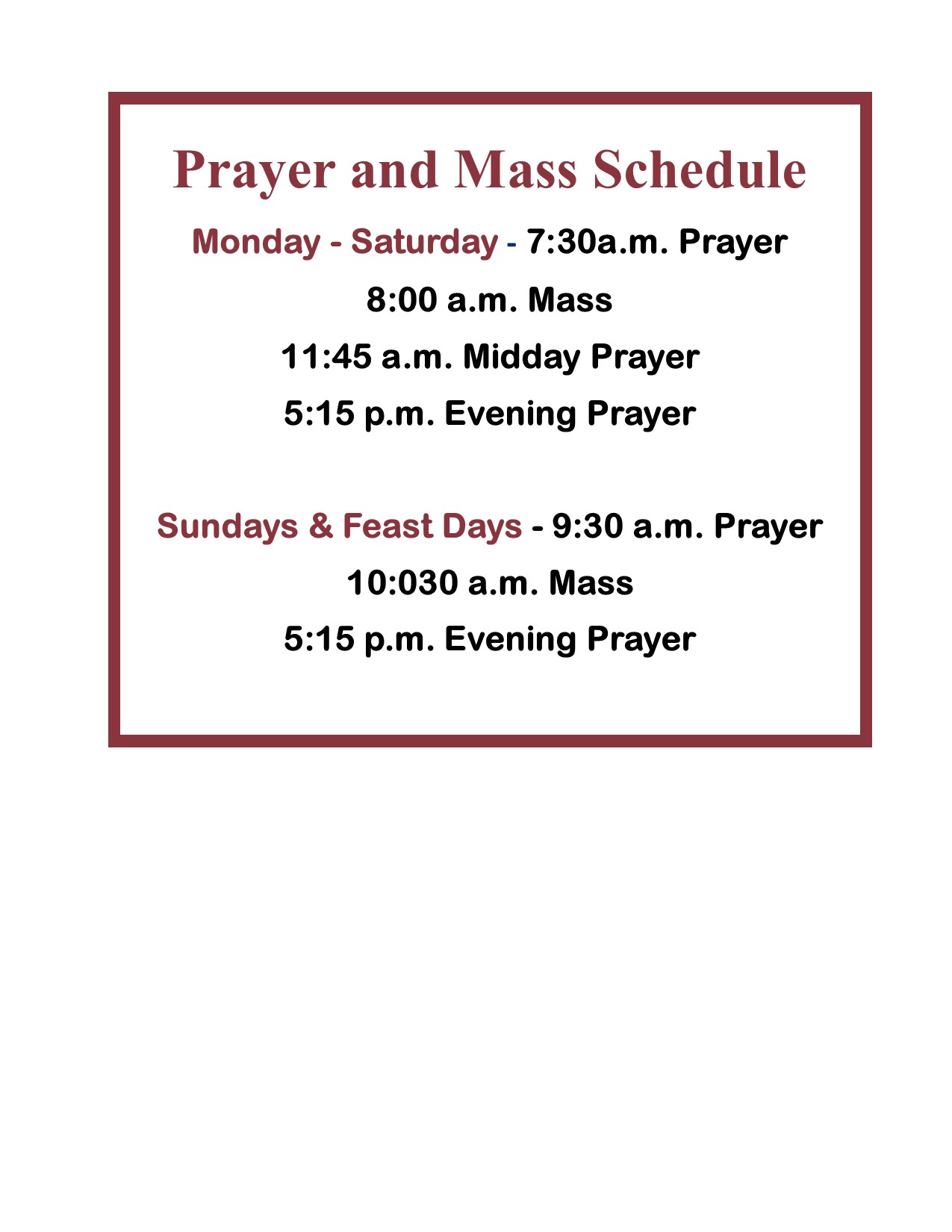
 Mass Schedule

Related Links

Copyright © 2026 · Benedictine Sisters of FL · Touching Lives Through Prayer and Service

Copyright © 2026 · Bendedictine Theme on Genesis Framework · WordPress · Log in