• Skip to primary navigation
  • Skip to main content
  • Skip to footer
Benedictine Sisters of FL

Holy Name Monastery
Founded 1889

Donate Now
  • Home
  • About Us
    • History
    • Being Benedictine
    • Benedictine Monasticism
    • Meet Our Community
    • Holy Name Academy-Alumnae
  • What We Do
    • Mission, Vision and Our Partners
    • Retreats
      • Invitation to Retreat
      • Accommodations
    • Volunteer Programs
    • Oblate Program
    • Spiritual Direction
    • Aqua/Hydroponics
    • More of Our Ministries
  • What’s Happening
    • Articles of Interest
    • Events
    • Newsletters
    • Brochures
    • Links
  • Support Us
    • Gifts of Support
    • Wish List
  • Stories Shared
  • Galleries
    • Photos
    • Videos
      • Benedictine Sisters of FL Videos
      • Other Videos
  • Contact Us

Peter

An Unspeakable Event

March 13, 2017 by Holy Name Monastery Leave a Comment

First Reading  Genesis 12:1-4a               Second Reading 2 Timothy 1:8b-10
Gospel   Matthew 17:1-9

Let’s set the scene: there is a mountain, there must have been clouds since we hear a voice come from out the clouds … then, there is Jesus. Three special friends, a face shining like the sun, clothes dazzling white, a voice from a cloud!   Something powerful is occurring here. And, it’s more than the disciples can comprehend.  They knew Jesus was someone special.  They’d known Him as a teacher, a healer, even a prophet… but that did not capture His full identity. Peter gets it “You are the Christ, the son of the living God!”    But his human understanding did not grasp the full meaning of what he said.

Peter recognizes that Jesus’ dazzling appearance in the presence of Moses and Elijah is significant–“Lord, it is good for us to be here!”   His suggestion to build three booths, or dwelling places sounds like an attempt to capture the moment, to preserve for safekeeping this frightening experience.   Imagine Peter (the extrovert par excellence) , jumping up and down with his hand in the air, like a child desperate to give the right answer, but who cannot quite get it right because he does not fully understand the question.

In his attempt to make sense of the magnificent transformation taking place before his eyes, Peter tries to talk it out, to speak words for the unspeakable event.  While he is still speaking, a bright cloud overshadows all of them and a voice interrupts: “This is my Son, my Beloved; in whom I am well pleased; listen to him.”

A stunned silence follows.  The four-some turns to go back down the mountain.  And Jesus asks them to tell no one what they experienced UNTIL He has been raised from the dead.

There are times when it is best to be quiet.  Times when we are a part of something much bigger than ourselves. There is more going on than what our physical eyes can see or understand. We have entered a mystery that can neither be defined nor discussed, only experienced.

There are moments like that in every life. Lovers gazing at each other see more than just another person. They have been brought face to face with the mystery of love. Parents and grandparents will recall when they beheld for the very first time the new baby in the family.  They see more than a baby. They are face to face with the mystery of life.  We’ve all seen a little child squealing with excitement. It is more than excitement. That child has come face to face with the mystery of deep joy. Recall a time you made a confession, formal or informal, and experienced the forgiveness of God or another person. It was about much more than words, past behavior, and the memory of estrangement. You came face to face with the mystery of grace.  And, many of us have been with a dying confrere, or parent, or friend.  We waited and watched for the person to be carried into new life. We came face to face with the mystery of death.

These are the moments of transfiguration. Each one of them is distinct, unique, and unrepeatable.  Yet they are somehow the same. Each one is so transparent, so real, they glow with the light of God’s presence. They are moments of pure grace. We cannot make them happen. We can only be there when it does happen. Thus, the importance of simply living in the present moment where everything around us seems to fall away.  It is a moment of pure, complete presence.

That is what happened to Peter, James, and John on the mountain.  They “looked up and saw only Jesus.”  This was as much their transfiguration as it was Jesus’. They didn’t just see the light they were absorbed into the light!

Jesus did not become something he was not before that night on the mountain. He was always filled with the glory of God. He didn’t become something new; but the disciples did.  In a flash of insight they saw the world with God’s eyes.  For, you see, transfiguration is not so much about what we see as it is about how we see. As long as we see only with our physical eyes, we will always be looking for something … looking over the fences of our own reality for that greener grass on the other side of the fence.

~ Reflection by Sister Roberta Bailey, OSB, Prioress
Continue Reading

Filed Under: Blog, Homily Tagged With: God, God's presence, Jesus, Mountain, Peter, Trasfiguration, unspeakable event

“Pursue What We Judge is Better for the Other Rather than Self”

June 27, 2016 by Holy Name Monastery 1 Comment

who-do-you-say-i-amWhile there are a number of crucial spiritual questions, none is more important than this question asked:  “But you, who do you say that I am?  Peter might have answered “Son of Mary and Joseph” or “Son of the carpenter” or “A great teacher.”  Or he might have uttered one of descriptions he’d learned since childhood from the Torah – titles we heard in last night’s reading from Judith: “Creator of the rivers, king of all creation, protector of the people.”  But, in a graced moment Peter cut to the heart of Jesus’ identity:  “You are Messiah, the Christ, son of the Living God.”

It’s crucial for each individual person to answer correctly.   Peter got it right but he did not realize the full impact of his answer.   It is the first time a disciple refers to Jesus as Messiah.  But, he and the other disciples had the wrong notion of Messiah.  To them it connoted a reigning King. They did not understand it involves suffering and death.   Their idea of a Messiah was all glory; no guts.

Only one answer is objectively correct to Jesus query:  “Who do you say I am?”  Jesus didn’t say, “Great answer, Peter! Do any of the rest of you have anything to add?  You others, how do you feel?”  How you feel about Jesus doesn’t change who He is. There is a single correct answer to the question that is not based on feelings or personal opinions, but on objective revealed truth.

To stretch their understanding,  Jesus immediately mentions His impending death and resurrection and the cost of discipleship.  He’s hinted at it before but this is the first explicit mention of it. From here on, it will become a frequent theme as Jesus makes this intention known to go to Jerusalem.   The disciples still did not really comprehend this until after Jesus’ resurrection. Once they had a fuller understanding of what Jesus meant – they were enabled to go out as bold witnesses.

Think about how difficult it must have been for the disciples to commit themselves to Jesus as the Christ? For centuries, faithful Jews had been waiting and looking for the promised Messiah. Many lived and died without seeing that hope fulfilled. Sometimes prophets came on the scene, raising hopes that they might be the Messiah. But they died and the people kept waiting. Then, suddenly there came upon the scene this young upstart, a mere carpenter from Nazareth who began preaching and performing miracles. Could He be the one? He certainly didn’t fit popular image of what the Messiah would be like. But the disciples committed themselves to Jesus as that long-awaited Messiah.

Remember, they didn’t have the 2000 years of church history that we have to confirm their faith.   They were the first ones to say, “This is the One!” And they had to say it in the face of public opinion that didn’t agree with them. This fact is underscored by the contrast between Jesus’ first question, “Who do the multitudes say that I am?” and His second question, “But you, who do YOU say that I am?”

The disciples had to stand against strong currents to affirm their conviction that Jesus is the Christ. The Roman government didn’t care if Christians followed Jesus as long as they affirmed Caesar as Lord.

They also had to go against the opinions of the Jewish religious crowd, which had varying notions of who Jesus might be. The disciples had to stand apart from the Jewish religious crowd to affirm Jesus as Messiah.

Perhaps the most formidable ones that the disciples had to oppose were the Jewish religious leaders. The disciples were not formally educated as their leaders were in the Hebrew Scriptures.  They had no public influence; they were not the recognized interpreters of the Law of Moses nor were they guardians of the Jewish law. Who did this bunch of uneducated fishermen think they were to go against the opinion of that august body of scholars?

This question: “Who do you say I am?” still divides people. It takes a strong faith, firm conviction and undying loyalty to take your stand with Peter and the disciples.  And, it takes an unwavering friendship with Jesus to steadfastly affirm your conviction.

And, how do we do that AND follow Jesus directive: do not tell anyone?  He said the same thing on the mount of the Transfiguration: “Tell the vision to no one.”  I wonder, was it His way of saying: actions speak louder than words?

In the next few lines of the Gospel, Jesus cautions: If you are sincere in saying you want to follow Me, you must deny yourself to the point of losing your life.  That’s a tall order!  But, not much less that Benedict telling us to keep death daily before our eyes.  That doesn’t mean being preoccupied with death because Jesus adds “you will have life.” So, be preoccupied with life – the opportunities of the moment.

Think about all the little deaths Jesus endured along the way: spending hours with the crowds when he might have preferred a quiet get-away for prayer – taking time to feed the crowd when it might have been simpler to take the disciples to mom’s for a home cooked meal; taking the energy to clear the temple of the sellers of unnecessary and costly sacraficial offerings when He might have slipped in through the side door to avoid the commotion at the main entrance.

We have abundant, daily opportunities to “die” these kinds of deaths. All that is required according to Benedict (in RB 72) is that we “pursue what we judge is better for the other rather than self.”  Or as we challenge and promise each other (in one of our Benedictine Sisters’ Community statements):  “We seek to form bonds of mutual love and respect and to call forth the best in one another.”    When it is exhausting or especially trying, remember what Jesus promised: whoever takes up her daily crosses, gives up herself for my sake, will save herself – you will have life!

~ Reflection by Sister Roberta Bailey, OSB, Prioress


Continue Reading

Filed Under: Blog, Homily Tagged With: Benedict, Christ, Jesus, Messiah, Peter, Scripture

Third Sunday of Easter

April 11, 2016 by Holy Name Monastery Leave a Comment

FishingwithJesusAt the end of a long day, swapping stories about Jesus and his miracles, Peter’s friends may have asked him, “When do you think we will see Jesus again?”  Peter could have replied, “I have no idea.  In fact, I’m getting a bit frustrated with his absence.  It had been easy to follow Jesus around during his earthly ministry, but now they never know where he’s going to appear.”

Peter, the leader, decides to make a move. “I’m tired of sitting around waiting for him.  I’m out of here. I’m going fishing.” It is what he knows best. The others go along with him.   I think he’s simply saying: I gotta get out of here – I need some space to unwind – figure this out!  Like a lot of people, Peter is grateful that the others joined him.  It’s comforting to have friends who are on the same page. And, this is where Jesus finds them.  Strange isn’t it since Jesus had told them to go into Galilee and wait there for Him?

These disciples had been fishermen most of their lives before Jesus called them.  Some say they suffered a moment of doubt – a scary moment of spiritual darkness. I prefer to think of it merely as a night stress reliever, not unlike the desire that many people have to go fishing today.  Like us sometimes, they just wanted to get away for a while – an excuse to leave the stress of the everyday by returning to nature.

They know their trade well, they know these waters like the back of their hands – just where to get the best fish.  But this is a frustrating night – nothing, nil, zip, nada!  After each toss of the net, they come up empty.

Well, it’s dawn by now.  They were ready to draw up the nets and call it a night, when they spied someone at the shore line – there by a charcoal fire.  They don’t recognize the fellow.  This time, unlike the night of the storm on the lake, Jesus does not tell them “It is I.”  What he says is, “Try the other side – lower the nets on the other side of the boat.”   Baffled but trusting that the stranger might know what he’s talking about, or maybe just to humor him, they switch the nets.  And AMAZINGLY they pull in a huge haul!  If you know anyone who goes fishing, you know they have to tell you about their catch.  It appears it is such an ingrained trait even the evangelist reports it – 153 fish!  The number may be symbolic or it may just be to emphasize it was a BIG catch.

Suddenly the light bulb goes off: this is a familiar voice – John cries out, “It is the Lord!”  Always the impetuous one, Peter grabs his garments and drives in the swim to shore.  He throws clothes ON to jump in the water – isn’t that a bit backwards?  But Jews regarded a greeting as a religious act that could be done only when one was clothed.”

The disciples reach the shore; they find that Jesus had a fire prepared with fish already cooking.  Jesus had all the things they needed after being out all night on the water.  They found food, warmth and companionship.  They found a Savior who loved them and who had all the provisions in place that they needed.  Everything they lacked on that boat, they found when they came to Jesus!

The last thing we hear Jesus did is to give Peter this command, “Follow Me!”  It wasn’t the first time Peter’d heard this.  The last call is the same as the first.  It’s a re-commissioning.  We see that Jesus hasn’t changed His mind about Peter, even though Peter had denied him or any knowledge of him.  Peter’s call had not changed.

What can we learn from this folksy story which is found only in John’s Gospel?  What lesson is Jesus teaching us?

First, I believe we have to acknowledge that our first call is our forever all.  And, I don’t mean a vocational call.  Long before our call to a state in life or a ministry in the church or a career, God called to each of us: You are Mine!  We may back step, misstep, wander off the path. But God still calls Follow me.  Remember the hymn: What a Friend we have in Jesus. – He is our forever friend.

Another thing we see in this story … we have to be willing to wait through the dark night, the darkness, the emptiness in our boat when nothing seems to be happening.  When fishing and everything else seems in vain….  Seekers go elsewhere, we have poor attendance at programs, plans fizzle, volunteers don’t show up.  Be patient!  As it says in the Benedictus we pray each morning: “In your tender compassion, O God, the morning sun will rise, giving list to those who wait.”

This is when we have to flexible – cast the nets of the “other side of the boat.”  Look at the trends, where the fish are biting – listen to others’ suggestions and try new ideas – that’s where the 153 fish are ready to take a nibble.

Remember the part in the story about Peter being lightly clad.  (Some translations say “naked”.)  We have to be willing to be unclad before God – to stand naked before the Lord: put down our defenses, let up the shades and face the shadow-self so that when Jesus appears we can be clothed with the garments of innocence and integrity to greet the Lord.

When the night is over, and the dawn approaches, our ministries will be expanded, our nets will be ready and in good shape to catch the “fish” God sends to us for hospitality and membership.  We’ll bring our gifts of bread and wine, made from gifts that God gave first us: grain and grapes, the fruit of the earth. God has no need of anything further. Yet God accepts the offering we bring  – “the work of human hands”—and transforms them into the gift of his very presence.

As the dawn comes, Jesus meets us on the shore with everything we need.  And it’s customized, personalized just for me, just for our faith community.   Jesus is not only standing on the shore, he is waiting.  The question for us is: how long must he wait?

~Reflection by Prioress, S. Roberta Bailey, OSB


Continue Reading

Filed Under: Blog, Homily Tagged With: 153 fish, disciples, fishermen, Follow Me, God, Jesus, Peter

  • « Go to Previous Page
  • Page 1
  • Interim pages omitted …
  • Page 3
  • Page 4
  • Page 5

Footer

Prayer / Newsletter / Info

 Contact Info

Benedictine Sisters of Florida

PO Box 2450
12138 Wichers Road
St. Leo, FL 33574-2450
(352) 588-8320
(352) 588-8443

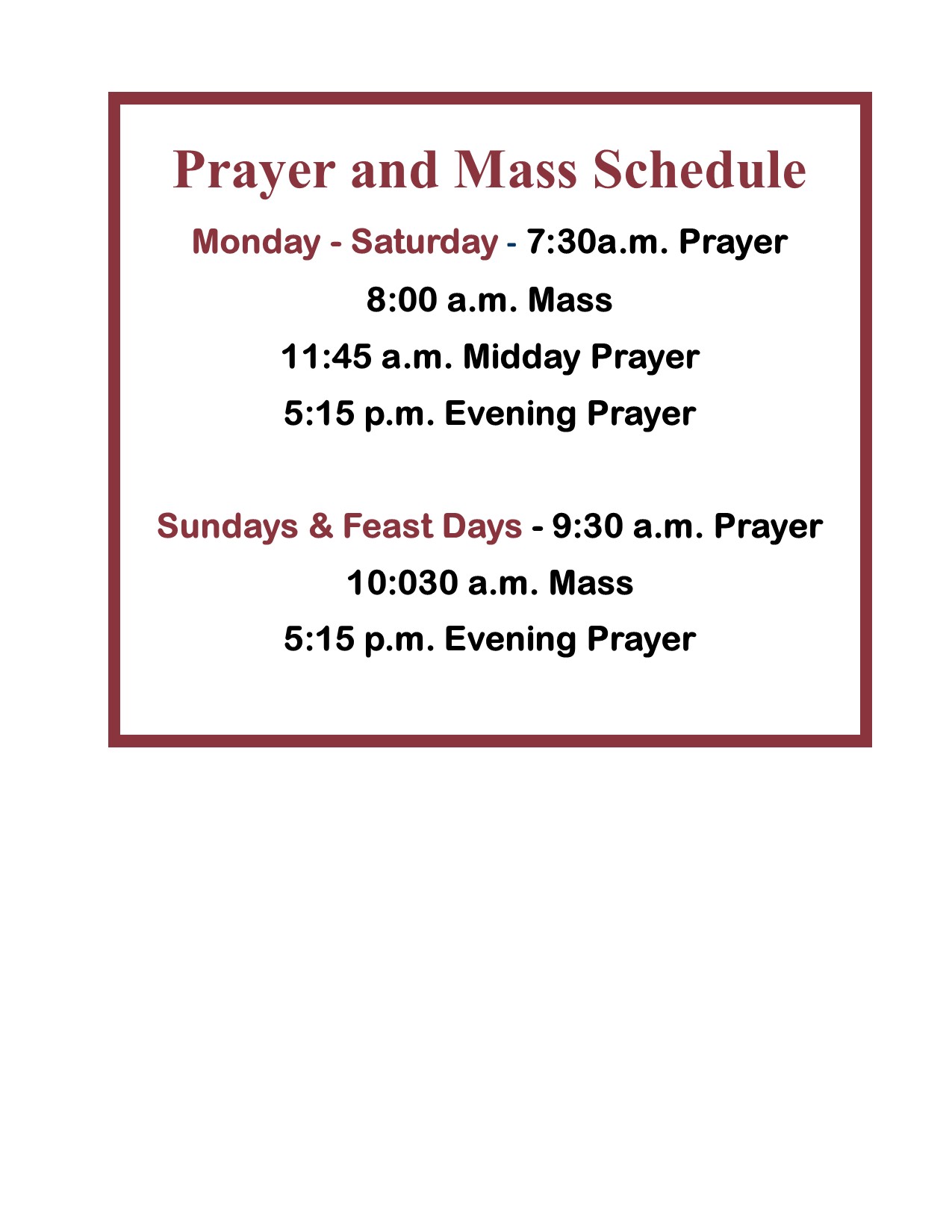
 Mass Schedule

Related Links

Copyright © 2026 · Benedictine Sisters of FL · Touching Lives Through Prayer and Service

Copyright © 2026 · Bendedictine Theme on Genesis Framework · WordPress · Log in