• Skip to primary navigation
  • Skip to main content
  • Skip to footer
Benedictine Sisters of FL

Holy Name Monastery
Founded 1889

Donate Now
  • Home
  • About Us
    • History
    • Being Benedictine
    • Benedictine Monasticism
    • Meet Our Community
    • Holy Name Academy-Alumnae
  • What We Do
    • Mission, Vision and Our Partners
    • Retreats
      • Invitation to Retreat
      • Accommodations
    • Volunteer Programs
    • Oblate Program
    • Spiritual Direction
    • Aqua/Hydroponics
    • More of Our Ministries
  • What’s Happening
    • Articles of Interest
    • Events
    • Commemorative Bricks
    • Newsletters
    • Brochures
    • Links
  • Support Us
    • Gifts of Support
    • Wish List
  • Stories Shared
  • Galleries
    • Photos
    • Videos
      • Benedictine Sisters of FL Videos
      • Other Videos
  • Contact Us

Easter

“Not the Kind of Perfect the Ninjas or Superman Display”

April 24, 2017 by Holy Name Monastery 1 Comment

First Reading  Acts of the Apostles 2:42-47   Second Reading   1 Peter 1:3-9
Gospel  John 20:19-31     Weekly Intention

The Frailty of Easter  Based in part on a reflection by John Slattery  (adapted)

We humans are a comparatively slow maturing and short-lived species. The average life-span in the United States hovers between 75 and 80.  The age of the earth, on the other hand, is around 4,500,000,000 years.  The age of the universe is around 13,800,000,000 years.  You and I inhabit just a small bit of that time, the tiniest morsel of space time lived out on a relatively small planet that orbits an average size star.  Our star, the Sun, is one of trillions upon trillions of stars, and our planet is one of trillions in the known universe.  But it’s ok.

Easter is all about smallness.   That’s why we are drawn to reading and re-reading the Easter accounts in the Gospels each year.  Despite the ocean of books, songs, sermons, and lectures written about Easter or on Easter-themes, our Scripture includes just four small stories about this Jesus who rose from the dead.  The combined resurrection stories encompass about 3500 words–the equivalent of about 15 pages, the length of an average term paper.

Jesus’ resurrection was such a humble thing.  There were no angel trumpeters or singers in the skies. It was more like the story in Psalm 119 that we prayed yesterday morning: “Without a word, without a sound, without a voice being heard, the message fills all the earth, resounding to the ends of the universe.”    First, Jesus surprised Mary in the garden.  She told a few other women,  then they told a few men and soon Jesus appeared to them.  He spoke about peace, about the Spirit of God, about hope.  He showed his wounds.  He ate some food and then he drifted up into the clouds.  He didn’t march on Rome or lead a rebellion against the priests who brought him to Pilate.  After his resurrection He didn’t heal anyone else or preach to vast crowds as He had done previously.  He didn’t cast out any more demons, trade barbs with rabbis, or visit the Temple.  The resurrection, in many ways, was quiet.

It challenges us to read that Jesus showed his followers his wounds.  “See,” he seems to say, “a broken body is not made whole by erasing the imperfections.  Feel this hole in my side,” he says to Thomas and to each of us.   “See, I have sanctified what the world calls spoiled.  A broken body is made whole not by removing the scars but by embracing the permanence of the wounds.”

We like this small and quiet resurrection where Jesus is not the definition of a contemporary superhero.  He doesn’t return triumphant and knock Pilate off his throne, bringing God’s wrath on the vicious Roman Empire.  He appears to his friends, simply showing his wounds and talking about love and peace.

This story today of Thomas illustrates our Christian experience. We are called to believe without seeing.    In fact, all Christians after the first witnesses have been called to believe without seeing. Thus, we sing “without seeing you, we love you; without seeing you, we believe.”  Thomas’ doubt is hardly surprising; the news of Jesus’ appearance was incredible to the disciples who had seen him crucified and buried. Thomas’ human nature compelled him to want hard evidence that the Jesus, who appeared to the disciples after his death, was indeed the same Jesus who had been crucified. Thomas is given the opportunity to act on that desire. He is our witness that Jesus is truly raised from the dead.  With him we proclaim: “We’ve been told, we’ve seen his face, and heard his voice alive in our hearts.”

Jesus wants us to be perfect, but not the kind of perfect that Ninjas or Superman display.  Jesus wants us to be perfect “as our heavenly Father is perfect.”  God’s perfection and the message of Jesus’ Resurrection calls us an unconditional embrace of frailty, pain, and brokenness.

It is an embrace that calls us to resist all forms of violence, power, and hatred.  There is growing acknowledgement of that fact that TV and video game violence, like second-hand smoke affects one’s lungs, permanently affects our brains.  Many families refuse to allow TV violence, fictionalized or news reports, to invade their living spaces.  Jesus did not arm his apostles with weapons for revenge — he armed them with prayer and baptized them in a spirit of hope and forgiveness.

We are surrounded today with so much sadness and fear and anger.  We who live in a peaceful community rejoice in the security and sanctity that empowers us to extend open arms in hospitality to those in the world who yearn for that same privilege.

At the end of our Gospel selection we read, “Jesus did many other signs that are not written in this book.  But these ARE written that you may come to believe …and through this belief you may have life in Jesus’ name.

We join the psalmist in singing: By the Lord has this been done; it is wonderful in our eyes.  This is the day the Lord has made; let us be glad and rejoice in it.”

~Reflection by Sister Roberta Bailey, OSB, Prioress
Continue Reading

Filed Under: Blog, Homily Tagged With: Easter, God, Jesus, Jesus' resurrection, John Slattery, unconditional embrace

Second Sunday of Easter

April 4, 2016 by Holy Name Monastery Leave a Comment

christ is risen w tombWelcome to the Second Sunday of Easter.  Notice it’s “of”, not “after” .. because, you know this, Easter’s not a single day, or even an octave but a season of 50 days.

There’s no question that we know how to do Easter as an even: the question is … How are we at Easter as a way of life?

The great Easter truth we celebrate is not that we are going to live anew after death, but, by the power of Jesus’ resurrection we are new here and now!

“Here and now” – that’s easier said than done. If it’s any consolation, the first Christians: those who had the direct experience of our risen Lord don’t seem to have been much better at it than we are.  During the Easter season we’ll be reading a series of “post – resurrection” stories: the women at the tomb who seemed to have forgotten the “punchline”: that Jesus told them he would rise after three days. It took the angels to remind them of that rather important detail. And then they ran back to tell the disciples, but, the men didn’t believe them!  And, Mary in the garden?  She thought Jesus was the gardener

Imagine today’s Gospel scene.  It’s a week later.  Without warning, Jesus is in their midst – no time to run and hide under the table.  He’s THERE.  Someone’s first reaction was probably, who left that door open?  Immediately, Jesus “breathed on them”.

Some things we just can’t see. But we know they’re there anyway. Like the air when a gentle breeze caresses our cheek.  God’s love is sort of like the air, isn’t it? It fills us up –  even though we can’t see it – we can feel it in our hearts.  When Jesus breathed on them, Thomas who had missed Jesus’ first visit and wants to see Jesus with his very own eyes, expresses his belief. But Jesus reminds him of something very important.   Sometimes we just have to believe in things that we can’t see. We have a special name for that. We call it “faith.”

You may recall the words of several hymns that refer to the spirit breath of God: “Be our breath,” “fall afresh on me,” “whose breath is seed outpoured –  calling all things to birth,” “with your breath melt the frozen, warm the chill,”        One of my favorite Marian hymns often heard at Christmas, is sung by Amy Grant, entitled “Breath of Heaven.  It’s the story of Mary’s pondering the workings of the Incarnational Spirit within her.  Mary’s prayer becomes mine: “Breath of heaven, Hold me together, Be forever near me, Breath of heaven – Be with me now, lighten my darkness, Pour over me your holiness, for you are holy, breath of heaven.”

It has become for me a prayer: to be filled with the breath of God … And, that’s what Easter as a way of life is all about. And it’s a way of life we live one day at a time: one step at a time — trusting that even if we take a mis-step, we never journey so far from God that the life-giving breath of that Spirit is beyond our reach: even when that seems impossible to believe.

That’s the lesson we learn from Thomas who has gone down in history as “doubting Thomas” because he refused to accept the testimony of others, but demanded his own experience.  He has borne the brunt of almost two millennia of bad press because of His skepticism about the resurrection and Jesus’ appearance to the other disciples.  Yet, what did Thomas ask for that the others had not received?  They had seen Jesus. They had maybe had a chance to touch His wounds.  Why is Thomas ridiculed for his insistence that he see for himself?

I’m a little intrigued, actually, about how quick we are to make Thomas the poster child for faithless doubt. As a matter of fact, the rest of the bunch didn’t do any better.  Remember:  the women at the tomb, the men who didn’t believe the women’s story, Peter who runs back to see for himself …. and here are the “faithful” disciples, after the appearance of Jesus: still locked in the upper room.

Think about it:  why did Thomas come back at all. Whatever had taken him away from the community, he came back. And it was in the midst of the community that Jesus came to him, and without so much as a confession or absolution, offered him what he needed to believe: “Touch, me Thomas. Do not be faithless, but believing.”

One of Thomas’ great virtues was that he absolutely refused to say that he understood what he did not understand, or that he believed what he did not believe. There was an uncompromising honesty about him: he would never still his doubts by pretending they did not exist.

But, he refused to surrender to the fear, too, which kept the other disciples shut up in that locked room. He ventured out and then had the courage to come back – to face a community which had had an experience that he had not shared.  At first he insisted on his own experience of God.   Jesus knew what he needed – He extended his hand to him – not a hand out; but a hand up, the nudge Thomas’ needed to bolster his faith “my Lord and my God.”  This is our challenge, and our privilege, to figure out what people need –  to offer the comfort, security and peace that will bolster their faith in a loving God.  This, too, is the challenge the Good Shepherd extends to us on Divine Mercy Sunday: to lead people to green pastures, where, surely goodness and kindness and mercy may follow them all the days of their lives.”

With Thomas, and all whose faith wavers:  we pray, “Breathe on me breath of God, until my heart is pure. Until with you, my will and Yours are one – not my will but yours be done.”

~ Reflection by Prioress, S. Roberta Bailey, OSB


Continue Reading

Filed Under: Blog, Homily Tagged With: 50 days, Easter, God, Jesus, Lord, Mary, risen, Second Sunday, Thomas

The Prodigal Son

March 8, 2016 by Holy Name Monastery Leave a Comment

prodigalIf you were around before Vatican II for long Latin choir rehearsals, you may recall the melody of the antiphon that announced the Fourth Sunday of Lent.  It’s one of those that stays with you … (sing) Laetare translates from Latin to English “Rejoice”.   This is also known as “Refreshment Sunday” – a day when the austerity of Lent is relaxed a little, and the violet vestments of Lent can be replaced with rose-colored ones.   A special kind of fruit cake was often served on this Sunday modestly breaking the Lenten Fast.

According to another old tradition, although it probably is not on anyone’s list of approved feast days, is “Laugher Sunday” or “Holy Humor Sunday” – a day celebrating the big joke that God pulled on Satan.  Thus the name: God’s Joke or the Easter Laugh – a day to lighten up, relax, and recall the joy and the goodness of the Lord.  (We anticipated it a bit with our Hoedown!)  In honor of Laughter Sunday, here’s one to tickle your funny bone.    During a lesson on Easter, a religious education teacher asked the class, “What did Jesus do on this day?  Getting no response, she prompted: It begins with R. “I know!” blurted out a child: “Recycle.”

But on a more serious bent … The context of today’s Gospel is not to be made light of.  Sinners and social outcasts were “all seeking the company of Jesus to hear what he had to say”. The Pharisees and Scribes, who were the “good and religious” people, were shocked and disturbed. “This man welcomes sinners and [even worse] eats with them.” By their standards, a “good” person avoids “bad company”. To be quite honest, don’t we think the same? If so, then we are not thinking like Jesus.

We typically title this Gospel story the “Prodigal Son” but, in fact, the emphasis is less on the son than on the father, who clearly represents God and Jesus.

No one can deny the appalling behavior of the younger son in this Gospel. He took all that his father generously gave to him as his inheritance and used it in leading a life of total debauchery and self-centered indulgence. Eventually, he had nothing and was reduced to living with pigs, something utterly abhorrent to the Jewish mind, and even sharing their slops, something even we would find appalling. “Served him right,” might be the reaction of many, especially the good and morally respectable.

This, however, is not the reaction of the father, who has only one thought in his mind – how to get his son to come back to where he belongs. The father does not say: “This son has seriously offended me and brought disgrace on our family. He better not come crawling back here.  I disown him!”  Instead he says: “My son went away, is lost and I want so much to have him back.” He stands in the doorway of his house many long hours, watching, waiting, longing … His love for his wayward son has not changed one iota.

There is no force involved. The police are not sent out. There is not an “Amber” alert. Servants are not instructed to haul him back. No, the father waits. It is up to the son himself to make the crucial decision: does he want to be with his father or not?

Eventually he “came to his senses”, that is, he realized the wrongness of what he had done. He became aware of just how good his father had been. The process of repentance had begun. He felt deeply ashamed of his behavior and then, most significant of all, he turned around to make his way back to his father.

The father, for his part, filled with compassion for his son’s experiences, runs out to meet him, embraces him and brushes aside the carefully prepared speech the son had prepared. If the son had known his father better, he would have realized that such a speech was unnecessary. Immediately, orders are given to bring the very best things in the house and a banquet is laid out.   This is forgiveness on the part of both the father and the son – a return to where each ought to be in relationship to the other.

This is where the elder son comes in. He simply cannot understand what is happening. “It’s just not fair!” How many times have we heard this spoken or, be truthful, felt in our hearts?  “It’s not fair, just because she’s the baby; you didn’t let me stay out that late when I was her age!”  And the litany grows.  We challenge our parents and one another’s generosity, operating from the perspective of limited resources. If she gets it, perhaps there won’t be enough for me.

Jesus wants his hearers (us) to understand that this is not how it is with God’s mercy, love and forgiveness. God offers love to all of us in abundance. The forgiveness of the father in the parable is an image of God’s love for us: generosity beyond measure!

By our standards, even God is unjust.  In fact, he is corrupted by love! That’s fortunate for us!  Supposing we went to confession one day and the priest said, “Sorry, that’s it. No more forgiveness, no more reconciliation. You’ve used up your quota. Too bad! ” Of course, it’s not like that.  Thankfully there is no limit to God’s forgiveness, mercy and love.  God has a deep desire to forgive – to be totally reconciled with us when we’ve severed the bond of relationship.  There is always a place in God’s company for us.  The question is: Do you truly believe that God acts this way towards us?  Can we humbly accept divine mercy without jealousy, knowing that God’s love for another does not diminish the love shown and showered upon us?

4th sunday web

Continue Reading

Filed Under: Blog, Homily Tagged With: Easter, forgiveness, God, Jesus, Lent, love, mercy, Prodigal son

  • « Go to Previous Page
  • Page 1
  • Page 2
  • Page 3
  • Page 4

Footer

Prayer / Newsletter / Info

 Contact Info

Benedictine Sisters of Florida

PO Box 2450
12138 Wichers Road
St. Leo, FL 33574-2450
(352) 588-8320
(352) 588-8443

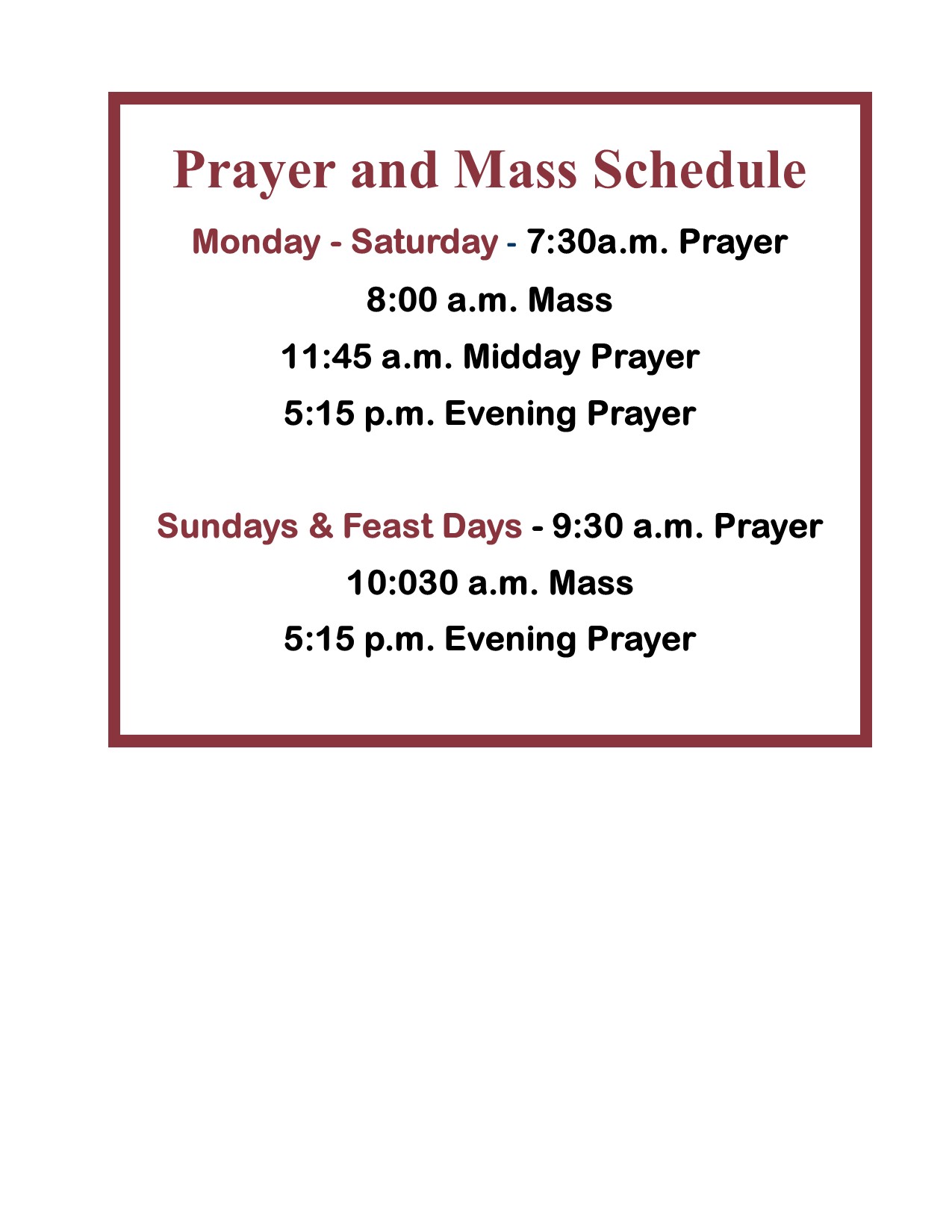
 Mass Schedule

Related Links

Copyright © 2026 · Benedictine Sisters of FL · Touching Lives Through Prayer and Service

Copyright © 2026 · Bendedictine Theme on Genesis Framework · WordPress · Log in