• Skip to primary navigation
  • Skip to main content
  • Skip to footer
Benedictine Sisters of FL

Holy Name Monastery
Founded 1889

Donate Now
  • Home
  • About Us
    • History
    • Being Benedictine
    • Benedictine Monasticism
    • Meet Our Community
    • Holy Name Academy-Alumnae
  • What We Do
    • Mission, Vision and Our Partners
    • Retreats
      • Invitation to Retreat
      • Accommodations
    • Volunteer Programs
    • Oblate Program
    • Spiritual Direction
    • Aqua/Hydroponics
    • More of Our Ministries
  • What’s Happening
    • Articles of Interest
    • Events
    • Commemorative Bricks
    • Newsletters
    • Brochures
    • Links
  • Support Us
    • Gifts of Support
    • Wish List
  • Stories Shared
  • Galleries
    • Photos
    • Videos
      • Benedictine Sisters of FL Videos
      • Other Videos
  • Contact Us

King

Salt to the World

October 4, 2021 by Holy Name Monastery Leave a Comment

I don’t mean to make light of the Scripture designated for this weekend.  However, I would like to call to your attention the lines between last Sunday’s proclamation and the verses skipped coming into today’s Gospel.  They are too rich, I believe, to let them slip from our attention.

“Everyone will be purified by fire, as a sacrifice is purified by salt.  Salt is good, but if salt becomes insipid, how can you make it salty again?”  “Insipid” – that’s a rich descriptive word, isn’t it?  If one becomes “insipid” can her/his ‘tang’ ever be restored?

I don’t think I’ve ever met anyone who doesn’t like at least a hint of salt.  We may use it sparingly but we use it, or a salt substitute, to make our food tastier.  Some, even when the doctor dictates against it, experience a craving for salt.  How quickly the potato chips and Fritos disappear!

Other spices are different – many people are picky about them.  Some think food is distasteful unless it’s peppery-hot.  The mere thought of hot spicy foods ties my stomach in a huge knot.  I marvel at people who devour a whole chili or ghost pepper.

But salt, you know, has many more uses than only bringing out flavor in foods.  I found a list of 60 everyday uses. Here is a sampling: it can be used to end an ant parade, deodorize your shoes, to gargle a sore throat, clean flower residue from a vase, freshen up artificial flowers, remove water rings from furniture, extinguish a grease fire, or a cloth soaked in salt water will prevent cheese from getting moldy.  Some of you will remember Sister Bernadette’s big dye pot!  Well, salt is used to fix the dye in fabric.  Without salt, the bright colors that we wear today would quickly fade.  It’s used in the production of over 14,000 different products.  Each year, food companies use an amount that is every bit as staggering as it sounds – 5 billion pounds of salt.

Let me not stray too far afield from Scripture, but it helps us understand why Jesus or the evangelist would use the image of salt in a lesson with us.  The usefulness of salt was a well-known fact long before Jesus walked this earth.  At one time, salt was so important and valuable that people were paid with salt.  Thus came the expression “are you worth your salt?”  Is it any wonder that Jesus told us that we were to be like salt to the earth?  Listen again to the words of Jesus.  “Salt is good, but if it becomes insipid, how can you restore its saltiness?  Have salt in yourselves, and be at peace with each other.”  I think that he was saying that we should “salt” that is, flavor our world with love.  And that likewise we should allow God to use us, and our saltiness, in making the world a better place.

You may remember this Indian folk tale about salt.  The story goes thus: Once there was a king who was trying to decide which of his daughters should inherit the kingdom.  So he asked each one, “How do you love me?  The first three daughters each answered: “I love you as sugar or honey.”  The youngest said, “Father, I love you as salt.”  The king frowned, but she persisted in repeating it, to the point that the king waved her away.

Sometime later she prepared a meal for her father but she didn’t add any salt to it.  When the king sat down to eat, the first course included only sweets which he picked at with displeasure.  Next, he was served meat, which he usually enjoyed but this was AWFUL.  By now he was very hungry, longing for something which he could eat.  The princess offered him a dish of common spinach, seasoned with salt.  The king signified his pleasure by finishing off the dish with relish.  She stepped cautiously forward saying, “Oh my father, I do love you so.  I love you as salt.  My love may be homely, but it is true, genuine and lasting.  Thus, as the saying goes, were the Scriptures fulfilled: let us “Have the salt of friendship among yourselves, and live in peace with one another.”

How about you?  Are you allowing Jesus to use you to be salt to the world?  How are you flavoring the world?  Are you an irritant rubbing salt in the wound?  Or are you a soothing poultice held lovingly to a tender hurt?  Are you worth your salt?  Are we drying the salt of tears for the abused?  Salt seasons soup in order to fulfill its purpose.  Remember salt is no good by itself – it takes companionship to bring out its flavor.  In whose life are you bringing out the flavor?  Who is salt in your life?

~Reflection by Sister Roberta Bailey, OSB, Prioress

Please join us in prayer for Congress that the members may come to one mind for the betterment of the people whose lives are impacted by their decisions.


First Reading:   Genesis 2:18-24             Second Reading:  Hebrews 2:9-11
Gospel:   Mark 10:2-16


Continue Reading

Filed Under: Blog, Front Page, Homily Tagged With: flavor to foods, Insipid, Jesus, King, Salt is good, Salt to the World

Solemnity of Christ the King

November 23, 2020 by Holy Name Monastery Leave a Comment

If you’ve ever had the good fortune to be in Rome.  And found yourself In St Peter’s square, you surely have seen the great obelisk that stands in the middle of the square.  [Whether you’ve been to Rome, or not, – it is really there.]  It about four and half thousand years old and originally stood in the temple of the sun in the Egyptian city of Heliopolis.  But it was bought to Rome by the dreadful Emperor Caligula and it was set right in the middle of a Roman racetrack known as the Circus of Nero.  It was in that Circus that St. Peter was martyred, and the obelisk may well have been the last thing on this Earth that Peter saw.  On top of the obelisk there now stands a cross representing the cross of Jesus’ crucifixion. But in ancient times there was a gold ball representing the sun.  On the pedestal of the obelisk there are two inscriptions.  The first of them in Latin, “Christus vincit, Christus regnat, Christus imperat”, freely translated in the words of a hymn “To Jesus Christ, Our Sovereign King:” Christ Jesus Victor! Christ Jesus Ruler!  Christ Jesus, Lord and Redeemer!  The other inscription, “The Lion of Judah has conquered.”  In the two we have the language of victory.  Christianity has triumphed by the power of the cross and triumphed over even the greatest power that the ancient world had known, the Roman Empire.  Here in the middle of St. Peter’s square stands the obelisk bearing those triumphant inscriptions.

In 1925, Pope Pius XI universally instituted the Feast of Christ the King to be celebrated on the last Sunday of October.  However, since the reform in the liturgical calendar in 1969, the feast falls on the last Sunday of Ordinary Time, the Sunday before Advent.

At the time of the institution of the feast, secularism and dictatorships in Europe were on the rise.  Respect for Christ and the Church was waning.  Today, we witness the same sense of distrust of authority – accelerated by political situations and the rise of individualism.  Some reject the titles of “lord” and “king” for Christ believing that such titles are borrowed from oppressive systems of government.  History proves that some kings have been oppressive.  Others have been converted to a more Christian style of ruling … often by the influence of a woman.

In 2015, during the Jubilee year of Mercy, Pope Francis added another part to the title: “…the living face of the Father’s mercy.”  The combined readings this year for the solemnity give us a glimpse of how Christ is at the same time both king and the face of the Father’s mercy.  In contrast to the oppression so prevalent in Jesus’ day, he connected his role as king to humble service, and taught his followers to be servants as well.  “You are my disciples if you do what I command you: love one another as I have loved you.”

As we observe the feast of Christ, the King, we are celebrating a ruler who was willing to die for us, for all humanity, to give us true freedom.  Jesus radically redefined the concept of kingship.  His example of love and kindness is lived out by us, his followers, in our reaching out to those in need – beginning with those we live with.

At the opening of every Eucharistic gathering, the celebrant greets us with the words: “The Lord be with you.”  In tomorrow’s opening hymn we will sing: “Praise, my soul, the King of Heaven.”  And in the responsorial psalm we’ll proclaim: “The Lord is my shepherd.”  We profess in the Creed: “I believe in one Lord Jesus Christ.”  We often raise a hand in benediction as we sing: “May the blessing of the Lord be upon you.”  Deep down do we believe JESUS IS LORD or is it just from force of habit that we say or sing those titles for Jesus?  If we believe it’s true Jesus is Lord, why do we sometimes scramble to find a substitute to replace the word “Lord?”

It strikes me that while we may struggle with the concept of Jesus as king … somehow, especially like on today’s feast (the Presentation of Mary) most of us have no problem calling Mary queen: queen of the universe, queen of heaven, Regina Caeli.

Our prayer intention this week is for the gift of a grateful heart.  Look at the person on either side of you – and across the aisle – with eyes filled with the compassion of Christ.  Let us pray that we can portray to the world the beneficence of a humble king, truly putting flesh on our Corporate Commitment “to respond with compassion to the hungers of the people of God.”

~Reflection by S. Roberta Bailey, OSB, Prioress

First Reading Ezekiel 34:11-12, 15-17             Second Reading1 Cor 15:20-26, 28
Gospel Matthew 25:31-46


Continue Reading

Filed Under: Blog, Front Page, Homily Tagged With: Christ, Eucharistic, King, Lord, Mary, Pope, Prayer, Rome, solemnity of Christ the King, St. Peter's Square

Have You Admitted It?

November 27, 2017 by Holy Name Monastery Leave a Comment

The feast of Christ the King was instituted by Pope Pius XI in 1925, during a time when respect for Christ and the Church was waning.  Today, the same distrust of authority exists.  The magnitude and the manifestations of the problem have evolved over the years to the point that Individualism has been embraced to such an extreme, that for many, the only authority is the SELF.  In such a system, the idea of Christ as King is rejected.  In our own liturgies we sometimes avoid the use of the title King and Lord.

The one and only time Jesus allowed himself to be treated like a king is recalled in the Holy Week liturgies.  Those Passion Gospels pointedly remind us that Jesus’ kingship is one of love and sacrifice, not power and domination.  In retrospect, the mocking, derisive jabs that Jesus endured served to proclaim his true identity: the messiah, the chosen one, the king of the Jews and our savior and the savior of all people.

Today’s particular Gospel (from Matthew), doesn’t use the word KING, but it does refer to Jesus in glory, seated on a glorious throne, with all the nations assembled before Him.  It makes it obvious, we won’t experience Christ’s reign all on our own.  We’re really part of something bigger than our own little selves, when we live “under” the reign of Christ.  We’re gathered with many people of varied kinds and you heard how Jesus described us – sheep and goats.

The full title of this celebration is “The Solemnity of Christ, the King of the Universe.” During the Jubilee year of Mercy, Pope Francis added another part to the title: “…the living face of the Father’s mercy.”  This title seems to be somewhat of a paradox.  When we think of the king of the world, let alone the king of the universe, we might tend to imagine a powerful, distant leader, disconnected from ordinary people.  But on the other hand, Christ is the face of the Father’s mercy, the one who binds up our wounds, heals us, blesses us, and saves us.  It may seem peculiar that He can be both the King of the universe, and the face of mercy.  However, the combined readings for the solemnity give us a glimpse of how Christ is both king and the face of the Father’s mercy, all at the same time.

The wonderful thing about Jesus’ use of parables is that we can identify ourselves with one or more of the characters in the story.  When we read or hear a parable it’s sort of like looking in a cloudy mirror.  There’s not much precision, but the general image is there.  You begin to squirm with the feeling: “This one’s about me.  He’s talking to me.” It’s that way with this parable of the sheep and the goats, the saved and the damned.  Both groups question:  When did we treat you, or not treat you, in the ways you describe?  And Jesus tells them straight forward: “Whenever you did (or did not do) for one of these least ones” – that’s how you treated me.

So, where do you see yourself in the story?  Do you belong to those that care, (the ones on the right), or those who simply didn’t have enough time to be bothered (those on the left)?  Or, like me, does it depend.  One day you see yourself on one side and wish you could honestly say you were on the other?  We’ve given of our time, our treasure, and our talent – and sometimes we’ve withheld them – depending upon a number of factors, some of which we’d be ashamed to identify.

But there’s another group in the parable that may be overlooked.  The message is so simple that we fail to see the BIG point.  There were those who helped, those who couldn’t be bothered, and then there were those who needed help!

So, here’s the BIG question for today.  Your salvation many hang on your answer.   When have you seen yourself as one who needed help?  The answer is awfully important because Jesus seems to identify Himself as those who are hungry or thirsty.   But, notice, He didn’t only identify Himself as one among many – NO, He identified Himself as living in those very people.  He was born poor and helpless, born in need and died in need.  He lived and moved and had His being in need.  Not among the poor ones – within each of those poor ones – no matter what features you see, Christ’s face speaks to us in the voice of each person.

Our connection is in this Gospel.  Christ will come and judge us by how merciful we have been to others.  The King of the universe wants us to be the face of his mercy to one another.  You heard how we will be judged.  Did we feed the hungry, clothed the naked, and visit the sick?  By giving mercy to others in the same way that Christ has given mercy to us we proclaim God’s mercy and Christ’s kingship to the world.  How will you proclaim his reign and his kingdom today?  Have you admitted that you are in need, that you’re not self-sufficient, that you`re on spiritual food stamps, and that you and Jesus find each other in need?  Jesus speaks in this parable in the first person: “when did YOU see ME in need?”

So which group DO you belong to in the parable?  Just how DO you identify yourself in it?  Could it be true that you just might have to change how you identify yourself not only in the parable but in real life?  Perhaps this is a moment of grace for you; perhaps you’re being touched again by God?

~Reflection by Sister Roberta Bailey, OSB, Prioress


34th Sunday  Feast of Christ the King
First Reading           Ezekiel34:11-12; 15-17                            Second Reading      1 Cor. 15:20-28
Gospel   Matthew 25:31-46
Continue Reading

Filed Under: Blog, Homily Tagged With: admit, Christ, God, Jesus, King, need, parable

  • « Go to Previous Page
  • Page 1
  • Page 2

Footer

Prayer / Newsletter / Info

 Contact Info

Benedictine Sisters of Florida

PO Box 2450
12138 Wichers Road
St. Leo, FL 33574-2450
(352) 588-8320
(352) 588-8443

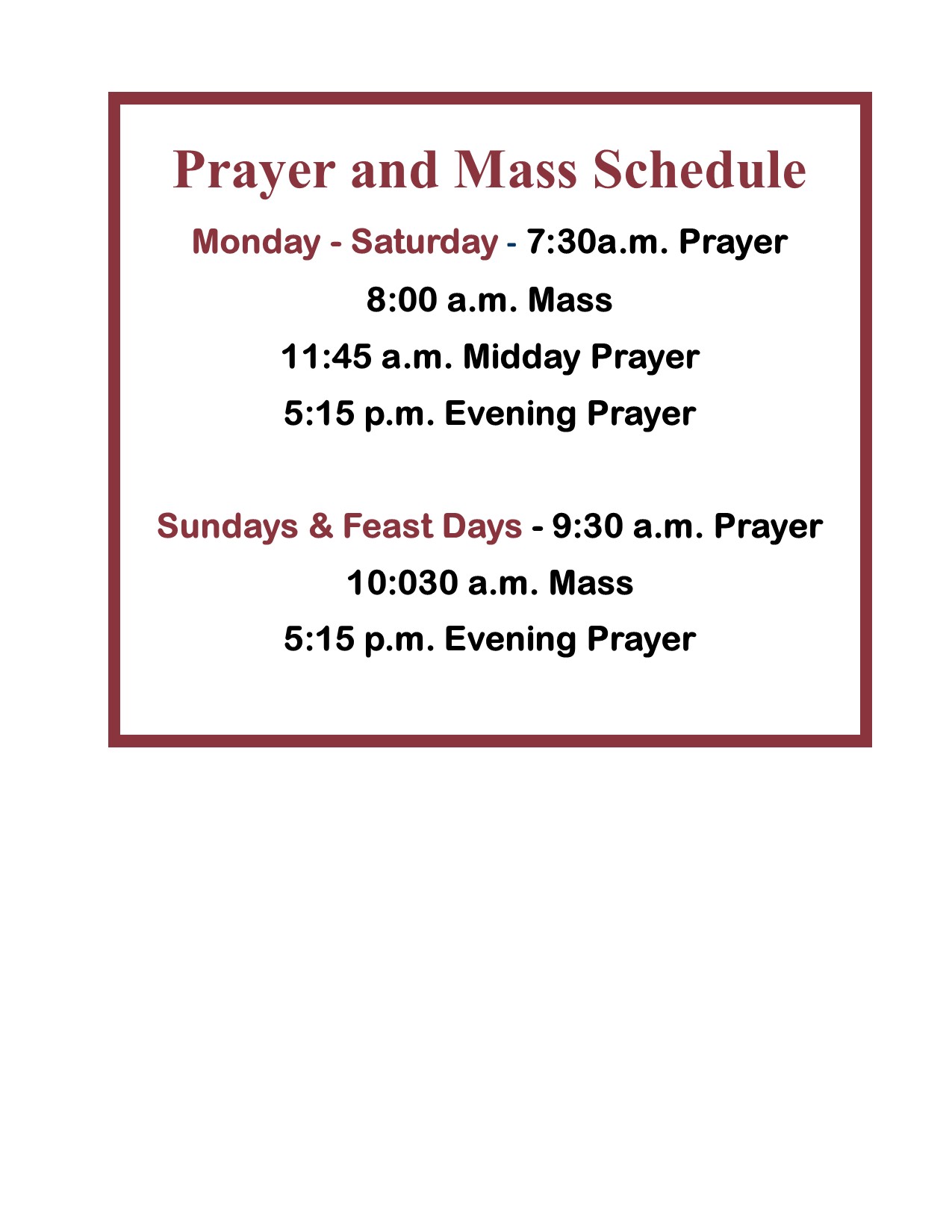
 Mass Schedule

Related Links

Copyright © 2026 · Benedictine Sisters of FL · Touching Lives Through Prayer and Service

Copyright © 2026 · Bendedictine Theme on Genesis Framework · WordPress · Log in