• Skip to primary navigation
  • Skip to main content
  • Skip to footer
Benedictine Sisters of FL

Holy Name Monastery
Founded 1889

Donate Now
  • Home
  • About Us
    • History
    • Being Benedictine
    • Benedictine Monasticism
    • Meet Our Community
    • Holy Name Academy-Alumnae
  • What We Do
    • Mission, Vision and Our Partners
    • Retreats
      • Invitation to Retreat
      • Accommodations
    • Volunteer Programs
    • Oblate Program
    • Spiritual Direction
    • Aqua/Hydroponics
    • More of Our Ministries
  • What’s Happening
    • Articles of Interest
    • Events
    • Commemorative Bricks
    • Newsletters
    • Brochures
    • Links
  • Support Us
    • Gifts of Support
    • Wish List
  • Stories Shared
  • Galleries
    • Photos
    • Videos
      • Benedictine Sisters of FL Videos
      • Other Videos
  • Contact Us

Healing

” Your actions speak so loud I cannot hear what you are saying.” – Ralph Waldo Emerson

September 9, 2024 by Holy Name Monastery Leave a Comment

In this Gospel story we find clues that promote our understanding of the sacramental “laying on of hands” and the sacredness of human touch.   We are struck by the physical means Jesus used to heal the man’s lack of hearing and speech:  the use of spittle and touch – both discouraged in today’s post-COVID “stay safe” world.  Jesus cannot explain to the deaf man verbally what He is about to do, so He uses a rough form of sign language to communicate His intentions. First, He sticks His fingers in the man’s ears to let him know that He is going to do something about his deafness. He spits on His finger and touches the man’s tongue to let him know that He is about to restore his speech. This might sound gross, but it’s what Jesus does!  And, it awakens faith in this man’s heart.

After touching the man, Jesus looks toward Heaven. This act serves two purposes. First, it communicates to the deaf man the origin of the healing.  Secondly, the act of looking toward Heaven demonstrates Jesus’ dependence on his Father. As Jesus raises his eyes heavenward, he “sighs”.   Of course, the deaf man cannot hear the sigh, but he can see Jesus’ expression. And, it speaks volumes, more than words could say: “I care about you and what you are going through!”  Jesus says one word, “Ephphatha”- “be opened”. When Jesus says this, the man’s hearing is restored and his tongue is loosed. He can hear and speak! What a miracle! One command from Jesus and his life has changed forever! The witnesses declared: “He has done all things well!”

This week we are invited to make an honest inventory of our true needs.    Have I found contentment? Am I close enough to God to receive guidance and strength? Have I secured peace of heart and mind? Deciding what we lack is the first step in securing it. Only then can we express our needs to Christ who has said: “Ask and you shall receive.”  But, remember God-time may not match our unspoken expectation.  When God takes time answering our prayers, it’s not because we’re not heard or that God doesn’t already know our needs.  God is giving us the gift of time to recognize what our true needs are.

One of the greatest weaknesses of the human heart is the inability to tune into people’s underlying needs.  One may indeed lack food for the table, but her real need may be for a fair wage for her 8-hr job.  We can hear the cries of broken, suffering people in lands across the sea, but be oblivious to the cues of the persons that every day are sitting right beside us. Remember the expression: “Your actions speak so loud I cannot hear what you are saying.”  (Ralph Waldo Emerson)

This man in the Gospel, though he was lacking hearing and speech, he had people around him that cared about him. They heard that Jesus was passing by, and they brought their friend to Jesus.  Benedict calls to us to “carry each other”. We can help one another understand the word of God spoken in community decision-making and help one another accept decisions that are contrary to personal wishes.  We are to uphold the weak, challenge the faint-hearted, rouse the sleepers, and open our eyes to the light that comes from God and our ears to the voice from heaven that every day calls out to us.  This is how St. Benedict teaches that we shall “progress in the way of life and faith, running on the path of God’s commands, our hearts overflowing with the inexpressible delight of love.”  With the help of community, he says: “We will run, and not grow weary”.

The closing words of our Gospel remind us that Jesus does all things well.  “All” may only be a three-lettered word but it is a mighty big word!  It covers a lot of territory. If one letter is missing – one person missing out in decision-making – all that God designs to be accomplished may not come to fruition. How can a two-legged stool keep balanced?  Jesus does all things well. Come to Him and let Him teach you the truth!  You’ll shake your head saying, “Well done! Well done! Very well done!”


~Reflection by Sister Roberta Bailey, OSB


Pray for peace in our times… and guidance during the upcoming voting season.



First Reading:   Isaiah 35:4-7a         Second Reading:  James 2:1-5
Gospel:   Mark 7:31-37
Continue Reading

Filed Under: Blog, Front Page, Homily Tagged With: deaf, God, Healing, healing touch, Jesus, Mark, speech

Are You the One of Ten Who Found Salvation?

October 10, 2016 by Holy Name Monastery Leave a Comment

luke-17-11_19First Reading   2 Kings 5:14-17              Second Reading    2 Timothy 2:8-13
Gospel    Luke 17:11-19

This Gospel has much to say about gratitude and salvation.  All 10 of the lepers were given the gift of healing, but only one found salvation because he recognized the gifts he had been given and knew to whom he owed thanks.

At the outset of this story we know that these ten men are stuck – Stuck in a “no-man’s” land of being socially, religiously, and physically unclean having to distance themselves from but all other lepers.  By the end of the story, all ten were made well.  But one has something more. He has seen Jesus, recognized his blessing and rejoiced.  Because he saw what had happened, this man is not just healed, but is made whole, restored, drawn back into relationship with God, and his family, friends and neighbors. In all these ways he has won salvation.

Recently I heard a true story of gratitude that wrought salvation.  The lady who told the story works downtown in a large city.  Every morning, she encountered a middle‑aged woman in a shabby coat soliciting spare change from passers-by.  She greeted everyone with a smile and a pleasant “Good morning.”  The lady who told the story almost always gave her something.  After almost a year of this routine, however, the woman in the shabby coat disappeared.  My friend wondered what had happened to her.  .

Then, one beautiful morning, she was in her place in front of the church, still wearing the same, shabby coat. As folks reached into their purses or pockets for their usual donation, the woman stopped each of them. “Thank you for helping me all those days,” she said. “You won’t see me again because I’ve found a job.” With that, she reached into a bag and handed each one a wrapped package. She had been standing at her old spot waiting, not for a handout, but for the people she recognized so that she could give each of them a doughnut.  She recognized those who had given to her in her time of need. This is gratitude!

In our account today ten men encounter Jesus and called out (the scripture say “loudly” or yelled) “We want to be well!”  You may know that leprosy also attacks the vocal chords so that these men probably could only make a raspy sound. But that didn’t stop them from raising their voices and crying, “Jesus, Master, have mercy on us!” The gracious Lord Jesus will never turn a deaf ear to a cry like that!

Jesus appears to do nothing, but quietly directs the men:  “Go, show yourselves to the priests.”  Now, you have to understand that the local priest, besides leading worship services was also something of a health official – to test and certify a complete removal of the dread disease and then to announce that the person was healed.

As these men took heed of Jesus’ words and set out in search of the priest, one may have noticed his hand, once eaten away by the disease now tingled with life.  Or maybe he dropped his crutch when we saw his leg was back, healthy, whole and complete.  Their skin was beginning to clear and regain natural color.  One looked at the other, another looked at the rest, and the screaming started. The smiles broke into cheering, and a sweet madness. They raced off in the distance, hardly believing that the nightmare was finally over.

But in order for the miracle to happen, the men had to start a journey in faith before their circumstances had begun to change even one tiny bit. We are not told whether the ten lepers had a debate about whether or not to go. I can well imagine one of them arguing, “We’ll look like fools if we show up before the priest in our present condition!” Another countered, “Yes, but we’ve got nothing to lose; this is our only hope.” “But it hurts to walk on these leprous feet!” “I know, but if we do what He says, maybe we’ll be healed.” “But this isn’t the way He healed the other lepers. Why doesn’t He heal us in the same way?” “I don’t know, but we must obey.”

Maybe they didn’t have any such debate, since the text doesn’t record any, but at any rate, it says, “as they were going, they were cleansed.” It must have been a marvelous experience!

One of the men came back to Jesus.  The gospel does not make it clear whether he had seen the priest and been declared clean.  The evangelist tells us he praised God. He was thankful. He was public about it. He was loud – he wasn’t shy at all.

Why was he so loud? This guy had been forced to yell for as long as he’d had leprosy. Might have been years? He’d probably yelled so long, he didn’t know how to come to the Lord quietly, or even in a normal voice. When he came back and fell at the feet of Jesus, he was just louder than the normal person, and he was praising God.

He had reversed his steps, put his family on hold, put the priest on hold, and came back to the one who was the Cause of his celebration. His response, his thankfulness led to action.

Jesus asked: “Where are the other nine?”  They had got what they wanted from God in terms of healed bodies.  But, according to the story, they never returned to Jesus to receive salvation. They received the temporal benefit of healed bodies, but it is only to the one thankful leper who returned that Jesus proclaimed, “Your faith has saved you.” In the same way, it is possible to receive special blessings from God in answer to prayer, and yet to fall short of the best blessing of all. Thus when we realize that God has blessed us with some temporal blessing, we must not become satisfied with that and stop before we’ve thanked the Source of all blessings.

A story is told of a man who was lost in the woods. Later, he told how frightened he was and how he had even finally knelt and prayed. Someone said, “Well, obviously God answered your prayer?” “Oh, no,” the man replied. “Before God had a chance, a guide came along and showed me the way.”

~Reflection by Sister Roberta Bailey, OSB, Prioress
Continue Reading

Filed Under: Blog, Homily Tagged With: Faith, gift, God, gratitude, Healing, Jesus, lepers, priests, salvation

Our Blind Eyes Opened, Spread God’s Love

October 26, 2015 by Holy Name Monastery 2 Comments

eye for GodMark 10:46-57                                           Intention:  Jubilarians


The story of Bartimaeus rings with a familiarity of the plight of many people today.  He once had a family, a job, a house, kids, the whole works. He was active at the local synagogue. He would tell his children stories of their ancestors.  Then things started to change, he started to get these real bad headaches and his vision would become blurry. At first he did not allow this to bother him but kept on working and living, but eventually the blurred vision got worse and worse and eventually he could barely see his wife and children. He told them to leave because he wouldn’t be able to support them or protect them. Then things went black and that’s the way it was.

He would lay his cloak on the ground so people could throw their loose change on the ground next to him. Most people avoided him altogether because in those days many people felt that blindness was caused by sinfulness either by the person or by their parents, so they were avoided. That’s the way it was for years. He struggled to survive, always hungry and thirsty and everything always black.

Despite all the hardships that he faced he still loved God. He remember the stories that he told his children and he saw in his mind the people in those stories and how God always came through for them in the end. Now Bartimaeus sat daily next to the road listening to the people passing by. The conversation lately had been about this guy named Jesus who had healed people, even blind people. Some had even said that he was the messiah that had come to redeem Israel. Bartimaeus thought, “Wow, if only Jesus would come around here.”

Then one day there was a commotion. There were more people on the road than usual and then he heard the name, Jesus. He was coming. Should he say something? Would Jesus come to him? Could he restore his vision? Something deep inside said “Yes, call out the name.” Bartimaeus opened his mouth: the crowd around him tried to silence him. Yet Bartimaeus persised, calling out more loudly and with greater urgency. He will not be silenced or deterred from getting Jesus’ attention. We notice how quickly the crowd’s reaction changes when Jesus calls for Bartimaeus. Those who sought to quiet him now encourage him.

Bartimaeus recognized power and authority when he saw it. We do the same thing. If we had a broken leg we wouldn’t go to AutoZone to have it fixed.  If the doctor came in overalls, we might have a few questions, but if he was in a white coat, with a stethoscope and a pocket protector we would have no problem. Even though it might be some Joe Schmo from the street dressed as a doctor, we recognize the uniform as power and authority; we don’t ask for credentials or references, we simply accept what experience told us was the situation.

Bartimaeus recognized Jesus’ authority.  Jesus didn’t have on a uniform, even if he did Bartimaeus was blind he couldn’t see him anyway. He had heard stories, but he had heard false rumors, too. This recognition came from a place deep within him.

We have that some recognition of Jesus. We have never seen Him.  We’ve see artistic renditions of Jesus but our recognition originates from a different sense than sight..  It comes from a spiritual sense. It comes before anything. It is grace that allowed us to have that first moment with God, when God was not just a figure in religion classes or in the Bible but God became personal, a friend.

When Bartimaeus recognized Jesus, he still had a choice to make: act on that recognition or let it pass by.  Bartimaeus cries out, “Jesus, Son of David, have mercy on me!” He addressed Jesus by name and by title, Son of David, the messianic title reserved for the redeemer of Israel.   We cry out as well when we get to the last point, the straw that breaks the camel’s back.  We cry, “Help me, Jesus.” “Have mercy, Jesus” Or simply, “Jesus” “Got in Hiemel.”  “Mi Dios!”  We realize that only God can help us in whatever situation we are in. God’s grace not only gives us the ability to perceive God’s power and love. It also gives us the strength to respond to it. Unlike Bartimaeus however, we are not limited to a once in a lifetime response. We must continually respond to the gift of grace and power in our lives.

What is Jesus’ response to Bartimaeus? “Go; your faith has made you well.” It is interesting to see that Jesus says that it is Bartimaeus’ faith that produced his healing not Jesus’ faith that made him well.   Bartimaeus’ faith, and ours too, is not born out of nothing, it does not come out of thin air, but it is a response to the love and grace of God.  It was Bartimaeus’ response to God’s initial contact through grace that made him well – restored his sight. Our response to the power or grace is also a restoration and a reconnection.  We might not be blind, physically but spiritually we may be walking around aimlessly. Our spiritual vision may be black as night, but God still initiates the reconnection through grace and gives us the freedom to respond or reject His gift.

That’s the end of the story, right? Not quite. What does Bartimaeus do once he has been restored?  Immediately he follows Jesus on the way.  It is not the end, but the beginning of a journey.  We don’t receive the fire of the Holy Spirit, the connection with God, only to sit it in the corner or in the closet, or even the chapel.  Instead we must take up the invitation and follow Jesus on the way.  The question facing us is: Am I going to do for God today, or for myself?  Am I going to spend today in connection and in conversation with God or am I going to satisfy my own selfish wants and desires?  Our blind eyes opened, we have a unique opportunity to spread God’s love in the world.  Lord, we pray: open our eyes and strengthen us to following your prompt to be an expression of your compassion and mercy in our world.

                                                                                                                        By    Sister Roberta Bailey, O.S.B.
Continue Reading

Filed Under: Homily, Prayer Tagged With: Bartimaeus, Blind, Faith, family, God, Healing, Jesus, Mark

23rd Sunday in Ordinary Time

September 8, 2015 by Holy Name Monastery Leave a Comment

ephphatha-mark7-34In this story we find clues about our understanding of sacrament.   We are struck by the physical means used to heal the man, the use of spittle and touch.  Jesus cannot tell the man verbally what He is about to do, so He uses a rough form of sign language to communicate His intentions. First, He sticks His fingers in the man’s ears to let him know that He is going to do something about his deafness. He spits on His finger and touches the man’s tongue to let him know that He is about to lubricate his speech. That’s gross, but it’s what Jesus does!

Nowadays babies often learn sign language before they speak … they signal when they are ready to nurse or take a bottle, YES, NO, MORE indicating that they comprehend long before they can articulate those concepts.

It would seem that here Jesus is attempting to awaken faith in this man’s heart. He is trying to help the man understand that something is about to happen in his life and that Jesus is the One who is going to bring about the changes.

After touching the man, Jesus looks toward Heaven. This act served two purposes. First, it told the deaf man where the healing was coming from.

Secondly, this act of looking toward Heaven also demonstrated Jesus’ dependence on the Father. Jesus often looked to Heaven for the help He needed.   Jesus lived a life of close communion with his Father.

After looking toward Heaven, Jesus “sighed”. This word means “to groan”. The deaf man could not hear the sigh, but he could see Jesus when He did it and it spoke volumes to him. The sigh said “I care about you and what you are going through!”

Then, Jesus said one word, “Ephphatha”, which means “be opened”. When Jesus said this, the man’s ears were healed and his tongue was loosed. He could hear! He could speak! Oh, what a miracle! One command from Jesus and his life changed forever! That is the power of the Word of God!

Scripture tells us that the people were “astonished beyond measure” . What they saw Jesus do was more than their minds could comprehend. It left them with their mouths hanging open in amazement. They summed up what they felt about Jesus by saying, “He has done all things well!”

“All” is a mighty big word! It covers a lot of territory. He does all things well. Come to Him and let Him teach you the truth!  He can fix it so you shake your head saying, “Well done! Well done! Very well done!”

In ancient Greece it was customary for peddlers who walked the streets with their wares to cry out, “What do you lack?” The idea was to arouse people’s curiosity and let, especially the housewives know they were in the vicinity.  They would come drifting out to see what the peddler was selling this time…  kinda like the Dollar Tree … what’s new today.  It might be something they lacked and needed, or simply something they wanted.

What do you lack? We may have sight and hearing, but what do we lack? We do well this week to take an honest inventory of ourselves.   Have you found contentment? Are you close enough to God to receive his guidance and strength? Have you secured peace of heart and peace of mind? Deciding what we lack is the first step in securing it. Only then can we express our needs to Christ.  Remember what Fr. David said a couple weeks ago: God takes time answering prayers not because he does not know our needs but to give us time to recognize what our true needs are.

The man in Mark’s story lacked the physical ability to hear and speak. We, too, may lack the spiritual ability to hear. We suffer a kind of a spiritual deafness. The affliction of not really  listening to people, or, to put it another way, the affliction of physically hearing what people say, yet failing to comprehend, to understand, and come to grips with the full meaning of the message.   Remember the saying: what you are not saying is speaking so loud I cannot hear what you are saying.

One of the greatest weaknesses of the human heart is that we are very able to hear the cries of the poor but overlook their real needs.  We can hear the cries of the hungry, broken people of the land across the sea, but miss the cues of the persons we live with.

This man, even though he was handicapped, had people around him that cared about him. They heard that Jesus was passing by and they brought their deaf friend to Jesus.  Benedict calls us to the carry each other, to help one another understand the word of God spoken in community, to uphold the weak, challenge the faint-hearted, rouse us from sleep and open our eyes to the light that come from God – and our ears to the voice from heaven that every day calls out to us.  …  This is how, teaches St. Benedict, that we shall “progress in the way of life and faith, running on the path of God’s commands, our hearts overflowing with the inexpressible delight of love… with the help of community “we will run, and not grow weary,  with the inexpressible delight of love – if we do now what will profit us forever.”

Continue Reading

Filed Under: Homily, Prayer Tagged With: Be opened, Ephphatha, God, Healing, Jesus, Mark 7:31-37

13th Sunday in Ordinary Time

June 29, 2015 by Holy Name Monastery Leave a Comment

jesus-heals-womanWe’ve just heard a story of healing that occurred because an ailing woman took a huge leap, a step forward, in faith.  In tomorrow’s Gospel you will hear a second healing miracle that concludes with Jesus insisting the on-lookers tell no one.  But, it seems to be impossible to obey what some refer to as “a messianic secret.”  Jesus seems to be telling us that each individual, each of us, must in the end, make our own act of affirmation that Jesus is our Savior.

Have you ever felt like the hemorrhagic woman – or known someone who did, or does?  Feeling like the bucket of life has a hole in it? That it leaks faster than you (or the person you are thinking of) can fill it? No matter what you do, how hard you work, where you go, what you try, you just can’t fill it up. Work, play, friends, family, community and even prayer somehow leave you feeling empty, restless, and searching. You can’t seem to get enough in your bucket. The outflow is greater than the inflow. You are left drained –  tired and weak, frustrated and hopeless, angry and resentful, sorrowful and grieving, fearful that you will never be as fulfilled as you figured you would be by the age you are. If you know what that is like, perhaps you know how hemorrhaging woman felt.

In the Gospel, we don’t know her name. We don’t know where she came from. She’s anonymous; just another face in the crowd. What we do know is that she is sick, desperate, and in need. She has been bleeding for 12 years. That’s 4,380 days. In all that time no one has been able to help her. She’s spent all she had – money and energy. She’s only gotten worse. Day after day, week after week, month after month, year after year it’s been the same.

This woman’s condition is more than physical. She’s losing more than blood. She’s losing her life, its warmth, vitality, and fruitfulness. That is more than a physical condition – it’s a spiritual matter.

At one level this is a story of this one woman.  Looked at from another level it’s our human story. Her story is our story. It’s not only about women.  It is as much about men. Drained of life, we go through the motions. We’re alive but not really living. Such people feel disconnected, isolated, and alone.

I suspect the bleeding women spent many of the last 4,380 days thinking, “As soon as.…” This particular day, however, something is different. Something in her has changed, shifted. She has heard about Jesus. Maybe she heard about his teaching, about him casting out demons, about him healing the sick, or about him calming the storm on the sea.

We don’t know what she had heard about Jesus but it was enough to make her believe in him. She was desperate.  She would no longer wait on others to fix her life. Today she would risk the crowd’s ridicule.  Today she would literally take matters into her own hands.  In her heart she knows, “If I but touch his clothes, I will be made well.”

Instantly a connection is made and a relationship established.  Life no longer leaked out of her but flowed into her.  And, Jesus knew that power had flowed out of Him.   “Who touched my clothes?”    It may take professional help, or a spiritual director, or a close friend to help us through the maze, but Jesus does offer each of us “life without hemorrhaging.”   We don’t have to live drained of life. We, too, can walk the path of peace fully alive if we but risk reaching beyond the circumstances of our lives. We don’t have to live “as soon as” lives.

We can begin by looking at the clothes Jesus wears.  Sometime he drapes himself in silence, solitude, and prayer. Sometimes it’s mercy and forgiveness. Sometimes it’s thanksgiving and gratitude. Other times it’s compassion and generosity. Always it is self-giving love. The very attributes and characteristics of his life are the clothes he wears and the clothes we are to touch.

If you are feeling drained, or for when you may in the future, I’ve put a few copies on the back table of a tool that may help the user get in touch with the area of life that may be the cause.  It can be used for self-examination, for self-direction or to discuss with a confidant.  If you would like a copy of this tool, just let Cheryl Chadick know at cheryl.chadick@saintleo.edu and she will send you one.

If you read the daily reflections in THIS DAY – on Thursday past you saw that the author refers to the Hemorrhaging Woman, the bleeding woman, as a First Century disciple.  When you feel you are living a drained life, call upon this woman in the crowd to intercede for courage to reach out and touch the clothes of Christ. Connect to Him.   Do whatever it takes to let Jesus transfuse you with his life, love, and power. Touch and be healed and go in peace.


                                                                                                                                        Sister Roberta Bailey, OSB


Continue Reading

Filed Under: Homily, Prayer Tagged With: Faith, Healing, Hemorrhagic Woman, Jesus, Woman

Footer

Prayer / Newsletter / Info

 Contact Info

Benedictine Sisters of Florida

PO Box 2450
12138 Wichers Road
St. Leo, FL 33574-2450
(352) 588-8320
(352) 588-8443

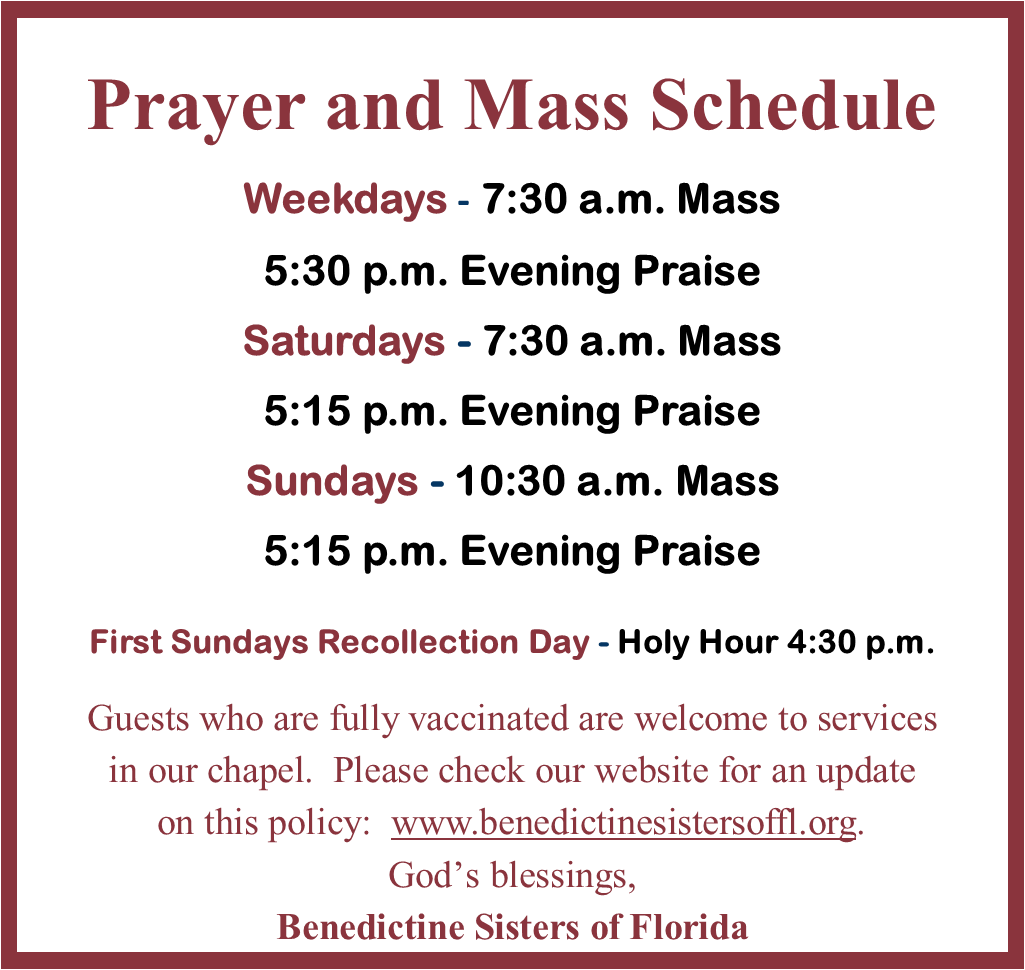
 Mass Schedule

Related Links

Copyright © 2026 · Benedictine Sisters of FL · Touching Lives Through Prayer and Service

Copyright © 2026 · Bendedictine Theme on Genesis Framework · WordPress · Log in