• Skip to primary navigation
  • Skip to main content
  • Skip to footer
Benedictine Sisters of FL

Holy Name Monastery
Founded 1889

Donate Now
  • Home
  • About Us
    • History
    • Being Benedictine
    • Benedictine Monasticism
    • Meet Our Community
    • Holy Name Academy-Alumnae
  • What We Do
    • Mission, Vision and Our Partners
    • Retreats
      • Invitation to Retreat
      • Accommodations
    • Volunteer Programs
    • Oblate Program
    • Spiritual Direction
    • Aqua/Hydroponics
    • More of Our Ministries
  • What’s Happening
    • Articles of Interest
    • Events
    • Newsletters
    • Brochures
    • Links
  • Support Us
    • Gifts of Support
    • Wish List
  • Stories Shared
  • Galleries
    • Photos
    • Videos
      • Benedictine Sisters of FL Videos
      • Other Videos
  • Contact Us

holyname

The Spirit of God is a Wild Thing.

June 5, 2017 by holyname Leave a Comment

First Reading Acts of the Apostles 2:1-11   Second Reading 1 Cor. 12:3b-7,12-13 Gospel John 20:19-23

“The following is an excerpt borrowed from Sister Joan Chittister.  And with Pentecost the Easter season comes to a close – the return to Ordinary Time came in with a lovely, light rain shower so needed by our earth… may peace also flood across the world.” AMEN.                                                                           Sister Roberta Bailey, OSB


Do I believe in the Holy Spirit? You bet I do. Nothing else makes sense. Either the Spirit of God who created us is with us still, either the presence of Christ who is the Way abides in us in spirit, or the God of Creation and the Redeemer of souls have never been with us at all. God’s spirit does not abandon us, cannot abandon us, if God is really God.   If we are to understand emerging consciousness as a manifestation of the Spirit of God alive in the land, then never has an age seen revelation, consciousness, and wisdom working more clearly than in this one. The signs of new awareness of the human relationship to God are everywhere, in all nations, in all peoples. The Holy Spirit has spoken through married couples and professional personnel about birth control, for instance. The Holy Spirit has spoken through women—and other eminent theologians, theological societies, and male scripture scholars as well—about the ordination of women. The Holy Spirit has spoken through laity and bishops and multiple other rites of the church about the ordination of married men. But no one listens. The Holy Spirit in people of good will is a voice crying in the wilderness, rejected, ignored, and reviled. One element of the church determines the voice of the Spirit and does so, it seems, by refusing to listen to its other manifestations.   The Spirit of God moves us to new heights of understanding, to new types of witness, to new dimensions of life needed in the here and now. The static dies under the impulse of the Spirit of a creating God. We do not live in the past. We are not blind beggars on a dark road groping our separate ways toward God. There is a magnet in each of us, a gift for God that repels deceit and impels us toward good. The gifts are mutual, mitered to fit into one another for strength and surety.   We are, in other words, in the most refreshingly trite, most obviously astounding way, all in this together—equally adult, equally full members, equally responsible for the church. Nor does any one dimension of the church, then, have a monopoly on insight, on grace, on the promptings of God in this place at this time. The Spirit of God is a wild thing, breathing where it will, moving as it pleases, settling on women and men alike.     —from Joan Chittister: Essential Writings, selected by Mary Lou Kownacki and Mary Hembrow Snyder (Orbis)

Continue Reading

Filed Under: Prayer

The Beatitudes or Blessings

January 30, 2017 by holyname Leave a Comment

“Be perfect as your Heavenly Father is perfect.” Jesus challenges us with this task in every time and place.  How often people shy away and make the excuse: “I’m only human. I’m not perfect.” Jesus never requires anything of us without giving us the means to acquire it. He calls us to perfection and, in turn, gives us the Beatitudes as the road-map to the path of perfection.

The Beatitudes have been called the Magna Carta of the Christian life, and the Charter of the New Covenant.  By striving to live them, we will grow in holiness.  In today’s Gospel, Jesus takes a seat on the Mount which signifies the ancient gesture of a teach communicating important truths to his followers.  The Beatitudes challenge us to measure ourselves against them.”

The eight Beatitudes, St. John Paul II, said are the road signs that show the way. It is an uphill path, but He has walked it before us:  Blessed are the poor in spirit. Blessed are those who mourn. Blessed are the meek. Blessed are those who hunger and thirst for righteousness. Blessed are the merciful. Blessed are the clean of heart. Blessed are the peacemakers. Blessed are those who are persecuted for the sake of righteousness.

What better way could we examine our consciences than to prayerfully reflect on the Beatitudes, their meaning in one’s life, and most of all to ask the question: “Am I living them?”  Even if we have failed to measure up to them, we can begin anew through the grace of God’s mercy in the sacrament of penance.  Jesus has given us the roadmap to heaven; let us do all in our power, with His grace, to reach our destination safely.                                                                                                        Fr. Paul Burke, Holy Spirit College


Continue Reading

Filed Under: Homily

Advent – The Season of Hope

November 29, 2016 by holyname Leave a Comment

adventcandlesWe started our service this evening (Nov. 27, 2016) with a short procession – barely six yards and a few steps from the doorway to the Advent candle — but it is long enough to set the tenor for this holy season. In a world where it would be easy to seclude ourselves and disengage from others, we walk… together… in silence.
Not more than a few steps were had before the silence occasionally is broken naturally enough. A cough, a sneeze; the perpetual sound of footfalls against the tile floor. Our voices start out quiet but our bodies aren’t. Indeed, it seems as if our very bodies sing out as we enter the chapel, calling out to the whole Body of Christ to march together in quiet contemplation as we chant an ancient Advent hymn – the verses change from week to week telling the story of salvation history.
As we walk, and as we pray, we all share one thing: a strained hope for a world of mercy, of justice, of peace. This season we’re not going “up to Jerusalem” but quietly moving together to “Bethlehem town” – to the cave of our own hearts and the cradle of God’s love incarnate.
And this is how we come to God: quietly shuffling along, coughing, maybe a whisper to point out the place in the hymn book, and bumping into one another. And, bowing to one another as we reverence the Christ within personified in our partners. We walk together toward the rebirth of our own spirits.
You see, this is not the glorious, boisterous, triumphant atmosphere of a Palm Sunday. Advent is a season for the broken, for those hurting in body or mind or spirit. It is a season for people who have struggled, who can do nothing else but wait. It is a season for a people whose exhausted, desperate cry is only, “Come!”
The four weeks of waiting, preparation, and anticipation is marked by the lighting of the candles on the Advent wreath. As we listen to the strike of a match (or these days to the click, click of a lighter) and watch the flame on the candle leap to life, something happens in us. Gazing on the lighted candles inspires reflection and the recall of memories – not whole stories but snippets of Advent and Christmas past: the gifts we received and the ones we gave – our presence at a special Christmas Mass or program. On and on goes the string of moments and episodes that people offer up when given an opportunity to share.

One such story is told by a woman who recalled the Christmas she experienced when she was a young child eager for a particular doll for her Christmas gift. She’d searched without luck every hiding place she knew her parents used. Now it was Christmas eve. Her parents had a rule that the children couldn’t get out of bed until 5 a.m. to wake them up and open their gifts. But the young girl couldn’t stand it, so at 4 a.m. she sneaked down to the tree to have a look. She recalled the tree was beautiful, all lit up and surrounded by presents. Some were obviously socks, and sweaters and PJs but one looked promising and was marked with her name. Against her better judgment, she peeled back a little bit of the wrapping paper – on the underside where she thought no one would notice. Lo and behold it was just the gift she had hoped for! She danced a silent, exhilarated gig in glee!
Hardly able to contain her joy, she put the wrapping paper back together as best she could and crept back upstairs and went back to sleep with visions of her doll dancing in her dreams. Then, about an hour later, she woke up her parents and the family trooped downstairs – the kids taking two stairs at time, the parents looking almost awake. Much to everyone’s surprise (well, almost everyone) they found a note from Santa that explained that, because Susie had peeked at her gift, Santa had taken back all her presents. She recalled she had never cried so hard in her life. It turned out it was all a prank by her older brother, who had witnessed the peeking. The story has a happy ending though: Susie’s presents reappeared.
Like an eager child, during Advent, Christians wait in anticipation for the gift of Christmas: the coming of Jesus. But unlike curiosity about toys, it’s OK to take a sneak peek. That’s because God wants us to anticipate. And, God will never ever take away our Christmas present from us.
It is the beautiful task of Advent to awaken in all of us memories of goodness and thus to open doors of hope. God only asks that we take time to be aware that in the very midst of our busy preparations for the celebration of Christ’s birth in ancient Bethlehem, Christ is reborn in the Bethlehem of our community, in our homes and daily lives. Take time, slow down, be still, be awake to the Divine Mystery that looks so common and so ordinary yet is wondrously present.
An Ancient Ones was fond of saying, ‘The devil is always the most active on the highest feast days.’ The supreme trick of the devil is to have us so busy decorating, preparing food, practicing music and cleaning in preparation for the feast of Christmas that we actually miss the coming of Christ. Hurt feelings, anger, impatience, injured egos—the list of clouds that busyness creates to blind us to the birth can be long, but it is familiar to us all. The coming of Christ and his presence among us—as one of us—gives us reason to live in hope: that light will shatter the darkness, that we can be liberated from our fears and prejudices, that we are never alone or abandoned.
May this season of Advent be a time for bringing into our hearts, and homes, a spirit of hope and transformation that flowers at Christmas.                                                                                                                        S. Roberta Bailey, Prioress


Continue Reading

Filed Under: Homily

Where do you find peace in challenging times?

August 8, 2016 by holyname Leave a Comment

 Praying Images Stock Pictures Royalty Free Praying Photos And Stock PhotographyExcerpt from a reflection by S. Susan Quaintance, OSB

Folks are unsettled. Between unprecedented levels of violence in our city and neighborhood, a presidential season revealing a deeply divided country, and climate change that brings never-before-seen threats, to name but a few current realities, I not something in people’s faces that I don’t really remember in my lifetime; sort of a mix of bewilderment, wariness and fear.

I wonder what my response should be as a Benedictine? Pondering this question, I make a mental dash to the Psalms.  They are, of course, the same Psalms prayed by Benedict and the communities he founded in the sixth century.  Their moment must have been similar in disease and anxiety. The collapse of the Roman Empire in 476 resulted in political instability and social chaos.  Sound familiar?

What do the psalms say about seeking peace? That text does a Benedictine spend more time with over the course of a lifetime than the Book of Psalms? The psalms are the river that flows over us, shaping our stony hearts into something closer to what they are supposed to be.  So I spent a Saturday morning looking at where the word peace shows up in the psalms and it reminded me of something I already knew and prompted my gratitude for something I didn’t.

The reminder: Peace is ultimately God’s work, not ours. Obviously that does not excuse us from whatever we can do to make peace (“Turn away from evil and do good; seek peace and follow after it.” Psalm 34:15).

Peace will be the hallmark of the reign of God’s anointed one (Psalm 72). This is an important truth to hold onto as we make our way in a world that is anything but peaceful. As we try to educate ourselves about global genocides and torture, as we search for the facts in the mudslinging of another presidential election, as we attempt to mend our sometimes fractured communities, we must acknowledge that our work alone will not be sufficient.

After a long day of doing what we do, saying what we say, living with whom we live, and humbly having to admit that it’s another day of coming up short, it is good to hear that God works through our small efforts, that God has the ultimate responsibility, that it is in and through God alone that the promise of peace is fulfilled.

The psalms are a primer for so many aspects of right relationship, and seeking peace is no exception. May we use them so. “Peace be upon Israel” (Psalm 125:5c)… and all of us.


Continue Reading

Filed Under: Blog

The Rich Fool

August 1, 2016 by holyname Leave a Comment

Rembrandt_-_The_Parable_of_the_Rich_Fool18th Sunday in Ordinary Time, Sunday, July 31, 2016

First Reading – Ecclesiastes 1:2; 2:21-23          Second Reading – Colossians 3:1-5, 9-11          Gospel Reading – Luke 12:13-21

This rich man’s world is small, just him and his possessions, and now he learns that he is to lose his life. What good are his possessions now? Jesus sums it up in two words:  You fool?”  And, continues with the reason – “This very night your life will be taken away. To whom will everything belong then?!”

The man is rankled over a continuing disagreement with his brother. He figures he can follow the customary practice of taking his dispute to the rabbi, the teacher he has heard everyone talking about. Of course, he expects a settlement in his favor. But Jesus refuses to take the case and instead gives the squabbling brothers a parable to “mull over.”  What is the point of Jesus’ story about a wealthy landowner and why does he call him a fool?

Jesus’ lesson holds a warning against covetousness – a wish to get wrongfully what another possesses or to begrudge others what God has give them. Jesus restates the commandment. The commandments are not a multiple-choice list of good ideas – they are to be applied to all. In this little parable Jesus probes the listener’s heart – where is your treasure? The thing we most set our heart on is our highest treasure.

In interpreting this parable to discover what it is we treasure most, it’s critical to assess carefully what the farmer’s error is. He is not portrayed as wicked – that is, he had not gained his wealth illegally or by taking advantage of others. He’s not portrayed as particularly greedy. Indeed, he seems to be somewhat surprised by his good fortune. So, what’s wrong we might ask with building larger barns, renting a storage unit, getting a POD in the back yard to store away some of today’s bounty for a leaner tomorrow?  Hanging on to clothing we’ve outgrown, rarely ever wear, haven’t seen since we moved in two years ago and persons who have less than we do would appreciate having it; or stockpiling furniture that serves only as a “catch all” because it’s just too nice to give away…Requesting more allowance than we actually need and giving none to charity – or accepting money gifts from lay people giving them the impression that our community does not take care of our needs. We might answer that none of this sounds so terribly wrong compared to the horrors of violence…except for two things.

First, notice what the farmer’s consistent focus is throughout the conversation – it’s all about himself. “What should I do, for I have no place to store my crops?” Then he said, “I will do this: I will pull down my barns and build larger ones, and there I will store all my grain and my goods.”

The relentless use of the first person pronouns “I” and “my” betray a preoccupation with self. There is no thought to using the abundance to help others, no expression of gratitude for his good fortune, no recognition of God at all. The farmer has fallen prey to worshiping the most popular of gods: the Unholy Trinity of “me, myself and I.”

This leads to, and is most likely caused, by a second mistake. This farmer is not foolish because he makes provision for the future; he is foolish because he believes that by his wealth he can secure his future.

There is danger in thinking this parable applies only to “those rich people.” To put the matter more pointedly, thinking of those rich fools enables me NOT to think of myself as a “rich fool.”

We cannot separate the warnings from the words of Jesus that follow. What’s his transition word? He begins with “therefore,” indicating that what He is saying is based upon what He has already said. Note, too, that in the text Jesus warned against “all kinds of greed” which suggests that greed has a variety of forms, some of which may tempt the rich and others that may tempt the less affluent.

Jesus’ response indicates that the man’s request was his error. But, what this man wants is a judge, not a teacher. Other teachers might be tempted to pronounce on such cases, but Jesus knew that this was not within the realm to get in the middle of a family squabble. This young man, itching for a flight, may have gotten the floor, but he did not get his request. What he got was far more than he asked for, but certainly what he deserved.

Jesus used the opportunity as a “teachable moment.” The whole exchange and the lesson stresses that life does not consist in things. It does not even consist in many things. The parable tells of a rich man, who is not rich enough. Jesus, the teacher, did not judge, but He did teach. In this parable He was not primarily teaching teachers how to teach, but rather teaching all of us how to live. To borrow the paraphrases Joe Biden’s words in his speech at the Democratic convention, referring to his wife who was a teacher: “teaching is not what Jesus did; it’s who He was.”

S. Roberta Bailey, OSB, Prioress

Continue Reading

Filed Under: Prayer

National Vocation Awareness Week

November 2, 2015 by holyname Leave a Comment

November 1 – 7, 2015 is National Vocation Awareness Week.

Join us in prayer for those discerning a religious vocation.

Are you or someone you know seeking a life of Prayer and Community?  It may be God calling.

The Benedictine Sisters of Florida can help you discern and answer the call. If you are a single Catholic

woman, 20-50 something, free to consider a religious vocation, we are here to help.

For more information contact:

S. Mary David Hydro, OSB

Holy Name Monastery, PO Box 2450, St. Leo, FL 33574 (352) 588-8320


Continue Reading

Filed Under: Prayer

  • « Go to Previous Page
  • Page 1
  • Page 2
  • Page 3
  • Page 4
  • Page 5
  • Go to Next Page »

Footer

Prayer / Newsletter / Info

 Contact Info

Benedictine Sisters of Florida

PO Box 2450
12138 Wichers Road
St. Leo, FL 33574-2450
(352) 588-8320
(352) 588-8443

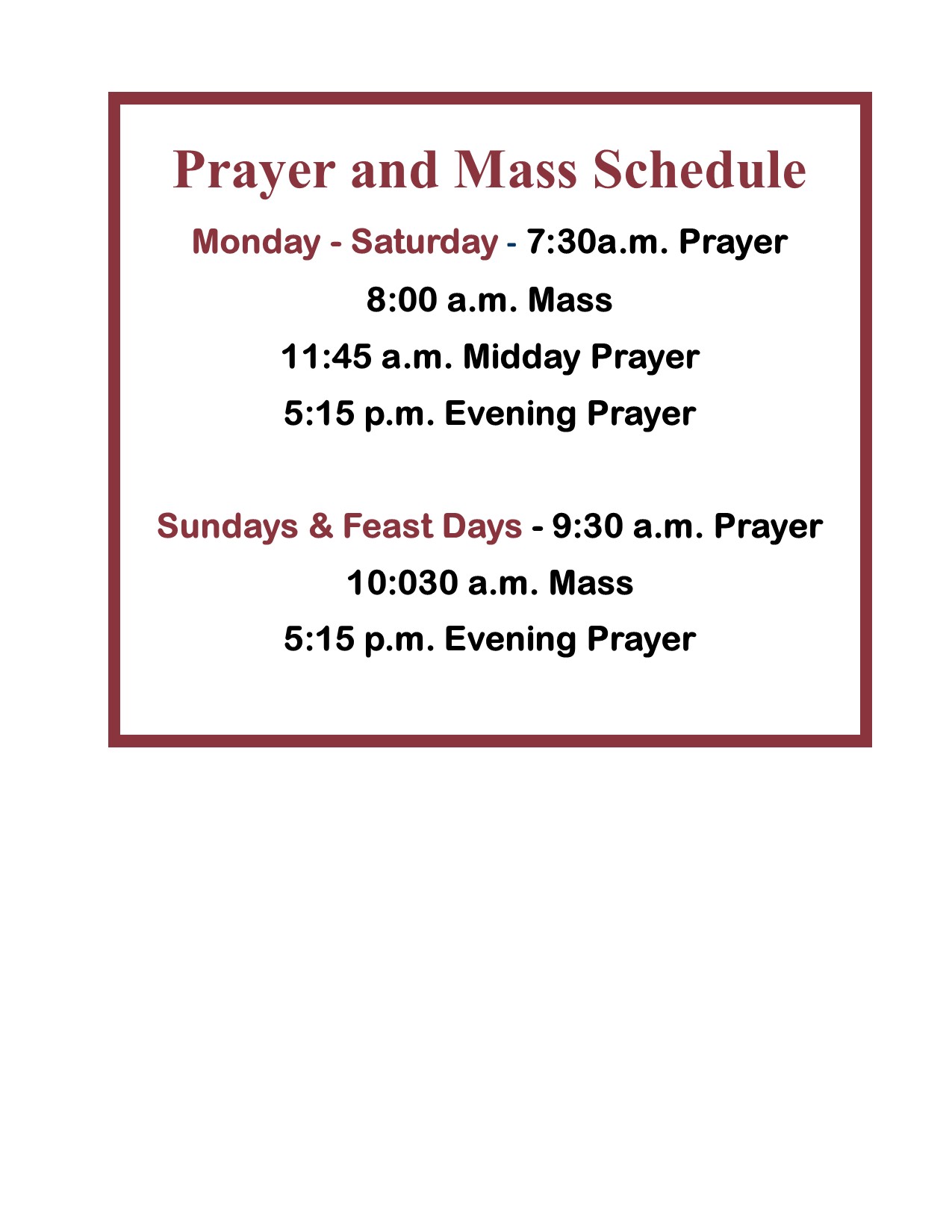
 Mass Schedule

Related Links

Copyright © 2026 · Benedictine Sisters of FL · Touching Lives Through Prayer and Service

Copyright © 2026 · Bendedictine Theme on Genesis Framework · WordPress · Log in