• Skip to primary navigation
  • Skip to main content
  • Skip to footer
Benedictine Sisters of FL

Holy Name Monastery
Founded 1889

Donate Now
  • Home
  • About Us
    • History
    • Being Benedictine
    • Benedictine Monasticism
    • Meet Our Community
    • Holy Name Academy-Alumnae
  • What We Do
    • Mission, Vision and Our Partners
    • Retreats
      • Invitation to Retreat
      • Accommodations
    • Volunteer Programs
    • Oblate Program
    • Spiritual Direction
    • Aqua/Hydroponics
    • More of Our Ministries
  • What’s Happening
    • Articles of Interest
    • Events
    • Commemorative Bricks
    • Newsletters
    • Brochures
    • Links
  • Support Us
    • Gifts of Support
    • Wish List
  • Stories Shared
  • Galleries
    • Photos
    • Videos
      • Benedictine Sisters of FL Videos
      • Other Videos
  • Contact Us

Front Page

Fifth Sunday in Ordinary Time

February 9, 2026 by Holy Name Monastery Leave a Comment

Today Jesus tells us two things that we are and are to be to each other, to our community / family and to the world. You are the salt of the earth and light of the world.

Let’s start with salt.  Now, we know that salt does two things – it preserves and it gives flavor; it can marinate or ruin.  We are well-aware when salt has lost its flavor.  As one translation says the “salt becomes insipid” – is no longer capable of adding flavor or preserving.

In ancient times salt was seen as a necessity of life. In many societies salt was so highly valued that it was used for money.  In Jesus’ day, however, table salt as we know it did not exist. Salt that was mined from a quarry was never completely pure. Sometimes the mined salt was so impure that it was not very salty at all.  When that happened, they would cast it outside the door to harden the pathway.

Salt by itself is tiny particles and considered worthless.  When added to food it becomes INVISIBLE.  When that happens only THEN does it become what it was intended for: enhancing flavor.  Remember, Jesus said, “You are the salt of the earth.”   We can “marinate” positive or negative impressions and energy.   Jesus is emphatic! He didn’t say you might be salt or you ought to be salt.  He said: you ARE salt!

If salt is only a mate for the pepper shaker on the dining room table, it is denied its primary function.  We, the salt of the earth, are useless until we “rub shoulders” with other grains of salt, God’s people alive.  We deny the “charism” of the salt when we fail to be kind, merciful, peacemakers. If we as salt don’t rub against those who have no flavor, we never realize our potential as individuals or as community.

Now let’s turn to the image of LIGHT.  In this Gospel passage Jesus describes us as light.  “I am, you are the light of the world.” Light is a form of energy.  It is always moving.   We know Jesus is the true light and that we are only reflections or reflectors of the light.  So what does that mean?   Darkness is banished as soon as you hit the light.  A room is flooded with light as soon as someone – or a timer – hits the switch.  People are not aware of the darkness they live in if they don’t see the light.   Light serves as a guide.   There is a saying: “It is darkest just before the dawn.”  But is it?  Or does it just seem that way in contrast to the light of the rising sun?

In Jesus’ day most homes had only one small window and were commonly dark. Indoor lighting was an oil lamp that had a wick. When a light was needed the lamp was placed on a lamp stand. No one wanted to let their light go out because it took too much effort to get the wick lit again. But people dared not leave their lamp burning in the house unattended for safety reasons.  When they left their homes the lamp would be taken from its lamp stand and placed under an earthen vessel where it could burn risk-free. As soon as anyone returned to the house, they would put the lamp on the stand.  Thus, we have the saying: no one lights a light only to put it under a basket or a bushel.

There is story told about a man whose job was to be on the railroad tracks and warn with his light the oncoming train that the bridge was damaged. That night as the train came the man showed his lamp but the train went right into the ditch. The man was taken to court because they wanted to know why the train did not pay attention to the man’s warning of the danger ahead. “Were you on duty on the night that the train had the accident?”  The man replied, “Yes sir.” “Did you have your lamp with you? “Yes, sir,” Then, the last question, “Did you wave your lamp to the train? “Yes sir!”  Thus, the man was not held responsible. Later the man told his friend, “I sure am glad that the judge did not ask me if my lamp was lit.”

One last point.  It is essential in the understanding of this Gospel to keep in mind the differences between salt and light. Salt works and expands itself quietly but you taste it working. Usually we don’t see the salt, unless we spill it or with a heavy hand add what we think the cook forgot.  Food is made delicious by its unseen presence.  On the other hand, light has a different type of effect. Light is visible – it works in the open.

People need to taste the salt and see the light.  They need to see how associating with us, and with our Benedictine values, is a seasoning to their lives and a light that reveals God’s presence.  We are like mirrors – we reflect the light. But in order to reflect the light we need to position our mirrors to the light and ourselves in relation to the mirror.  We have to take care not to cause a glare that blinds others.  We do this by studying God’s word, by praying and by Lectio with the Word and pacing our approach to others so that the truth is not a rude awakening but a gradual exposure to the lens of truth.  We have to position ourselves in right relationship with God and each other so we can catch and reflect the true Light.

Unlike real salt and real light which are dead material things, we are living salt and living light.  What good is salt if it has no flavor, or a light which cannot challenge the darkness?  We can change.  We can regain our flavor and we can rekindle our vitamin-packed and three-way wattage light with God’s WORD, our marinade.

~Reflection by Sister Roberta Bailey, OSB


This week we celebrate the feast of St. Scholastica – it’s a good time to ask ourselves: are we giving out light?  Is our presence here in hilly Pasco County, not far from a university and a lake, a beacon to those who dwell in darkness?  When we move to a different section of our monastery what light do we want to take with us – a pencil flashlight, a hurricane lantern, an LCD that slowly brightens our lives and gives light of those who come into our “realm of influence?”  What light, what salt shall be bring to our new space here in our home?


First Reading:   Isaiah 58:7-10         Second Reading:  1 Corinthians 2:1-5
Gospel:   Matthew 5:13-16
Continue Reading

Filed Under: Blog, Front Page, Homily Tagged With: Fifth Sunday in Ordinary Time, Jesus, light, oil lamp, pepper, salt

Jesus invited: Come after me.

January 26, 2026 by Holy Name Monastery Leave a Comment

Jesus invited: Come after me. 

At once they left their nets and followed him.

Our call to holiness is not a one-time beckoning.  Everything was not hunky-dory when Peter, Andrew, James and John rolled up their nets and walked away with Jesus.  The call back to the simple, predictable life of a fisherman may at times have been strong enough to give them second thoughts about this little-known upstart from Nazareth.  The barbs of criticism aimed at them and their hero and their suffering as the butt of jeers must have stung deeply.  But they were, for the most part, steadfast in their loyalty to the Master.  They could have spent time wringing their hands bemoaning the awful conditions of their known world.  Instead, they looked to Jesus for direction and followed his unwavering example of feeding the hungry, caring for the sick, comforting the sorrowful.

Even in the darkest hours they clung to hope.  Hope is a spark that can become a flame.  The same puff of breath that can snuff out the spark, more gently exhaled can coax the spark to burst into a lively flame.  The same vocabulary we use to engender hope, spoken in a derisive tone, may dash all hope to the ground.

In these days of our Sisters’ strategic planning I invite you to figuratively hold hands in fervent prayer that we will be courageous, hope-filled, sensitive, patient, considerate – truly “sisters” to one another as we grapple with the tough issues that lie in our laps.

We are made for this time.  Benedictines are committed to being life-long learners.  For all our preceding years we have been training, practicing, getting ready for this exact moment in our history. As Hel Basse writes in Give Us This Day for January 23, 2026: “If you want to go fast, go alone.  If you want to go far, travel together.”

A few years ago, Pope Francis said in one of this Sunday addresses: ”Go forth and don’t be discouraged.  Don’t be fools, remember, a Christian doesn’t have the luxury of being foolish.  An idiot, a fool – you can’t give yourself that luxury.  You have to be clever, be astute!”

Let us reach out.   Let us catch the light from each other’s flickering flames, coax them brighter and bring them closer together to shed a united light on possibilities that will lead us into the future God already has in mind for us.

Pray this week that you may discern what nets are holding  you back from following Jesus’ daily quiet calls.

~Reflection by Sister Roberta Bailey, OSB
 

This is also Oblate Sunday at the Monastery – they will gather at the monastery or via ZOOM for Mass and dinner with the Sisters.  This Sunday they will spend time with S. Tonette for a presentation on the obligations of Oblates.  As time permits, S. Mary David will lead a teaching session including discussion of the “homework” assignments.

Basically, a Benedictine oblate is a layperson or secular priest who associates themselves with a specific Benedictine monastery, committing to live according to the

Rule of Saint Benedict in their daily life. While not taking formal vows or living in the monastery, they become part of an extended monastic family, integrating prayer, work, and spiritual values into their personal lives in the world.

 Key Aspects of a Benedictine Oblate:

  • Spiritual Affiliation: Oblates affiliate with a particular monastery, participating in its spiritual life while maintaining their own vocations, whether single, married, or working.
  • The Rule of Saint Benedict: They adapt the principles of the Rule—such as moderation, community, and prayer—to their secular life.
  • Oblation as Self-Offering: The term means a “gift of themselves” to God in union with the monastery.
  • Promises: Oblates make promises that often include stability (a commitment to their monastery), fidelity to the spirit of the Rule, and obedience to God’s will.
  • Prayer Life: They often engage in the Liturgy of the Hours and Lectio Divina (sacred reading)


First Reading:   Isaiah 8: 23- 9: 3-6         Second Reading:  1 Corinthians 1: 10-13, 17
Gospel:   Matthew 4: 12-23
Continue Reading

Filed Under: Blog, Front Page, Homily Tagged With: Andrew, Come after me, fisherman, James, Jesus, Jesus invited, John, Peter, they left their nets and followed him

2nd Sunday in Ordinary Time

January 19, 2026 by Holy Name Monastery Leave a Comment

The readings for this weekend offer a challenge.  What to emphasize?  The week opens today (Sunday) with the observance of the Week of Prayer for Church Unity.  This ritual has a rich history of 100 years of prayer for the fulfillment of Jesus’ prayer at the Last Supper “that all may be one.”

Prince of peace, we cry out for Your divine intervention in Israel and the surrounding regions.  We earnestly petition You to bestow tranquility upon this land. May prosperity flourish, and may Your unwavering peace reign over the hearts of all people.

Tomorrow (Monday) our nation takes time to contemplate the impact of Martin Luther King on the course of history. It may be tempting to treat this day like any other.  Many of us, however, cannot forget that we grew up in a segregated society.  Most of us remember attending – or for that matter teaching in – racially segregated schools.  We can remember “whites only” water fountains, lunch counters and seats on the bus.  The name of Martin Luther King, Jr. stands for the blood, sweat and tears of many, many people.  Praise God for people who live by the courage of their convictions.

Now, if that doesn’t offer us enough to pray about, let’s turn to the three readings in our liturgy.  They are, I believe, an example of a woven piece of God’s mysterious message-giving.  They create a colorful piece with threads that weave the way from Isaiah, through Paul’s First Letter to the Corinthians, into the Gospel of John, laced with verses from the Responsorial Psalm 96.

From Isaiah (in the first reading) we hear: “I will not be silent; I will not be quiet.” (Mmm – Didn’t Martin Luther King echo that same message?)  Now slip in a line from the Responsorial Psalm: “Announce God’s salvation day by day.” (sentiments of Unity Week). Some years this leads us right into a touching Gospel story of a son’s response to an implied request of His mom.  Mary could not resist the impulse, the urge to encourage her Son to come to the rescue of a wedding couple’s embarrassment.  She’d raised this man/child.  She knew he’d take her hint.  Turning toward the wine-servers, she says simply: “Do what he tells you.”  And they did just that.

A question to ponder: Who could have observed that quiet exchange?  Scriptural Scholars tell us it was the beloved John, the only one of Christ’s original disciples who lived into old age and was not martyred for the faith.  He can tell that story from an old man’s perspective laced with the wisdom and vision that is a gift of the elderly.  We know so well that stories are a gift given by older members to the newer ones.  The elders are the torch bearers; the younger are the keepers of the torch.  It is they who are responsible for coaxing the sparks that keep the embers glowing.  They breathe new life into our legacy.  Stories of the “good ole days” may wear old but consider what we’d miss if John and the other evangelists had kept secret their experiences with Jesus.

In today’s world, much like the days of early Christianity, people are facing crises of migration, prejudice, hunger for food, companionship, health care services, violence and indifference. How can we show “unusual kindness” exemplified in Mary’s keen insight and Jesus’ quick response to her tip: “Do what He tells you.”   As Benedict advises: “Be the first to …  (anticipate) Pass-it-on-Kindness” or “Pay it Forward Kindness” that is a witness to God’s loving providence for all people. When we invite people to “come and see” they are looking for more than a tour of our monastery building and a list of volunteer ministries. Our spirit of hospitality will have a ripple effect (positive or negative) that makes visible (or not) Jesus’ love in today’s world. We pray that we and all peoples of diverse backgrounds, cultures and religions, are enlightened to accept each other with open hands and hearts and that world peace will prevail in our lifetime.

~Reflection by Sister Roberta Bailey, OSB


First Reading:   Isaiah 49: 3, 5-6         Second Reading:  1 Corinthians 1:1-3
Gospel:   John 1:29-34
Continue Reading

Filed Under: Blog, Front Page, Homily Tagged With: 2nd Sunday, 2nd Sunday in Ordinary Time, Martin Luther King, Week of prayer, week of prayer for unity

Baptism of Jesus

January 12, 2026 by Holy Name Monastery Leave a Comment

“Yes, Now’s the Time!”

Maybe you’ve heard the story about the fellow wandering soul, lost in thought, who stumbled upon a baptismal service one Sunday afternoon.  This was one of those “down by the river” sort of baptisms in the warm waters of the South.   Curious about what was going on, this fellow walked right down into the water and stood next to the Preacher.  When the minister finally noticed him, he asked the young man, “Are you ready to find Jesus?”  With a quizzical look and some hesitancy in his voice, he answered: “Yes, Preacher, I think I am.” The minister then dunked the fellow under the water and pulled him right back up.

“Did you find Jesus?” “No… should I have?!” The preacher then dunked him under for a bit longer, brought him up and said, “Now, brother, have you found Jesus?” “No … I haven’t, Preacher.” The preacher in disgust held the man under for at least 30 seconds this time; brought him to the surface of the water and repeated the question, “Friend, are you sure you haven’t found Jesus yet?” The confused fellow wiped his eyes, gasping for breath said, “Naw, Sir, are you sure this is where he fell in?”

Sound familiar?  Isn’t that sometimes how we are?  Our heads under the waters washing over us?  Cares, distractions, prayer for others’ intentions, confused by the circumstances of our life?  Looking for Jesus in muddy waters of our own making?  Sometimes we aren’t quite sure if “now” is the right time for things. At the Jordan River, about 30 years after Jesus was born, NOW was the time. If you could go back and stand on the shoreline of that river in the wilderness, you’d probably be nodding your head in agreement, “Yes, now is the time!”

John recognized Jesus as one who didn’t need a baptism of repentance or forgiveness. He knew that Jesus was much greater than he was, and that he wasn’t even fit to tie Jesus sandals. John must be thinking, “This is backwards! This shouldn’t be happening this way!”  But listen to Jesus’ response, “‘Let it be so now; it is proper for us to do this to fulfill all righteousness.” And John consented.  Jesus was saying, “At another time, John, you would be right in what you’re thinking. But NOW is the time for this baptism. This is what my Father in heaven is asking of us NOW!   NOW is the time for Jesus to begin his public mission, the course that would take him to the cross. NOW we hear the Father’s affirming commendation: “Outstanding, Son!”

In our lives, too, there have been times, (haven’t there?) when we had no idea how close the kingdom of heaven had come to us.  A time when you just didn’t see it or recognize it for what it was. You had no idea that God would show up in that way, that place, that time, that situation.  You can look back and realize what you missed.

How many times, I wonder, do we ignore God simply because we have no idea or we doubt the possibility?  Or we’re just plain were oblivious to the truth that divine providence is working in the mix.  “And do you come to me?” That’s not just John’s question; it’s also ours. Sometimes it just seems too incredible to believe that God would come to us. Maybe it’s because we see God as distant … sitting on a throne, up there in heaven … observing but not really involved.  Maybe it’s because we see ourselves as unworthy and undeserving. Maybe it’s because we were raised with the idea that God is more concerned about our behavior than our life. Maybe the pain, difficulty, and losses in one’s life have caused them to wonder whether God even cares. Maybe God’s ways don’t fit within our expectations. God won’t fit within our box and we can’t seem to get out of it.

Whenever or however that question comes up for you – reach down deep – you DO know the answer.  The answer is found in the baptism of Jesus. His baptism answers once and for all the question, “And do you come to me?”  He answers: “Allow it for now… thus it is fitting.” That’s Jesus’ answer to John … and, to you, to me, to everyone.  “Allow it for now.”

~Reflection by Sister Roberta Bailey, OSB


First Reading:   Isaiah 47:1-4, 6-7         Second Reading:  Acts 10:34-38
Gospel:   Mark 1:7-11


Continue Reading

Filed Under: Blog, Front Page, Homily Tagged With: Baptism, Baptism of Jesus, God, Jesus, John, preacher

Solemnity of the Epiphany

January 5, 2026 by Holy Name Monastery Leave a Comment

Some say this Gospel reading raises more questions than insight.  Sometimes we think we know more about something than we really do know. A case in point is the Gospel text about the birth of Jesus and the story of the three wise men.  We even think we know their names. We believe that they came from the east bringing their gifts of gold, frankincense and myrrh for the baby Jesus. Finally, we think calling them wise is justified.  What is factual and what is legend?  And, what ever happened to the gifts the Magi gave the young Jesus and his family?

We can dispense with the information there were three Kings. Scripture simply does not say how many there were.  We know there was more than one but we can’t assume just because there are three gifts there were three givers   Nor does Scripture tell us their names; that’s tradition but not factual.    We can’t be sure either that they came from the East.  It seems a more likely conclusion if they saw the star in the eastern sky they would be coming the West.

A detail we can be fairly certain about is when these men arrived at the home of Jesus.  It was before His second birthday since we know that Herod had all the male children two years and younger killed in order to catch Jesus.

Scripture teaches us that they made a connection between that particular star and that something phenomenal was happening.  King Herod heard the news that these new comers were seeking for the King of the Jews. Now, Herod thought of He was King of the Jews.  This was the first he was hearing about a rival.  He was a very fearful person –  he was also shrewd one.  Knowing about the prophecy of Micah that a king would be born in Bethlehem he spoke to the wandering astrologers, told them to go to Bethlehem, find and let him know where the new king was and he would come later to worship him.

The unwitting Wise Men were about to return to tell Herod where they had found Jesus. However, God directly intervened and warned them to take a different route home. The Spirit also warned Joseph in a dream to get the family out of Bethlehem and flee to Egypt. Because of these interventions, the life of the young Jesus was spared.

As we can see, the Wise Men weren’t so wise after all. If it had been left to their wisdom, the infant Jesus would have been found and killed by Herod.  Not unlike the common people, they did not figure out by human wisdom that the King of the Jews had been born.  No one came to Jesus because they had reasoned it out. The angels had to announce it to the shepherds that Jesus had been born. It was by the grace of God that the Magi were led to the child Jesus, and that Jesus was protected from the wrath of Herod.

There’s our lesson – if we are to know anything about the true meaning of Christmas it will have to come by God’s grace. Unless God opens up our hearts – and we allow them to be pried open to receive the truth, we will never know it.

In case you noticed I never answered the question: what became of the gifts the Magi gave the child?  That was not a question that had come to my mind until a visit at the local Dollar Tree.  A colorful story of a child’s generosity was peeking out from a tumbled jumble of after-Christmas selections.   “The Miracle of the Myrrh” is an original, fanciful tale of what became of the Little Drummer Boy, Mary (Jesus’ mother) and the Kings’ gifts of gold, frankincense and myrrh. What a treasure for only $1.25!

~Reflection by Sister Roberta Bailey, OSB


Christmas this year is a mixture of emotions for the Sisters.   Our Sister Mary Clare died on December 22nd  – funeral Mass and burial on January 8th.

   May you and your loved ones know good heath and peace in 2026.   Best wishes from the Benedictine Sisters – be assured we you are remembered in our prayers.


First Reading: Isaiah 60:1-6              Second Reading: Ephesians 3:2-3a, 5-6
Gospel: Matthew 2:1-12
Continue Reading

Filed Under: Blog, Front Page, Homily Tagged With: 2026, Angels, Herod, Jesus, Solemnity of the Epiphany, Three Kings, Wise men

Feast of the Holy Family

December 29, 2025 by Holy Name Monastery Leave a Comment

Today the Church celebrates the Feast of the Holy Family.  So, what does that mean to (and for) us as monastics?  We came from a family, we still have families and here we live in an intentional family we call community.  We are guided by the simple, yet profound, guidelines designed by St. Benedict, a man of great wisdom, compassion and common sense.  We know that after some time of living with his original Rule, he added advice based on his lived experience with a great variety of characters.  Imagine having to warn his men not to sleep with knives, to wear clean underwear on a trip, for the learned to help those who could not read.  His prudence shines through when, in so many words, he says: this is what works for us now – if the schedule of psalmody, the daily schedule and other daily living details don’t fit your need, change it.

It is the spirit of the Rule that has survived because Benedict, even in his youth, had a deep understanding of human psychology.  A study of his early life tells us that he spent much time with his grandparents who lived a few miles from his home.  Along the trek to their summer home he passed the huts and caves of hermits, wise “seasoned” men and women.  Before Benedict was sent to Rome to pursue academics, he and his twin sister spent hours chit-chatting with these solitary men and women to absorb the wisdom and practical advice from the older generation.  This is evident in the Rule.  Notice how he tempered discipline with compassion and saw the spiritual quest as a joyful pursuit of God within the structures of ordinary life. It is this joyous delight in everyday spirituality that to this day makes the Rule come alive for so many. For over 1500 years his simple principles of living together under God’s love have been applied beyond monasteries, especially by Oblates, to family life.

If we only know the first word of the Rule “LISTEN” what an impact it could make on our own happiness and concord between peoples.  To truly listen requires perception, knowledge of human nature, biting the tongue before speaking and an ‘open-hands’ approach in conversation.  To listen requires an attentive spirit … not a scramble to respond with advice, a witty remark or a one-upmanship story.   When we truly listen we can see that anger is a cover for fear.  When we listen to another we can identify their feelings, let them resonant within and know that very often all the person wants is a signal that we care.

Benedict’s down-to-earth advice works in community, in our intentional family or for any living group, be it for family or dorm or apartment mates because of its inner dynamic. St. Benedict was not writing for an IB or Honors class of students. The Rule is not intended to be a great and lofty treatise on prayer or spirituality. Rather, the Rule is filled with practical guidance for ordinary people to live together. Benedict expected his followers to work hard, study hard and pray hard.  Benedictine life, in or out of a monastery, is a grace-full blend of prayer, work and living together – a simple, effective prayer life, open communication, mutual respect – not for mature saints but for those who choose to walk a path of life-long falling down and getting up in a community where each member is valued and loved unconditionally.

The Rule offers us a very high ideal, but it is a beautiful one, and one that we should never feel compelled to apologize for.   And when we breach the ideal we need to be humble enough to ask forgiveness both from God and from each other.

From that first word in his Rule LISTEN… to his advice to begin every good work with prayer … to keeping a lamp burning at night … to not loitering outside chapel if you are late … it is evident that Benedict saw God at work within the ordinary events of everyday life – in the joys and sorrows of our everyday lives.

So, LISTEN to your heart to your comrades’ hungers and longings, to God deep in your heart … just LISTEN – with your ears, but also with eyes and heart and feelings – and all other aspects of your life, our life in community, will fall into place.


~Reflection by Sister Roberta Bailey, OSB


Happy New Year!  Peace to all!

Continue Reading

Filed Under: Blog, Front Page, Homily Tagged With: Benedict, feast, Feast of the Holy Family, Holy Family, Rule, Rule of Benedict

  • Page 1
  • Page 2
  • Page 3
  • Interim pages omitted …
  • Page 76
  • Go to Next Page »

Footer

Prayer / Newsletter / Info

 Contact Info

Benedictine Sisters of Florida

PO Box 2450
12138 Wichers Road
St. Leo, FL 33574-2450
(352) 588-8320
(352) 588-8443

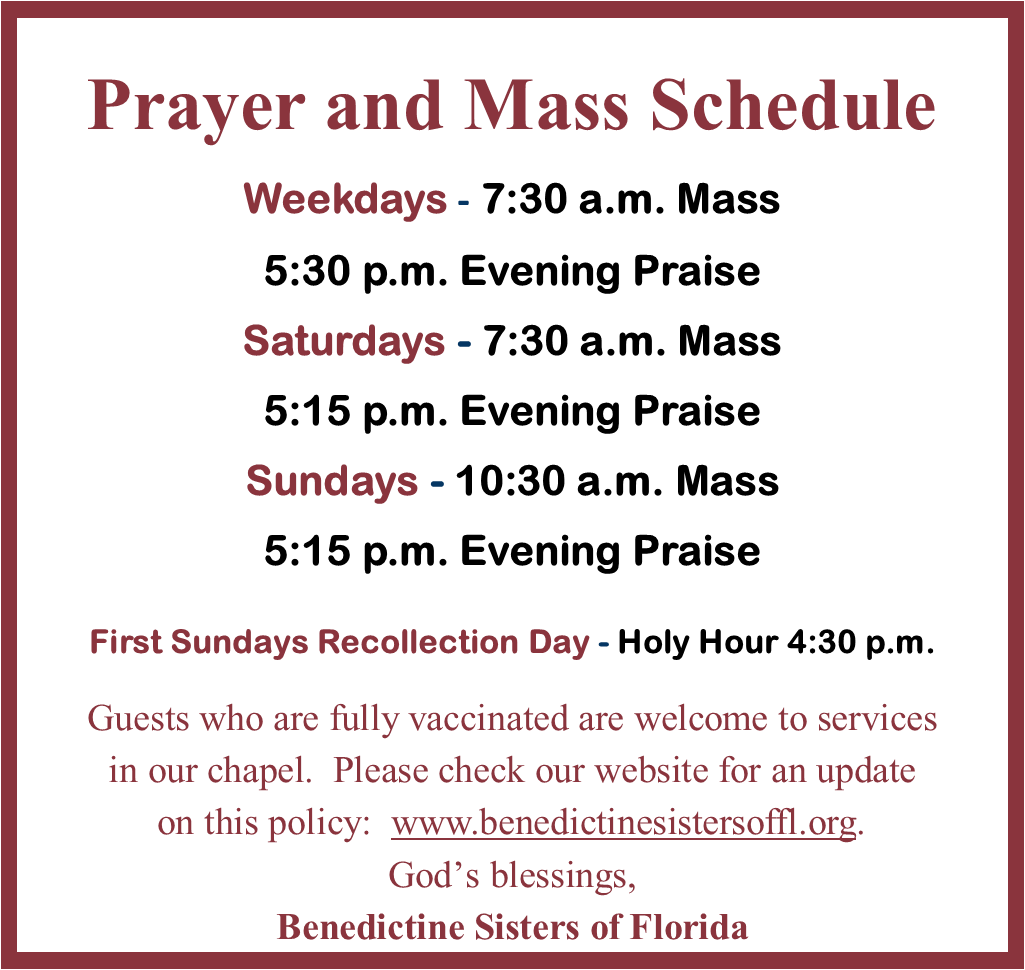
 Mass Schedule

Related Links

Copyright © 2026 · Benedictine Sisters of FL · Touching Lives Through Prayer and Service

Copyright © 2026 · Bendedictine Theme on Genesis Framework · WordPress · Log in